13.2.2 The French jurisdictional system in patent matters
13.2.2.1 Centralized and unified litigation
13.2.2.1.1 Centralized litigation
The need for greater specialization in patent law was recognized as early as 1968, when jurisdiction for patent litigation was reserved for certain specialized courts – and then again on October 9, 2009, when Decree No. 2009-1205 centralized jurisdiction for patent cases within the Paris Court of First Instance (known since January 1, 2020, as the Paris Judicial Court) and the Paris Court of Appeal (Articles L. 615-17 and D. 631-2 of the IPC referring to Article D. 211-6 of the Code of Judicial Organization).
This specialization was intended to address the highly particular and technical character of patent litigation, to permit continuous training for the judges handling such cases and ultimately to ensure more predictable judicial outcomes and more consistent case law.
This exclusive jurisdiction applies to all French patents, French parts of European patents and the “supplementary protection certificates” that may be attached to them since 2014 under Act No. 2014-315 of March 11, 2014 on strengthening the fight against counterfeiting. It also extends to litigation concerning employee inventions and their remuneration.
This jurisdiction extends as well to contractual litigation requiring analysis specific to patent law (for instance regarding the validity of a sub-licensing contract involving an examination of the rules relating to the grant of patents by the EPO and the particular patent covered by the contract28). The principle is that the specialized court has jurisdiction whenever the claim involves an examination of the existence of, or the failure to observe, a right attached to a patent.29
This specialization implies that, notwithstanding the separation of administrative and judicial branches in French law, judicial courts have jurisdiction for patent-related matters even where entities governed by public law (such as patent-owning universities or public research entities) – or the state itself – are involved.30
A somewhat isolated exception is made for appeals against administrative acts by the Minister responsible for industrial property, for which Article L. 615-17 of the IPC assigns jurisdiction to administrative courts. Administrative judges have also retained jurisdiction for patent-related tax litigation (particularly regarding entitlement to the research tax credit).
Another exception relates to patents and patent applications for inventions exploited for national defense purposes by the French State or its suppliers or subcontractors, without a license to do so. While the jurisdiction of the Paris Judicial Court has not been affected, a specific procedural system has been established in such cases by Article L. 615-10 of the IPC, providing for in camera court proceedings (without public hearings) and disallowing certain interim measures.
Similarly, jurisdiction for all appeals against patent-related decisions by the INPI Director General has been centralized in the Paris Court of Appeal.31
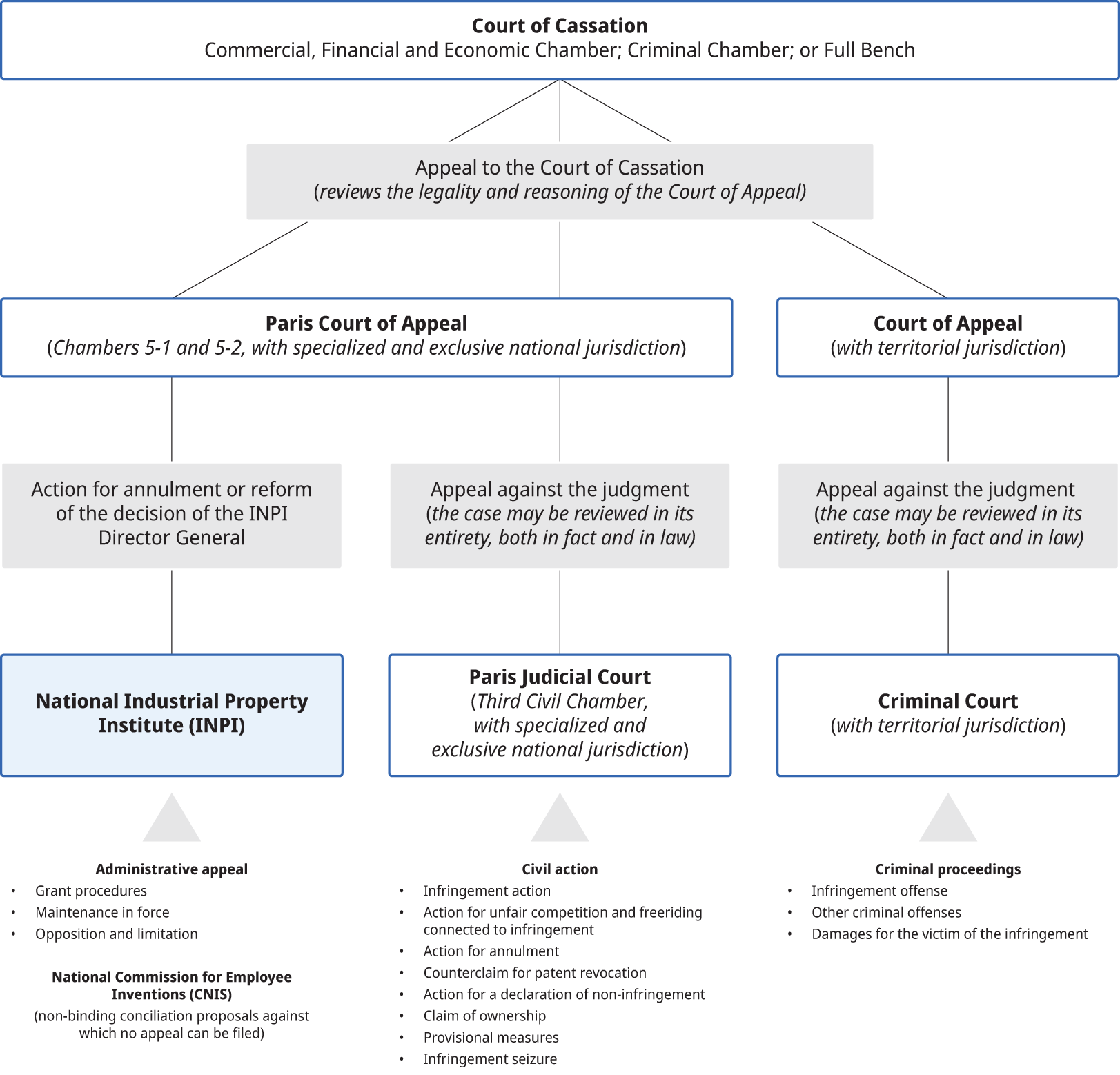
Lastly, the validity of patent decisions rendered by the Paris Court of Appeal in patent matters is examined by the Commercial, Financial and Economic Chamber of the Court of Cassation (and by the Full Bench for the most significant cases).
Figure 13.2 shows the judicial administration structure in France.
Figure 13.2
13.2.2.1.2 Unified litigation, without bifurcation
The French system, unlike some other European systems, provides for integral jurisdiction in patent matters, without bifurcation: the Paris Judicial Court is competent to assess a patent's terms, scope and validity as well as alleged acts of infringement against it – and also to declare non-infringement as the case may be. It also has jurisdiction for all such related matters as unfair competition (Article L. 615-17 of the IPC), the award of damages and other means of redress (including publication of the decision and product destruction and recall).
Actions relating to unfair competition, however, are subject to the Civil Code, Articles 1240 and 1241 of which provide that “Any act of man that causes injury to another obliges the person at fault to remedy it” and that “Every person is responsible for injury they cause, not only by their actions, but also by their negligence or imprudence.” Thus, a plaintiff who brings both a patent infringement action and an action for unfair competition must demonstrate both an infringement of their exclusive right of exploitation and the commission of a fault – that of unfair or parasitic competition, requiring proof of specific facts.32 An action for unfair competition, moreover, may be based on facts materially identical to those alleged in an infringement action, even if rejected for failure to establish an exclusive right or for the non-opposability of an exclusive right to third parties.33 Although both actions seek the same objective of compensating the damage, they are regarded as having a different legal basis.34
This integral and centralized jurisdiction within the Paris Judicial Court encompasses all aspects of litigation: from the search for and establishment of evidence before trial (Article L. 615-5 of the IPC), to the ordering of urgent measures before or during proceedings on the merits (Article L. 615-3 of the IPC), to examination of a patent's validity or ownership and alleged acts of patent infringement, thereby sparing plaintiffs from inconsistent interpretations and issues of territorial jurisdiction under domestic law – albeit subject to specific exceptions in European or international law as will be seen below.
13.2.2.1.3 The specific role of criminal justice
Articles L. 615-12 et seq. of the IPC are dedicated to criminal proceedings for patent infringement, treated as a criminal offense. Article L615-14 establishes penalties for knowing infringement, with varying degrees of severity if committed by natural or legal persons or organized groups.
The specialization and concentration established on the civil side have not been extended to criminal litigation in patent cases, which falls under the jurisdiction of criminal courts within whose territorial jurisdiction acts of infringement are committed (Article 382 of the Code of Criminal Procedure). In practice, however, criminal proceedings for infringement are quite rare.
13.2.2.1.4 Court costs
For the parties involved, the cost of patent litigation is moderate in France, where in the event of success, reimbursement can be obtained for all or part of attorney fees.
Legal action can be initiated at first instance free of charge, and on appeal by paying a stamp duty of 135 euros.
Losing parties, pursuant to Article 699 of the CCP, must pay the costs of the proceedings and enforcement activities.
Subject to this regime is the payment of certain costs, notably the costs of serving a summons (which initiates the proceedings), investigative measures ordered by the judge (judicial expertise) and necessary procedural acts subject to official tariffs (in the range of a few hundred euros for each act). Translation costs, where mandatory, are also paid by the losing party.
Parties must each ensure payment of their own attorney fees, as assistance and representation by a lawyer before the Judicial Court, Court of Appeal and Court of Cassation are mandatory.
In principle, however, those costs are ultimately borne by the losing party, or the party ordered by the court to pay them, in whole or in part. Pursuant to Article 700 of the CCP, the court's decision on that point is based on “equity or the economic situation of the party ordered to pay.” In intellectual property (IP) matters, the provision is interpreted in the light of Article 14 of Directive 2004/48/EC.
In France, those costs are not subject to any scale, threshold or cap. Their amount varies according to the importance and complexity of the litigation, and possibly the parties’ conduct during the proceedings (dilatory behavior, lack of front-loading, etc.). The costs of fact-finding, private or judicial expertise and infringement seizures (saisie contrefaçon) carried out by a bailiff (commissaire de justice) must also be reimbursed and are similarly subject to variable fees.
13.2.2.2 Specialized judges and professionals
The examination of patent litigation is handled by specialized chambers: at first instance by the Third Chamber of the Paris Judicial Court, which comprises three sections; and, on appeal, by Chambers 5-1 and 5-2 of the Paris Court of Appeal, for economic and commercial matters.
This structural specialization is combined with functional specialization. Each of the professional judges composing these chambers – who are tenured, thereby guaranteeing their independence – is assigned based on their skills and experience in the litigation dealt with. They are also required to complete a certain number of hours of continuous training organized by the National School for the Judiciary (ENM).
These specialized judges also attend regularly organized meetings to discuss specific legal issues and court decisions and to exchange views on their profession, notably under the auspices of the Court of Cassation.
This specialization is also enriched and facilitated in France by the organization of meetings, symposiums and debates among members of the Court of Cassation, INPI, the Center for International Intellectual Property Studies (CEIPI) and certain universities – with an active role also played by professional associations dedicated to industrial property matters (notably the Association of European Patent Practitioners (APEB), International Association for the Protection of Intellectual Property (AIPPI) and Association of Intellectual Property Lawyers (AAPI)).
This same high degree of specialization and expertise is also encountered among law firms specializing in industrial property, whose partners often include patent attorneys (conseils). The latter are not, however, authorized to represent their clients before the French courts, a function reserved for avocats. Such is not the case, on the other hand, for matters brought before the UPC or the EPO.
Finally, during their university studies, law students and future judges or attorneys are offered numerous specialized programs on intellectual and industrial property.
This level of specialization contributes to technical and legal analysis of high quality, as well as stable and consistent case law.
13.2.2.3 Alternative dispute resolution (pre-litigation)
There is no mandatory requirement in France to engage in pre-litigation or alternative dispute resolution (ADR) processes, except in disputes involving claims under 5,000 euros, or those exhaustively listed in Article 750-1 of the CCP (but not involving patents). Such processes are, however, strongly encouraged, as offering confidential, rapid, tailored solutions without the publicity or risks associated with court proceedings.
13.2.2.3.1 Arbitration
While courts were initially hesitant about the process, legislators embraced arbitration for disputes over IP in 1978, by way of wording in Article L. 615-17 of the IPC that “the preceding provisions shall not prevent recourse to arbitration, under the conditions provided for in Articles 2059 and 2060 of the Civil Code.”
This has made arbitration a universally available alternative.35 Controversy remains, however, over the arbitrability of patent validity. Some authors consider arbitration impossible where private justice might “encroach upon the prerogatives of public authority”,36 unless arbitrators refrain from ruling erga omnes (with effect toward all) on a patent’s validity, confining themselves to an inter partes assessment of a patent’s opposability (between the parties involved only). Consistent with this view, in a judgment of June 12, 2013, the Court of Cassation held that “an arbitral tribunal finding that an invention is part of the state of the art without ruling on the larger issue of the patent’s validity does not disregard its mission, nor the adversarial principle, nor international public policy,”37 suggesting the possibility of arbitrating a nullity defense on an incidental basis, or “relative arbitrability.”
Be that as it may, arbitration remains a fully viable means of resolving disputes over patent ownership, infringement and contracts.
Articles 1442 et seq. of the CCP govern the conditions and content of arbitration agreements, the composition and role of the arbitral tribunal, recourse to the juge d’appui (supervising judge), the conduct of arbitral proceedings and the arbitral award (considered res judicata and subject to compulsory enforcement only by an exequatur order). Arbitrators may not, however, hear criminal prosecutions or order infringement seizures.
Specific provisions have also been incorporated into the CCP for international arbitration, for which the President of the Paris Judicial Court, unless otherwise agreed, serves as the juge d’appui.
13.2.2.3.2 Mediation, conciliation and friendly settlement hearings
A patent dispute may be resolved through a confidential friendly settlement process with third-party involvement. The third party may play a neutral role (as mediator) or an active one (proposing concrete solutions, as conciliator) – or be a judge, able to advise on points of law (friendly settlement hearings). This latter approach is possible only if a lawsuit has been initiated. A detailed description of these processes is provided below (Section 13.3.6.2.5).
13.2.2.4 Trial at first instance
A brief overview of French trials at first instance is provided here, with greater detail to follow in Section 13.3.
13.2.2.4.1 Summary proceedings
Summary proceedings in patent matters are provided for in Article L. 615-3 of the IPC, which establishes an exceptional legal regime permitting a decision to be obtained quickly from a single judge sitting in summary proceedings.
Persons holding rights to bring patent infringement actions may, on the basis of their patents, apply in summary proceedings to the President of the Judicial Court, prior to commencing an action on the merits, to request interim measures, whether the infringement is imminent or already established. Pursuant to Article 485 of the CCP, the case will be examined, depending on the degree of urgency, either at a standard summary hearing or at a special hearing, at a specified day and time (the so-called “hour-by-hour” summary procedure).
While patents cannot be annulled in summary proceedings, the judge can assess during such proceedings whether there are serious grounds for doing so38 – and may dismiss requests for interim measures where appropriate. Urgency is not a condition for admitting a summary action but may be taken into account in considering the proportionality of the interim measures requested. The burden of providing evidence is favorable to plaintiffs, who need only demonstrate a “likelihood of infringement” balanced against the gravity of the consequences. Summary proceedings differ from proceedings on petition (which are ex parte proceedings) in that defendants must be summoned to adversarial proceedings and allowed to present arguments in their defense (see also Section 13.3.7).
The judge’s provisional decision, which takes the form of an order, is not considered res judicata on the main issue, is not binding on the judge called upon to rule on the merits of the dispute and may be appealed to the Paris Court of Appeal within 15 days.
If admitted, an action must be brought on the merits within 20 working days, or 31 calendar days, from the date of the summary order, failing which the measures initially ordered lapse.
Interim measures may exceptionally be ordered during ex parte proceedings, as examined below (Section 13.3.7).
13.2.2.4.2 Action on the merits
13.2.2.4.2.1 Preliminary search for and establishment of evidence
Before initiating actions on the merits, plaintiffs must provide evidence that their rights have been infringed, which may be “proven by any means.”39
Means of proof accepted in France, subject to respect for trade secrets, include bailiff reports, internet reports, purchase reports, infringement seizures (ordered by the judge either on petition in non-adversarial proceedings or after action on the merits has been initiated), private expertise, judge-ordered expertise and even information obtained through a customs seizure. Regarding private expertise, according to consistent case law of the Court of Cassation, judges may not rely exclusively on non-judicial expert reports prepared at a party’s initiative40 (see Section 13.3.3, on evidence).
All of those measures and the conditions for their performance may give rise to litigation if legal provisions have not been respected or if the petitioner has acted in bad faith in their implementation.41
13.2.2.4.2.2 Conduct of the proceedings
The procedure is written and the parties must be represented by a lawyer authorized to act before the Paris Judicial Court. The judge is seized exclusively by written pleadings with supporting evidence. Arguments and claims not so submitted are not considered by the court (unless they may only be developed orally and are then considered during the hearing for oral arguments).
The plaintiff must arrange in advance for a court bailiff to serve a writ of summons to the defendant communicating the date and place of the hearing and setting out the plaintiff’s claims and the grounds in fact and in law on which they are based. This document must be served within a mandatory time limit if an infringement seizure or cease-and-desist order has been issued beforehand.
The defendant has 15 days from the date of the summons to appoint a lawyer.
Once the summons has been served and entered into the court’s docket, a pre-trial judge (juge de la mise en état) is designated with broad powers to oversee the instruction of the case and the fair conduct of the proceedings (Article 780 of the CCP). The pre-trial judge presides over the written procedure and has exclusive jurisdiction to rule, inter alia, on procedural exceptions, incidents terminating the proceedings, interim payments and measures, and investigative procedures. The pre-trial judge also rules on pleas of inadmissibility (fins de non-recevoir) for statute-of-limitations reasons, or lack of standing or lack of interest in the legal action, unless they consider that the complexity of the grounds cited for inadmissibility, or the progress of the case’s instruction, justify the plea being examined at the end of the instruction by the trial court called upon to rule on the merits. The pre-trial judge may also order the production of documents considered useful to resolving the dispute.
The pre-trial judge does not issue any preliminary opinion or opinion on the merits of the case. Nor are the pre-trial judge’s decisions subject to appeal if they result in termination of the proceedings or pertain to a procedural exception or plea of inadmissibility.
Upon completion of the pre-trial phase, the instruction is closed and the case is scheduled for a hearing before the court. After which no further written pleadings or evidence are admissible unless the order closing the instruction is revoked.
The time required to resolve patent cases in France, from the commencement of legal action to a decision on the merits, averages two years, which may be reduced by means of a contractual pre-trial arrangement – to establish a collaborative procedure for instance – or in cases of demonstrated urgency, based on a fixed-date procedure, without a pre-trial phase, which the plaintiff may request pursuant to Article 840 of the CCP (see Section 13.3.6.2 on the conduct of the trial for more details).
13.2.2.4.2.3 The parties to the trial
Patent infringement litigation traditionally involves the following parties:
the patent owner, co-owner, assignee, and/or exclusive licensee (having informed the owner), or non-exclusive licensee (if so authorized by the license contract and having informed the owner), as per Article L. 615-2 of the IPC, joined where appropriate by a distributor of the products covered by the patent; and
the alleged infringer, and potentially all participants in acts of infringement defined in Article L. 613-3 of the IPC.
More exceptionally, the trial may involve other actors, such as the Public Prosecutor (with the power, among others, to annul patents ex officio); the INPI Director General (for disputes relating to the latter's decisions); creditors' representatives (in the event of insolvency proceedings); insurers and any other persons having an interest and standing to sue or defend, intervening voluntarily or called to intervene forcibly.
13.2.2.4.2.4 The hearing
Cases may be pleaded before a collegiate panel of three judges (if the parties so request) or before one or two reporting judges, who will then deliberate with other members of the court. It may also be agreed between the parties to proceed without a hearing, although this is rarely requested.42
The hearings are public and open to all (in person only), subject to restrictions relating notably to trade secrets as defined in Articles L151-1 et seq. of the Commercial Code.43 Specific arrangements are made for the production and communication of documents containing trade secrets, including in camera hearings and delivery of court judgments.44
On the day of the hearing, the reporting judge first reads a report outlining the context of the case and the main legal issues underlying the dispute (Article 804 of the CCP). The court then hears the attorneys' oral arguments. Except where particularly complex technical fields are involved, it is very rare for experts, patent attorneys or witnesses to be heard. Article L. 615-20 of the IPC allows the court, either ex officio or at a party's request, to appoint a consultant to follow the pre-trial procedure and then attend the hearing. Such consultants may also be authorized to address questions to the parties or their representatives.
Once the case has been pleaded, the court takes the case under advisement but must announce to the parties the date on which its decision will be rendered (Article 450 of the CCP). That generally occurs within six weeks to three months later, depending on the complexity of the case.
After the hearing, except with the express authorization of the court, parties may not produce new evidence or written pleadings, or respond to the Public Prosecutor's arguments. Such communications must take the form of supplemental written submissions to be handled in accordance with adversarial procedures.
13.2.2.4.2.5 The decision and its enforcement
If it finds patent infringement, the court may order various measures, as will be seen, including in-kind or pecuniary compensation, injunctions, destruction of infringing products and publication of the decision, which may be accompanied by a periodic penalty payment (astreinte), either decided by the court (if it has reserved jurisdiction over the dispute) or by a specialized magistrate called an enforcement judge (juge de l'exécution).
Decree No. 2019-1333 of December 11, 2019, established automatic provisional enforcement of court decisions, as provided for in Article 514 of the CCP, "unless the law or the decision rendered provides otherwise." Such provisional enforcement may only be set aside, in whole or in part, if the judge considers it incompatible with the nature of the case. It cannot be set aside when a judge rules in summary proceedings, prescribes interim measures for the duration of proceedings or orders precautionary measures, or when a pre-trial judge grants an interim payment to a creditor (Article 514-1 of the CCP).
Security for enforcement may be required but is rarely ordered in litigation between commercial companies. Enforcement is in principle carried out at the risk and peril of the party requesting it, given the chance of a subsequent revocation (rule of strict liability towards the party that suffers directly from the measure).45
If a patent is annulled, INPI records the judgment in the National Patent Register.
The Paris Judicial Court renders approximately 150 patent decisions each year.46
13.2.2.5 Appeal proceedings
As indicated, the Paris Court of Appeal, and specifically the two chambers dedicated to patent litigation within its economic and commercial division, has exclusive jurisdiction to examine appeals filed in patent cases against: judgments on the merits by the Paris Judicial Court; orders issued by that court's President in ex parte or summary proceedings (e.g., to authorize or refuse infringement seizure requests); orders issued by the pre-trial judge; and decisions taken by the INPI Director General.
Since 2021, the Paris Court of Appeal has rendered between 55 and 65 patent-related judgments each year.
13.2.2.5.1 Appeal against first-instance decisions
13.2.2.5.1.1 Conduct of the appeal proceedings
Appeals lodged in patent cases are governed by the same general rules that apply to other appeal proceedings.
Once a first-instance decision has been rendered, any party may appeal it within the standard time limit of one month from notification of the decision (increased by two months for persons residing abroad). The time limit is shorter (15 days) for appeals against orders rendered by a judge in summary or ex parte proceedings, or by a pre-trial judge.
Parties are required to appoint a lawyer to represent them throughout the proceedings.
Furthermore, where the first-instance decision is accompanied by provisional enforcement (as is generally the case), the respondent, pursuant to Article 524 of the CCP, may request removal of the case from the court docket for failure by the appellant to demonstrate compliance with the decision under appeal. This makes it incumbent on the appellant to either comply with the judgment or apply to the First President of the Court of Appeal for a provisional stay of enforcement. Failure to do either could result in the pre-trial judge removing the case from the court's docket, should the respondent so request – unless the appellant can demonstrate their inability to execute the decision or that its enforcement will likely have manifestly excessive consequences, subject to the judge's sovereign power of appraisal. Reinstatement of the case, if removed from the docket, can then be authorized upon proof of execution of the contested decision.
The President of the chamber decides how the case will proceed. If it appears to be urgent or relates to an order from a judge in summary proceedings or a pre-trial judge, the President may fix a date for initiating proceedings on short notice, or may designate a pre-trial judge for the appeal with broad powers to rule on procedural exceptions for appeal proceedings, developments warranting termination of the proceedings, the admissibility of interventions, questions relating to a lapsed notice of appeal or the inadmissibility of written pleadings or procedural acts. The pre-trial judge may also order the production of certain documents or grant an interim payment to the creditor where the obligation is not seriously contestable.
A conventional instruction may also be carried out, subject to priority scheduling (Article 127 of the CCP).
In addition, where interested parties can demonstrate that their rights are in peril, they may petition the First President of the Court of Appeal for a fixed-date summons to obtain priority scheduling for the case (Article 917 of the CCP).
13.2.2.5.1.2 Strictly regulated proceedings
Without attempting to be exhaustive on this point, it should be mentioned first that parties to standard appeal proceedings are subject to mandatory three-month time limits for filing written pleadings and responding to their opponents, with respondents subject to the same time limit for lodging cross-appeals. All exchanges of written pleadings and evidence are conducted electronically via the Réseau Privé Virtuel des Avocats (RPVA), a private virtual network for French lawyers.
It is not allowed, save for the exceptions listed in Article 564 of the CCP, to submit new claims in appeal proceedings. Parties may, however, add requests that are accessory to, a consequence of, or a necessary complement to claims submitted to the first-instance judges. They may also, pursuant to Articles 566 and 567 of the CCP, submit counterclaims, which under Article 70 of the same Code must be linked to the original claims by a sufficient connection to be deemed admissible.
For instance, a counterclaim for infringement of an industrial property title is deemed sufficiently linked to a request seeking the title's annulment.47 Similarly, a request seeking to annul a patent is deemed admissible, even though submitted for the first time on appeal, as a legal means to defeat an infringement claim.
By contrast, a party's request for a declaration of non-infringement, made as an additional claim within the framework of a nullity action, has been ruled inadmissible on appeal. While the action for annulment constituted a challenge to the patent's validity in that case, the appeal court reasoned that a declaration of non-infringement would not affect that validity.48 A new claim relating to unfair competition, after only infringement had been claimed at first instance, has likewise been ruled inadmissible on appeal. Infringement actions, it was reasoned, seek to sanction the violation of a proprietary right, whereas unfair competition relates to misconduct, within the meaning of Article 1382 (now Article 1240) of the Civil Code. The Court of Cassation now holds “that a party which brought an action for infringement at first instance that was dismissed for lack of a proprietary right is admissible, for the first time on appeal, to bring a claim based on unfair competition or parasitism, where those claims are based on the same facts.”49 It is a matter of principle in French law, moreover, that parties must present all their claims on the merits of a case in their first written pleadings (although new evidence and new arguments can be advanced to support those claims on appeal).
Once the pre-trial phase has concluded, a hearing is held for the parties' lawyers to be heard after a report has been presented by the reporting judge. The case may be pleaded before a collegiate panel of three judges, or before a single judge who will then report to the other members of the trial court before the start of deliberations. As at first instance, it is very rare for experts, patent attorneys or witnesses to be heard, except in complex technical fields and at the request of the parties.
An average period of two years elapses between the lodging of an appeal and the delivery of the judgment.
13.2.2.5.2 Specificity of appeals against INPI decisions
The Paris Court of Appeal has exclusive jurisdiction to examine appeals against decisions taken by the INPI Director General, according to a procedure organized under Articles L. 411-4 and R. 411-19 et seq. of the IPC. Those provisions distinguish between two types of appeal, according to the nature of the decision rendered. The first relates to INPI decisions to grant, reject, maintain or limit industrial property titles. The aim of this first type of appeal is simply to invalidate the INPI decision (such as the refusal to issue a supplementary protection certificate) concerned. The second type of appeal relates to INPI rulings on oppositions. The aim of this second type is for the Court to reform the INPI decision: that is, to replace it with a new one.
Court rulings invalidating an INPI decision are “without devolutive effect”: the court must judge the legality of the decision according to the conditions existing when it was taken, irrespective of any new evidence submitted.50
In the case of appeals to reform INPI decisions, on the other hand, parties may invoke new grounds, produce new documents and propose new evidence. They may not, however, submit new claims to the Court, except for those relating to questions arising from the intervention of a third party or the occurrence or revelation of a fact (Article R. 411-38 of the IPC).
The number of appeals, which remains very limited compared with the number of patent applications, has fluctuated since 2020 between one and 10 per year. Appeals relating to oppositions rose to seven in 2023 before stabilizing at three in 2024, while those in respect of INPI rejection decisions have remained stable at one or two a year.
The rules governing appeal procedures are set forth either in the IPC or the CCP (by reference per Article R. 411-20 of the IPC), it being specified, however, that a pre-trial counsel (conseiller de la mise en état) is not designated.
While INPI is not a party to appeal proceedings, the parties' written pleadings and evidence must be communicated to it, under penalty of the notice of appeal being declared void for the petitioner (Article R. 411-29 of the IPC) and of the written pleadings being declared inadmissible by the court of its own motion for the respondent (Article R. 411-30 of the IPC); the Court of Appeal rules only after hearing the INPI Director General, or after the latter has been called and given the opportunity to present oral or written observations.
The Public Prosecutor may take cognizance of cases in which it is considered necessary to intervene (Article R. 411-23 of the IPC).
Procedural acts, under penalty of inadmissibility, declared ex officio, are submitted to the court electronically, except where impracticable for reasons beyond the control of the party performing the procedural act (Article R. 411-24 of the IPC). The appeal submitted to the court registry must include the content specified in Article R. 411-25 of the IPC. The clerk of the court then notifies the parties and the INPI Director General of the appeal. The petitioner has three months from the date of the appeal to submit written pleadings to the registry. The respondent then has three months from the notification of those pleadings to submit its own written pleadings and, where appropriate, lodge a cross-appeal (Articles R. 411-29 et seq. of the IPC).
The jurisdiction of the Paris Court of Appeal also extends to the harmful consequences of liability actions brought against the INPI Director General in the exercise of their duties, without distinction as to whether the liability action is initiated by the applicant of the action for annulment, as an accessory to that action, or by a third party.51
The Paris Court of Appeal rules that appeal proceedings against a decision of the INPI Director General may give rise to an indemnity on the basis of Article 700 of the CCP.
The Court renders its judgment within a period of six weeks to three months.
The decisions of the Court of Appeal are notified by registered letter with acknowledgment of receipt by the court registry to the parties to the proceedings and to the INPI Director General (Article R. 411-42 of the IPC).
All decisions rendered by the Court of Appeal may be appealed to the Court of Cassation within two months from the notification of the contested decision (Article 612 of the CCP).
13.2.2.6 Appeal in cassation
The Court of Cassation is the highest court in the French judicial system.
It is seized by means of an appeal on points of law drafted and filed by a lawyer at the Council of State (Conseil d'État) and the Court of Cassation,52 with no need for prior judicial authorization. However, the Court may dismiss the appeal, with no need for a detailed explanation, if the appeal or one of its grounds is manifestly not of such a nature as to lead to cassation. Such summary dismissals are, however, rare in patent cases.
The role of the Court of Cassation is to monitor and unify the interpretation and application of the law throughout French territory. It does not re-try a case but rules on the legal correctness of the decision submitted to it and, in the event of cassation, remands the case to another court of appeal. As a court reviewing how lower court judges have applied the law, rather than a court deciding the merits of the case itself, the Court of Cassation always intervenes after a lower court has rendered its decision. Lacking the power to reassess factual elements, it relies on, and does not call into question, the factual findings of the courts on the merits – unless it is established that those courts distorted the meaning of a written document.
The Court of Cassation performs a dual review of lower court judgments: first, a normative review (of their legality and correct interpretation of the law); and second, a rationality review (of the quality of their reasoning).
The grounds then given in practice for quashing a decision (cassation) fall into two categories:
In industrial property matters, the Court may thus review whether judges have misrepresented a patent document53 and how54 they have assessed the novelty55 or inventive step56 of the invention concerned.
See Paris Court of Appeal, June 17, 2022, RG No. 21/12155.
Court of Cassation, Com., February 16, 2016, Appeal No. 14-085, Bull. 2016, No. 30.
See notably Paris Court of Appeal, June 17, 2022, RG No. 21/12155.
Court of Cassation, Com., March 26, 2025, Appeal No. 23-13.589.
Court of Cassation, Com., April 24, 2024, Appeal No. 22-22.999.
Court of Cassation, Com., September 26, 2018, Appeal No. 16-25.937.
Motulsky, H. (1974). Écrits [Writings], Vol. 2. Dalloz, p. 91.
Court of Cassation, First Civil Chamber, June 12, 2013, Appeal No. 12-16.864.
Court of Cassation, Com., October 21, 2014, Appeal No. 13-15.435.
Court of Cassation, Mixed Chamber, September 28, 2012, Appeal No. 11-18.710.
Court of Cassation, Mixed Chamber, May 12, 2025, Appeal No. 22-20.739, concerning a purchase report.
Court of Cassation, Com., February 10, 2015, Appeal No. 13-20.150, Bull. 2015, IV, No. 26.
For example, Paris Court of Appeal, October 15, 2021, RG No. 21/01289.
Paris Court of Appeal, October 20, 2017, RG No. 15/09777.
Court of Cassation, Com., March 18, 2026, Appeal No. 24-17.016; see also Court of Cassation, Com., September 26, 2018, Appeal No. 16-25.937, Bull. 2018, IV, No. 102, Court of Cassation, Com., March 29, 2011, Appeal No. 10-12.046.
Court of Cassation, Com., January 31, 2024, Appeal No. 22-18.374; and Court of Cassation, Com., March 19, 2025, Appeal No. 23-20.000.
Court of Cassation, Com., March 11, 2014, Appeal No. 12-28.036.
Avocats aux conseils constitute a distinct profession, appearing before the Council of State and the Court of Cassation.
Court of Cassation, Com., June 18, 1991, Appeal No. 89-11.266.
Court of Cassation, Com., May 17, 2023, Appeal No. 19-25.509.
Court of Cassation, Com., April 19, 2005, Appeal No. 03-12.994; Court of Cassation, Com., March 19, 2025, Appeal No. 23-13.576.
Court of Cassation, Com., November 20, 2012, Appeal No. 11-18.440; Court of Cassation, Com., March 19, 2025, Appeal No. 23-13.576.