Chapter 13 France
Authors: Judge Déborah Bohée, Judge Malik Chapuis, Judge Arthur Courillon-Havy,
Grégoire Desrousseaux, Colin Devinant, Anne-Charlotte Le Bihan,
Judge Nathalie Sabotier
The authors express their thanks to President Vincent Vigneau, Judge Pascale Tréfigny, Référendaire Judge Mélanie Bessaud, Judge Françoise Barutel and to attorneys at law Pierre Véron, Denis Monégier du Sorbier and Thomas Bouvet, for their collective review and numerous suggestions for improving this chapter.
13.1 Overview of the patent system
Patents – understood as property titles for intellectual goods meeting specific criteria – have been protected in France since the revolutionary era, starting with the Law relating to useful discoveries and the means of securing the property thereof to their authors, dating back to January 7, 1791. With the dawn of the industrial age, the Law on Patents of Invention adopted on July 5, 1844, organized protection for all new inventions. That law was eventually repealed by legislation adopted on January 2, 1968, to incorporate the Strasbourg Convention on the Unification of Certain Points of Substantive Law on Patents for Invention (Strasbourg Convention) of November 27, 1963, into French law. The Strasbourg Convention then provided the foundation for contemporary French patent law, establishing the requirement of an inventive step and the obligation for patents to include claims defining the scope of the property rights concerned.
That 1968 Law, subsequently amended on several occasions, was eventually codified by the Act of July 1, 1992, creating the Intellectual Property Code (IPC). Book VI of the IPC, starting at Article L. 611-1, specifically deals with patents.
Various subsequent amendments transposed directives of the European Parliament and of the Council into French law, specifically those concerning the protection of biotechnological inventions (Directive 98/44/EC of July 6, 19981) and the enforcement of intellectual property rights (Directive 2004/48/EC of April 29, 20042). More recently, the procedure for granting patents in France was modified under the Act No. 2019-486 of May 22, 2019, on business growth and transformation (Plan d'Action pour la Croissance et la Transformation des Entreprises (PACTE) Act).
French law has also been significantly influenced by several international agreements, including the Paris Convention for the Protection of Industrial Property of March 20, 1883 (as amended); the Patent Cooperation Treaty of June 19, 1970 (PCT); and the European Patent Convention of October 5, 1973 (EPC), revised on November 29, 2000, and also known as the Munich Convention. The European Patent Office (EPO) was established under the EPC.
Table 13.1 shows the statistics for patents in force in France, by origin, as provided by the French National Industrial Property Institute (INPI):
Table 13.1 Patents in force in France at December 31, 2024
|
2020 |
2021 |
2022 |
2023 |
2024 |
| Issued by INPI |
91,051 |
94,949 |
96,278 |
95,392 |
84,590 |
| Issued by EPO (non-UP) |
546,086 |
576,181 |
590,978 |
591,042 |
587,981 |
| Issued by EPO (UP) |
0 |
0 |
0 |
6,004 |
31,747 |
| Total |
637,137 |
671,130 |
687,256 |
692,438 |
704,318 |
Figure 13.1 shows the total number of patent applications (direct and Patent Cooperation Treaty (PCT) national phase entry and European patent FR designation) filed in France from 2000 to 2024. Between 2020 and 2024, approximately 15,000 French patent applications were filed per year (source: INPI), compared to the roughly 200,000 European patent applications filed annually with EPO.
The main institutional players concerned with patents in France are as follows:
INPI, responsible for the examination and granting of French patents and the maintenance in force of the French parts of European patents; and
the French Judiciary, where civil patent litigation and actions relating to unfair competition and free-riding fall under the exclusive jurisdiction of the Paris Judicial Court (at first instance), the Paris Court of Appeal and ultimately the French Court of Cassation.3 The Paris Court of Appeal also hears appeals against decisions taken by the INPI Director General. In addition, the National Commission for Employee Inventions (CNIS), established in 1982, offers voluntary recourse for disputes involving employee inventions.
Figure 13.1 Patent applications filed in France, 2000–2024
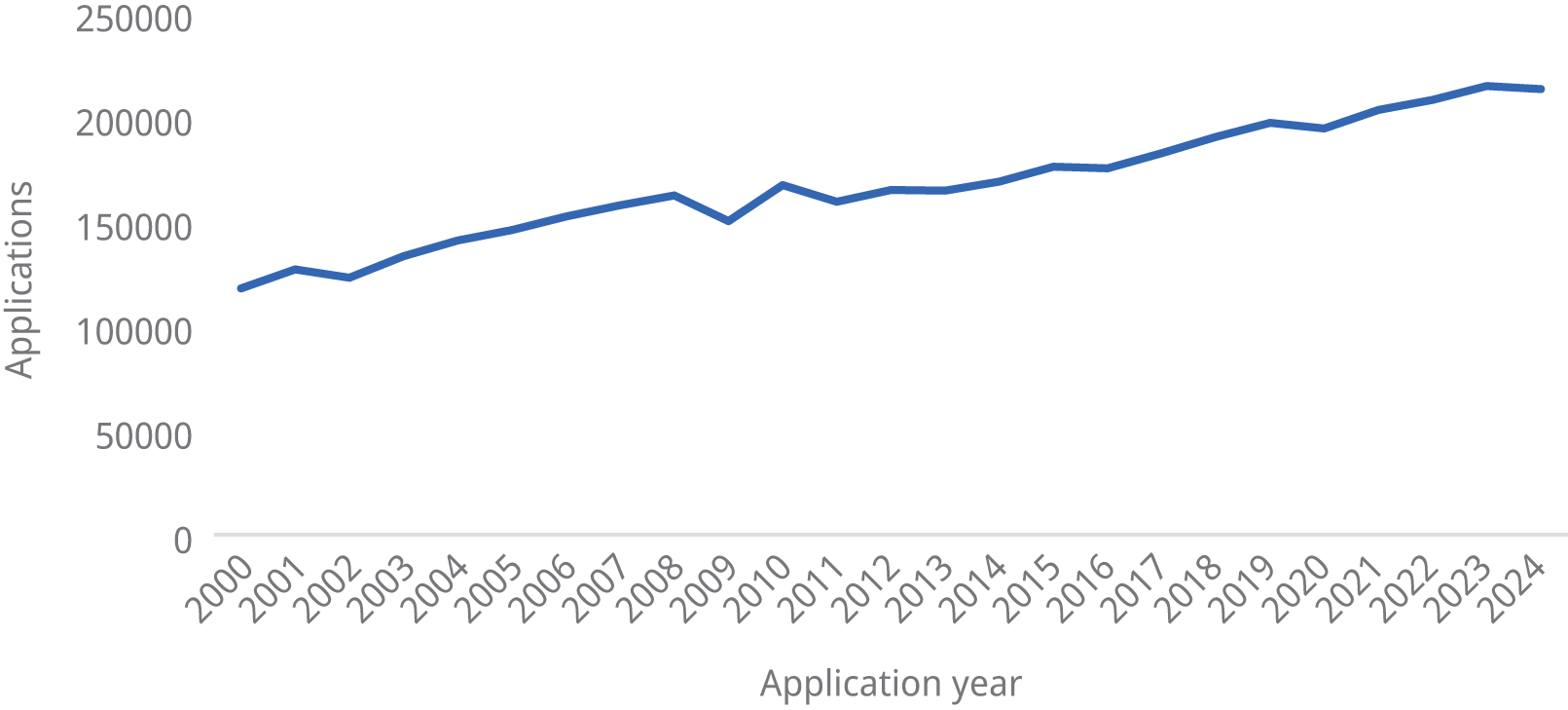
Source: WIPO IP Statistics Data Center, available at www3.wipo.int/ipstats/index.htm?tab=patent
13.2 INPI and the courts
13.2.1 INPI
INPI is responsible for granting, denying and maintaining in force French industrial property titles, including those for designs, patents and trademarks. Since “classic” European patents designating France are subject to the same legal regime as national patents, INPI performs the same maintenance-in-force functions for the French part of those patents.
Those functions are part of the broader mandate of INPI to promote innovation by:
centralizing and disseminating all information necessary for the protection of innovations;
approving or amending the specifications for geographical indications that protect industrial and commercial products; and
taking any initiative aimed at the ongoing adaptation of national and international law to the needs of innovators and businesses.
INPI is also responsible for maintaining the National Register of Companies (RNE) and disseminating RNE information to the public.
Other functions performed by INPI include serving as secretariat for the CNIS (see Section 13.4.5) and participating in the organization of related professions, including maintaining the national list of qualified industrial property specialists,4 organizing the examinations for inclusion on that list and maintaining the list of industrial property attorneys.5
In organizational terms, INPI is a public administrative body established in 1951. By law, its Director General's decisions – concerning the grant, rejection or maintenance of industrial property titles – are subject not to administrative review but to review by judicial bodies, with the Paris Court of Appeal having exclusive nationwide jurisdiction over appeals against such decisions in patent matters (relating, for example, to application denials and opposition).6 The jurisdiction of judicial bodies also extends to liability actions brought against the Director General in connection with such decisions (see Section 13.2.1.5).
INPI provides local support for innovation through regional offices, helping companies to integrate industrial property into their business strategies.
The following sections outline the procedures followed by INPI for examining and granting patent applications and for considering opposition and limitation actions brought against such applications, each compared with the corresponding procedures followed by the EPO (Sections 13.2.1.1 to 13.2.1.3). The ceasing of effect of French patents is covered in Section 13.2.1.4.
The payment of annual maintenance fees and the rules governing the registration of patents in the National Patent Register (RNB) are covered in Sections 13.2.1.5 and 13.2.1.6.
13.2.1.1 The grant of French patents
Patent applications filed with INPI are initially subject to secrecy and may not be disclosed or exploited without prior authorization from the Director General of INPI, acting on the opinion of the Minister responsible for defense.7 This mechanism allows the French State to reserve the invention for itself by keeping it confidential, where its potential value to the country is deemed to warrant delaying or prohibiting its disclosure, or where such disclosure is considered prejudicial to defense or national security interests. Such INPI authorization is otherwise obtained automatically five months after filing and is generally granted in practice within a few weeks.
Following a formal examination and verification that the invention is not unpatentable,8 INPI issues and provides notification of a preliminary search report. If the search yields relevant documents, notification of the report triggers a three-month (renewable) response period, during which the applicant may submit observations or amend the application. This initial three-month period also applies to any third-party observations.
Article L. 612-21 of the IPC provides that INPI will publish the file of any patent application after a period of 18 months from the date of filing – or, if priority has been claimed, from the priority date. The application can be published earlier at the request of the applicant.
If the preliminary search report is established prior to the publication of the application (this would typically be the case for a first French filing), the three-month deadline for third party observations will run from the publication of the application.
Until 2020, INPI's power to reject patent applications was limited. The INPI Director General could do so on the following main grounds:9
for formal reasons;
in the event of amendments extending beyond the subject matter of the application as filed, or not supported by the description;
if the application related to a manifestly non-patentable invention; or
if the search report manifestly indicated a lack of novelty.
Challenges to such rejections related primarily to patentability, in particular that of computer-implemented inventions.
For patent applications filed since May 22, 2020, INPI has examined inventive step, and the Director General has been empowered to reject:
Any patent application:
[...]
7. the subject matter of which is not patentable within the meaning of Article L611-10, para. 1.10
In addition, the adverb “manifestly” has been deleted from some of the other grounds listed, thus empowering INPI to examine all conditions of patentability. Accordingly, the current procedure is as follows:
Following the responses to the preliminary search report, the examiner considers the pending claims. If they do not appear patentable, the applicant is notified to that effect and allowed two months to respond.
If the applicant’s response is not deemed satisfactory, the examiner issues a draft decision of rejection (total or partial); the applicant is so notified and allowed another two months to file a request for continued processing.
If the applicant’s response is deemed satisfactory, the examination continues; if the applicant does not respond, the application is rejected.
The rejection decision may then be appealed to the Paris Court of Appeal, subject to the conditions and time limits set out in Section 13.2.1.5.
INPI also grants utility certificates with conditions of validity identical to those for patents (i.e., the invention must constitute patentable subject matter, be novel, involve an inventive step and be capable of industrial application). Suitable for inventions with shorter lifespans, the utility certificate protects the invention for a term of 10 years (compared to 20 years for a patent). It allows the applicant to obtain a title at the end of a streamlined procedure that, in principle, does not require a prior art search.
A utility certificate application may be converted into a patent application if the request is made before the start of technical preparations for publication of the application – specifically, more than six weeks prior to commencement of an 18-month period from the filing or priority date.11 A patent application can likewise be converted into a utility certificate application subject to the same time limit.
INPI does not prepare search reports for utility certificates; it conducts only a formality examination. Applicants may amend their claims. In the event of litigation, however, the law12 provides that the applicant must produce a search report subject to the same conditions as for a patent application.
13.2.1.2 Administrative challenge to the title: opposition before INPI
Oppositions may be filed against French patents granted as from April 1, 2020. As indicated in the report presented to the President of the Republic on the PACTE Act, relating to reforms contained in that legislation, the right of opposition is recognized as a simple and inexpensive administrative procedure permitting judicial proceedings to be avoided in less complex cases. The opposition procedure thus complements the patent grant procedure in France, allowing French law to align with the practices of other industrial property offices in Europe and worldwide. By facilitating the revocation or amendment of legally fragile patents, this opposition procedure serves to strengthen the quality of French patents and the legal certainty of the protection conferred by industrial property titles.
While modeled on the opposition procedure established by the EPO, the French procedure has its own particular characteristics, both before INPI and before the Paris Court of Appeal. A notable difference, in addition to the procedural aspects discussed below, is that INPI examiners who process a grant may not process oppositions filed against it.13 Costs are borne in principle by each party but may also be apportioned, if equity so requires, within a limit fixed by order.14
The time limit for lodging a notice of opposition is nine months from the date of publication of the grant.
The grounds for opposition under Article L. 613-23-1 of the IPC are similar to those provided for in Article 100 of the EPC:
The procedure before an opposition board initially includes a phase for verifying the admissibility of the opposition.
If the opposition is found to be admissible, a substantive investigation phase begins, during which observations are elicited first from the patent owner and then from the opposing party in response. Amendments to the original patent (“auxiliary requests” in European terminology) may also be proposed during this phase. The patent owner is allowed a non-renewable three-month time limit for those purposes. Following the expiry of that period, the opposition board notifies the parties of its provisional opinion based on the notice of opposition and the patent owner’s response. The parties are then allowed a non-renewable two-month time limit to respond to that provisional opinion.
A written phase then begins: INPI notifies the parties of the responses received, opening a non-renewable two-month time limit for the submission of further observations (and further amendments by the patent owner). Upon expiry of that period, the further observations received are transmitted to the parties for information, bringing this written process to an end.
At the request of a party, or on INPI’s own motion, an oral phase may then begin. The notice convening such a phase may be accompanied by an agenda. The session is then organized similarly to oral proceedings before an EPO opposition division: in particular, the opposition board may provide interim opinions and generally announces the decision it intends to take. The end of this oral session marks the end of the substantive investigation phase.
A final decision phase then lasts no more than four months, during which the opposition board approves the minutes from the oral session and reaches its decision.
The entire procedure may be summarized as follows, based on the most common scenario (in which the parties respond to all invitations and request an oral session):
Time limit for the opposition request: nine months from publication of the grant.
Verification of admissibility: two months.
Receipt of the patent owner’s observations: three-month non-renewable time limit.
Provisional INPI opinion: within three months from expiry of preceding time limit.
Receipt of parties’ responses: two-month non-renewable time limit (from date of INPI’s provisional opinion).
Receipt of parties’ further observations: two-month non-renewable time limit (from transmission by INPI of previous reactions).
End of written phase, oral session convened.
Decision: within four months following the end of the oral session.
Notification of the opposition board’s decision triggers a one-month time limit for appeal, extended, depending on distance, for parties residing in the 12 French overseas territories (by an additional month) or abroad elsewhere (by an additional two months), as per ordinary appeal procedures.15
Recourse in such cases to the Paris Court of Appeal, as discussed below (Section 13.2.2.5.2), differs significantly from that before EPO boards of appeal, in that the proceedings are conducted on a devolutive basis (the parties may submit new arguments and new evidence, though not new claims). Another significant difference is that the Court of Appeal applies the general rules on the reimbursement of costs under the Code of Civil Procedure (CCP), and may therefore award the successful party substantial sums as reimbursement for attorney fees. Finally, judgments of the Paris Court of Appeal are subject to appeal before the Court of Cassation under the conditions of ordinary law.16
13.2.1.3 Administrative limitation of the patent
By a law of August 4, 2008, an administrative limitation procedure was established for French patents,17 allowing patent owners to voluntarily limit the scope of their protection.
Such a request for limitation applies not only to French patents but also to the French parts of “classic” European patents.18
The limitation procedure before INPI is similar to that before the EPO.
The decision of the INPI Director General on this question may be appealed to the Court of Appeal, but not by third parties (including, in particular, alleged infringers where the limitation is invoked during litigation). Such third parties may, however, bring an action for annulment of the patent, as so limited, before a lower court.19
13.2.1.4 The ceasing of effect of French patents
Article 139(3) of the EPC provides that any Contracting State may prescribe whether, and on what terms, an invention disclosed in both a European patent application or patent and a national application or patent having the same date of filing or, where priority is claimed, the same date of priority, may be protected simultaneously by both applications and patents.
Exercising this freedom prior to the entry into force of the Agreement on a Unified Patent Court (UPCA), on June 1, 2023, French legislators had adopted a principle that such inventions could not be protected simultaneously by both applications and patents.
Now, however, Article L. 614-13 of the IPC, on the ceasing of effects, distinguishes between whether or not the European patent has been subject to an opt-out from the jurisdiction of the Unified Patent Court (UPC).
If the European patent has not been subject to such an opt-out, the French patent continues to produce its effects (Article L. 614-13(II)).
If the European patent has been subject to an opt-out from UPC jurisdiction, the French patent ceases to produce its effects:
at the end of the opposition period for the European patent (in the absence of an opposition); or
at the end of the opposition procedure; or
on the date of recording of an opt-out for the patent from UPC jurisdiction (if this date is later than the end of the opposition period or the end of the opposition).
The French patent thereby ceases to produce its effects only to the extent that it covers the invention for which the European patent has been granted. Thus, unless some of the claims of the French patent are not included in the European patent, the ceasing of effects is total.20
That ceasing of effects occurs only at the end of the opposition period (in the absence of an opposition) or at the end of the opposition procedure (where the European patent is maintained). It occurs only if the European patent exists at the time of the ceasing of effects.21
If the ceasing of effects does not occur solely because the European patent has not been subject to an opt-out from UPC jurisdiction, it occurs when such an opt-out is recorded.
The law specifies that such ceasing of effects for the French patent is irrevocable, and thus not affected if the European patent subsequently lapses, or is revoked, or if the opt-out is subsequently withdrawn.
Lastly,
Article L. 614-16-4 of the IPC prohibits and renders null and void the transfer of a French patent application or a French patent, independently of the corresponding European patent with unitary effect;
Article L. 614-15 of the IPC requires a judge hearing an infringement action based on a French patent liable to cease producing effects to stay the proceedings until the end of the opposition period for the European patent (or until the end of the opposition procedure).
13.2.1.5 Payment of fees and maintenance in force of titles
Under the law, INPI is also responsible for monitoring the maintenance of titles (and therefore also of applications) for French patents and the French parts of “classic” European patents (that do not have unitary effect).
Annual fees fall due (as before the EPO) on the last day of the anniversary month of the filing of the application. The filing fee covers the first annual fee.
In the event of non-payment, INPI issues a warning before forfeiture, the payment of the annual fee may take place within a six-month grace period from the day following the due date (i.e., from the first day of the month following the anniversary month of the filing, unlike the “ultimo-ultimo” rule of the EPO). The absence of a warning, however, is not a ground for restoration.
Failing payment within the six-month time limit, INPI issues a forfeiture decision.
As in the case of failure to comply with other time limits during the grant procedure, such forfeiture may be subject to a petition for restoration: the time limits are the same as those under Article 122 of the EPC:
The difference from the mechanism established in the EPC is that INPI accepts as a legitimate excuse an error committed by the representative, whether the latter is external or in-house.
Once again, the decision of the INPI Director General to deny a request for restoration may be appealed by the applicant (or the owner in the case of an annual fee payment) before the Paris Court of Appeal.
13.2.1.6 The National Patent Register
Article L. 613-9 of the IPC provides that, in order to be opposable to third parties, all acts transferring or modifying the rights attached to a patent or patent application must be recorded in the National Patent Register. This register is kept by INPI to record grant, rejection and forfeiture decisions.
This recording requirement does not apply, however, when acts pertaining to European patents or patent applications designating France are recorded in the European Patent Register.22 If so recorded during the opposition period or opposition proceedings for the patents or applications concerned, such acts are thus opposable to third parties – without the need for a “mirror” recording in the National Patent Register.
A specific regime applies where a French patent and a European patent designating France relate to the same invention: so far as the common parts of such patents are concerned, it is not possible to transfer only one of the two patents to a third party, under penalty of nullity.23
Furthermore, for the transfer of the French patent to be opposable to third parties in this scenario, it is not sufficient to record it in the National Patent Register: it must also be recorded in the European Patent Register.24
What sanctions should apply when such acts are not recorded, or are recorded late, has been a long-standing issue. If the assignment of a French patent is recorded long after the fact, and prejudice is suffered in the interim (the so-called “gray period”), can the assignee claim remedies? The Court of Cassation,25 drawing inspiration from the Court of Justice of the European Union (CJEU) (related trademark case law),26 has ruled such a claim admissible. The action can thus be started after the recordal of the transfer with the relevant patent register(s) – and remedies can be sought for all acts committed after the date of transfer. Furthermore, if so provided in the act transferring the patent, remedies for the period before the transfer can also be claimed by the assignee.
Again, a refusal to record by the INPI Director General is subject to appeal before the Paris Court of Appeal. This appeal is not open to third parties, as they retain the option of contesting the opposability of the title and the admissibility of the action before the court hearing the case on the merits.27
13.2.2 The French jurisdictional system in patent matters
13.2.2.1 Centralized and unified litigation
13.2.2.1.1 Centralized litigation
The need for greater specialization in patent law was recognized as early as 1968, when jurisdiction for patent litigation was reserved for certain specialized courts – and then again on October 9, 2009, when Decree No. 2009-1205 centralized jurisdiction for patent cases within the Paris Court of First Instance (known since January 1, 2020, as the Paris Judicial Court) and the Paris Court of Appeal (Articles L. 615-17 and D. 631-2 of the IPC referring to Article D. 211-6 of the Code of Judicial Organization).
This specialization was intended to address the highly particular and technical character of patent litigation, to permit continuous training for the judges handling such cases and ultimately to ensure more predictable judicial outcomes and more consistent case law.
This exclusive jurisdiction applies to all French patents, French parts of European patents and the “supplementary protection certificates” that may be attached to them since 2014 under Act No. 2014-315 of March 11, 2014 on strengthening the fight against counterfeiting. It also extends to litigation concerning employee inventions and their remuneration.
This jurisdiction extends as well to contractual litigation requiring analysis specific to patent law (for instance regarding the validity of a sub-licensing contract involving an examination of the rules relating to the grant of patents by the EPO and the particular patent covered by the contract28). The principle is that the specialized court has jurisdiction whenever the claim involves an examination of the existence of, or the failure to observe, a right attached to a patent.29
This specialization implies that, notwithstanding the separation of administrative and judicial branches in French law, judicial courts have jurisdiction for patent-related matters even where entities governed by public law (such as patent-owning universities or public research entities) – or the state itself – are involved.30
A somewhat isolated exception is made for appeals against administrative acts by the Minister responsible for industrial property, for which Article L. 615-17 of the IPC assigns jurisdiction to administrative courts. Administrative judges have also retained jurisdiction for patent-related tax litigation (particularly regarding entitlement to the research tax credit).
Another exception relates to patents and patent applications for inventions exploited for national defense purposes by the French State or its suppliers or subcontractors, without a license to do so. While the jurisdiction of the Paris Judicial Court has not been affected, a specific procedural system has been established in such cases by Article L. 615-10 of the IPC, providing for in camera court proceedings (without public hearings) and disallowing certain interim measures.
Similarly, jurisdiction for all appeals against patent-related decisions by the INPI Director General has been centralized in the Paris Court of Appeal.31
Lastly, the validity of patent decisions rendered by the Paris Court of Appeal in patent matters is examined by the Commercial, Financial and Economic Chamber of the Court of Cassation (and by the Full Bench for the most significant cases).
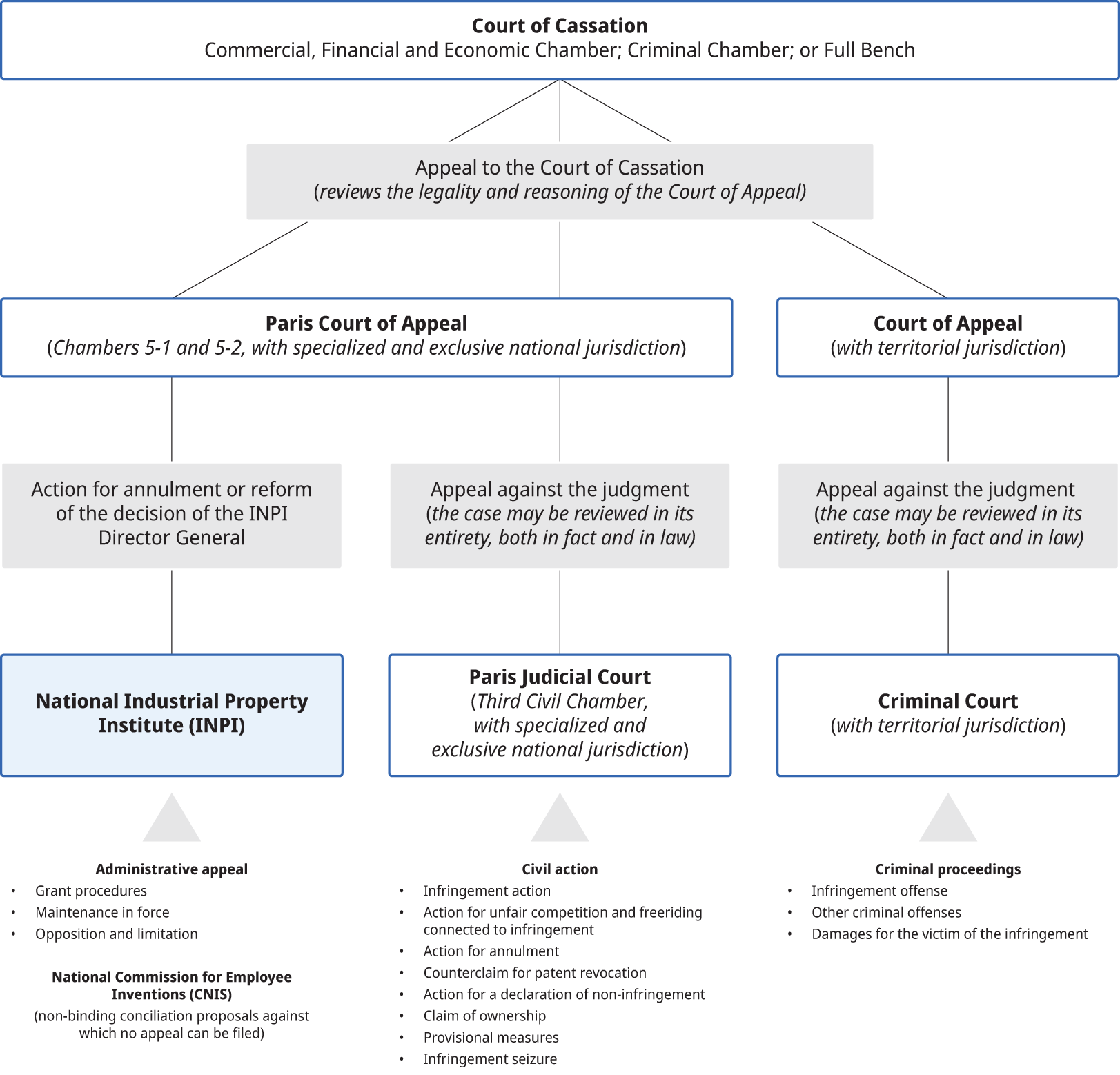
Figure 13.2 shows the judicial administration structure in France.
Figure 13.2
13.2.2.1.2 Unified litigation, without bifurcation
The French system, unlike some other European systems, provides for integral jurisdiction in patent matters, without bifurcation: the Paris Judicial Court is competent to assess a patent's terms, scope and validity as well as alleged acts of infringement against it – and also to declare non-infringement as the case may be. It also has jurisdiction for all such related matters as unfair competition (Article L. 615-17 of the IPC), the award of damages and other means of redress (including publication of the decision and product destruction and recall).
Actions relating to unfair competition, however, are subject to the Civil Code, Articles 1240 and 1241 of which provide that “Any act of man that causes injury to another obliges the person at fault to remedy it” and that “Every person is responsible for injury they cause, not only by their actions, but also by their negligence or imprudence.” Thus, a plaintiff who brings both a patent infringement action and an action for unfair competition must demonstrate both an infringement of their exclusive right of exploitation and the commission of a fault – that of unfair or parasitic competition, requiring proof of specific facts.32 An action for unfair competition, moreover, may be based on facts materially identical to those alleged in an infringement action, even if rejected for failure to establish an exclusive right or for the non-opposability of an exclusive right to third parties.33 Although both actions seek the same objective of compensating the damage, they are regarded as having a different legal basis.34
This integral and centralized jurisdiction within the Paris Judicial Court encompasses all aspects of litigation: from the search for and establishment of evidence before trial (Article L. 615-5 of the IPC), to the ordering of urgent measures before or during proceedings on the merits (Article L. 615-3 of the IPC), to examination of a patent's validity or ownership and alleged acts of patent infringement, thereby sparing plaintiffs from inconsistent interpretations and issues of territorial jurisdiction under domestic law – albeit subject to specific exceptions in European or international law as will be seen below.
13.2.2.1.3 The specific role of criminal justice
Articles L. 615-12 et seq. of the IPC are dedicated to criminal proceedings for patent infringement, treated as a criminal offense. Article L615-14 establishes penalties for knowing infringement, with varying degrees of severity if committed by natural or legal persons or organized groups.
The specialization and concentration established on the civil side have not been extended to criminal litigation in patent cases, which falls under the jurisdiction of criminal courts within whose territorial jurisdiction acts of infringement are committed (Article 382 of the Code of Criminal Procedure). In practice, however, criminal proceedings for infringement are quite rare.
13.2.2.1.4 Court costs
For the parties involved, the cost of patent litigation is moderate in France, where in the event of success, reimbursement can be obtained for all or part of attorney fees.
Legal action can be initiated at first instance free of charge, and on appeal by paying a stamp duty of 135 euros.
Losing parties, pursuant to Article 699 of the CCP, must pay the costs of the proceedings and enforcement activities.
Subject to this regime is the payment of certain costs, notably the costs of serving a summons (which initiates the proceedings), investigative measures ordered by the judge (judicial expertise) and necessary procedural acts subject to official tariffs (in the range of a few hundred euros for each act). Translation costs, where mandatory, are also paid by the losing party.
Parties must each ensure payment of their own attorney fees, as assistance and representation by a lawyer before the Judicial Court, Court of Appeal and Court of Cassation are mandatory.
In principle, however, those costs are ultimately borne by the losing party, or the party ordered by the court to pay them, in whole or in part. Pursuant to Article 700 of the CCP, the court's decision on that point is based on “equity or the economic situation of the party ordered to pay.” In intellectual property (IP) matters, the provision is interpreted in the light of Article 14 of Directive 2004/48/EC.
In France, those costs are not subject to any scale, threshold or cap. Their amount varies according to the importance and complexity of the litigation, and possibly the parties’ conduct during the proceedings (dilatory behavior, lack of front-loading, etc.). The costs of fact-finding, private or judicial expertise and infringement seizures (saisie contrefaçon) carried out by a bailiff (commissaire de justice) must also be reimbursed and are similarly subject to variable fees.
13.2.2.2 Specialized judges and professionals
The examination of patent litigation is handled by specialized chambers: at first instance by the Third Chamber of the Paris Judicial Court, which comprises three sections; and, on appeal, by Chambers 5-1 and 5-2 of the Paris Court of Appeal, for economic and commercial matters.
This structural specialization is combined with functional specialization. Each of the professional judges composing these chambers – who are tenured, thereby guaranteeing their independence – is assigned based on their skills and experience in the litigation dealt with. They are also required to complete a certain number of hours of continuous training organized by the National School for the Judiciary (ENM).
These specialized judges also attend regularly organized meetings to discuss specific legal issues and court decisions and to exchange views on their profession, notably under the auspices of the Court of Cassation.
This specialization is also enriched and facilitated in France by the organization of meetings, symposiums and debates among members of the Court of Cassation, INPI, the Center for International Intellectual Property Studies (CEIPI) and certain universities – with an active role also played by professional associations dedicated to industrial property matters (notably the Association of European Patent Practitioners (APEB), International Association for the Protection of Intellectual Property (AIPPI) and Association of Intellectual Property Lawyers (AAPI)).
This same high degree of specialization and expertise is also encountered among law firms specializing in industrial property, whose partners often include patent attorneys (conseils). The latter are not, however, authorized to represent their clients before the French courts, a function reserved for avocats. Such is not the case, on the other hand, for matters brought before the UPC or the EPO.
Finally, during their university studies, law students and future judges or attorneys are offered numerous specialized programs on intellectual and industrial property.
This level of specialization contributes to technical and legal analysis of high quality, as well as stable and consistent case law.
13.2.2.3 Alternative dispute resolution (pre-litigation)
There is no mandatory requirement in France to engage in pre-litigation or alternative dispute resolution (ADR) processes, except in disputes involving claims under 5,000 euros, or those exhaustively listed in Article 750-1 of the CCP (but not involving patents). Such processes are, however, strongly encouraged, as offering confidential, rapid, tailored solutions without the publicity or risks associated with court proceedings.
13.2.2.3.1 Arbitration
While courts were initially hesitant about the process, legislators embraced arbitration for disputes over IP in 1978, by way of wording in Article L. 615-17 of the IPC that “the preceding provisions shall not prevent recourse to arbitration, under the conditions provided for in Articles 2059 and 2060 of the Civil Code.”
This has made arbitration a universally available alternative.35 Controversy remains, however, over the arbitrability of patent validity. Some authors consider arbitration impossible where private justice might “encroach upon the prerogatives of public authority”,36 unless arbitrators refrain from ruling erga omnes (with effect toward all) on a patent’s validity, confining themselves to an inter partes assessment of a patent’s opposability (between the parties involved only). Consistent with this view, in a judgment of June 12, 2013, the Court of Cassation held that “an arbitral tribunal finding that an invention is part of the state of the art without ruling on the larger issue of the patent’s validity does not disregard its mission, nor the adversarial principle, nor international public policy,”37 suggesting the possibility of arbitrating a nullity defense on an incidental basis, or “relative arbitrability.”
Be that as it may, arbitration remains a fully viable means of resolving disputes over patent ownership, infringement and contracts.
Articles 1442 et seq. of the CCP govern the conditions and content of arbitration agreements, the composition and role of the arbitral tribunal, recourse to the juge d’appui (supervising judge), the conduct of arbitral proceedings and the arbitral award (considered res judicata and subject to compulsory enforcement only by an exequatur order). Arbitrators may not, however, hear criminal prosecutions or order infringement seizures.
Specific provisions have also been incorporated into the CCP for international arbitration, for which the President of the Paris Judicial Court, unless otherwise agreed, serves as the juge d’appui.
13.2.2.3.2 Mediation, conciliation and friendly settlement hearings
A patent dispute may be resolved through a confidential friendly settlement process with third-party involvement. The third party may play a neutral role (as mediator) or an active one (proposing concrete solutions, as conciliator) – or be a judge, able to advise on points of law (friendly settlement hearings). This latter approach is possible only if a lawsuit has been initiated. A detailed description of these processes is provided below (Section 13.3.6.2.5).
13.2.2.4 Trial at first instance
A brief overview of French trials at first instance is provided here, with greater detail to follow in Section 13.3.
13.2.2.4.1 Summary proceedings
Summary proceedings in patent matters are provided for in Article L. 615-3 of the IPC, which establishes an exceptional legal regime permitting a decision to be obtained quickly from a single judge sitting in summary proceedings.
Persons holding rights to bring patent infringement actions may, on the basis of their patents, apply in summary proceedings to the President of the Judicial Court, prior to commencing an action on the merits, to request interim measures, whether the infringement is imminent or already established. Pursuant to Article 485 of the CCP, the case will be examined, depending on the degree of urgency, either at a standard summary hearing or at a special hearing, at a specified day and time (the so-called “hour-by-hour” summary procedure).
While patents cannot be annulled in summary proceedings, the judge can assess during such proceedings whether there are serious grounds for doing so38 – and may dismiss requests for interim measures where appropriate. Urgency is not a condition for admitting a summary action but may be taken into account in considering the proportionality of the interim measures requested. The burden of providing evidence is favorable to plaintiffs, who need only demonstrate a “likelihood of infringement” balanced against the gravity of the consequences. Summary proceedings differ from proceedings on petition (which are ex parte proceedings) in that defendants must be summoned to adversarial proceedings and allowed to present arguments in their defense (see also Section 13.3.7).
The judge’s provisional decision, which takes the form of an order, is not considered res judicata on the main issue, is not binding on the judge called upon to rule on the merits of the dispute and may be appealed to the Paris Court of Appeal within 15 days.
If admitted, an action must be brought on the merits within 20 working days, or 31 calendar days, from the date of the summary order, failing which the measures initially ordered lapse.
Interim measures may exceptionally be ordered during ex parte proceedings, as examined below (Section 13.3.7).
13.2.2.4.2 Action on the merits
13.2.2.4.2.1 Preliminary search for and establishment of evidence
Before initiating actions on the merits, plaintiffs must provide evidence that their rights have been infringed, which may be “proven by any means.”39
Means of proof accepted in France, subject to respect for trade secrets, include bailiff reports, internet reports, purchase reports, infringement seizures (ordered by the judge either on petition in non-adversarial proceedings or after action on the merits has been initiated), private expertise, judge-ordered expertise and even information obtained through a customs seizure. Regarding private expertise, according to consistent case law of the Court of Cassation, judges may not rely exclusively on non-judicial expert reports prepared at a party’s initiative40 (see Section 13.3.3, on evidence).
All of those measures and the conditions for their performance may give rise to litigation if legal provisions have not been respected or if the petitioner has acted in bad faith in their implementation.41
13.2.2.4.2.2 Conduct of the proceedings
The procedure is written and the parties must be represented by a lawyer authorized to act before the Paris Judicial Court. The judge is seized exclusively by written pleadings with supporting evidence. Arguments and claims not so submitted are not considered by the court (unless they may only be developed orally and are then considered during the hearing for oral arguments).
The plaintiff must arrange in advance for a court bailiff to serve a writ of summons to the defendant communicating the date and place of the hearing and setting out the plaintiff’s claims and the grounds in fact and in law on which they are based. This document must be served within a mandatory time limit if an infringement seizure or cease-and-desist order has been issued beforehand.
The defendant has 15 days from the date of the summons to appoint a lawyer.
Once the summons has been served and entered into the court’s docket, a pre-trial judge (juge de la mise en état) is designated with broad powers to oversee the instruction of the case and the fair conduct of the proceedings (Article 780 of the CCP). The pre-trial judge presides over the written procedure and has exclusive jurisdiction to rule, inter alia, on procedural exceptions, incidents terminating the proceedings, interim payments and measures, and investigative procedures. The pre-trial judge also rules on pleas of inadmissibility (fins de non-recevoir) for statute-of-limitations reasons, or lack of standing or lack of interest in the legal action, unless they consider that the complexity of the grounds cited for inadmissibility, or the progress of the case’s instruction, justify the plea being examined at the end of the instruction by the trial court called upon to rule on the merits. The pre-trial judge may also order the production of documents considered useful to resolving the dispute.
The pre-trial judge does not issue any preliminary opinion or opinion on the merits of the case. Nor are the pre-trial judge’s decisions subject to appeal if they result in termination of the proceedings or pertain to a procedural exception or plea of inadmissibility.
Upon completion of the pre-trial phase, the instruction is closed and the case is scheduled for a hearing before the court. After which no further written pleadings or evidence are admissible unless the order closing the instruction is revoked.
The time required to resolve patent cases in France, from the commencement of legal action to a decision on the merits, averages two years, which may be reduced by means of a contractual pre-trial arrangement – to establish a collaborative procedure for instance – or in cases of demonstrated urgency, based on a fixed-date procedure, without a pre-trial phase, which the plaintiff may request pursuant to Article 840 of the CCP (see Section 13.3.6.2 on the conduct of the trial for more details).
13.2.2.4.2.3 The parties to the trial
Patent infringement litigation traditionally involves the following parties:
the patent owner, co-owner, assignee, and/or exclusive licensee (having informed the owner), or non-exclusive licensee (if so authorized by the license contract and having informed the owner), as per Article L. 615-2 of the IPC, joined where appropriate by a distributor of the products covered by the patent; and
the alleged infringer, and potentially all participants in acts of infringement defined in Article L. 613-3 of the IPC.
More exceptionally, the trial may involve other actors, such as the Public Prosecutor (with the power, among others, to annul patents ex officio); the INPI Director General (for disputes relating to the latter's decisions); creditors' representatives (in the event of insolvency proceedings); insurers and any other persons having an interest and standing to sue or defend, intervening voluntarily or called to intervene forcibly.
13.2.2.4.2.4 The hearing
Cases may be pleaded before a collegiate panel of three judges (if the parties so request) or before one or two reporting judges, who will then deliberate with other members of the court. It may also be agreed between the parties to proceed without a hearing, although this is rarely requested.42
The hearings are public and open to all (in person only), subject to restrictions relating notably to trade secrets as defined in Articles L151-1 et seq. of the Commercial Code.43 Specific arrangements are made for the production and communication of documents containing trade secrets, including in camera hearings and delivery of court judgments.44
On the day of the hearing, the reporting judge first reads a report outlining the context of the case and the main legal issues underlying the dispute (Article 804 of the CCP). The court then hears the attorneys' oral arguments. Except where particularly complex technical fields are involved, it is very rare for experts, patent attorneys or witnesses to be heard. Article L. 615-20 of the IPC allows the court, either ex officio or at a party's request, to appoint a consultant to follow the pre-trial procedure and then attend the hearing. Such consultants may also be authorized to address questions to the parties or their representatives.
Once the case has been pleaded, the court takes the case under advisement but must announce to the parties the date on which its decision will be rendered (Article 450 of the CCP). That generally occurs within six weeks to three months later, depending on the complexity of the case.
After the hearing, except with the express authorization of the court, parties may not produce new evidence or written pleadings, or respond to the Public Prosecutor's arguments. Such communications must take the form of supplemental written submissions to be handled in accordance with adversarial procedures.
13.2.2.4.2.5 The decision and its enforcement
If it finds patent infringement, the court may order various measures, as will be seen, including in-kind or pecuniary compensation, injunctions, destruction of infringing products and publication of the decision, which may be accompanied by a periodic penalty payment (astreinte), either decided by the court (if it has reserved jurisdiction over the dispute) or by a specialized magistrate called an enforcement judge (juge de l'exécution).
Decree No. 2019-1333 of December 11, 2019, established automatic provisional enforcement of court decisions, as provided for in Article 514 of the CCP, "unless the law or the decision rendered provides otherwise." Such provisional enforcement may only be set aside, in whole or in part, if the judge considers it incompatible with the nature of the case. It cannot be set aside when a judge rules in summary proceedings, prescribes interim measures for the duration of proceedings or orders precautionary measures, or when a pre-trial judge grants an interim payment to a creditor (Article 514-1 of the CCP).
Security for enforcement may be required but is rarely ordered in litigation between commercial companies. Enforcement is in principle carried out at the risk and peril of the party requesting it, given the chance of a subsequent revocation (rule of strict liability towards the party that suffers directly from the measure).45
If a patent is annulled, INPI records the judgment in the National Patent Register.
The Paris Judicial Court renders approximately 150 patent decisions each year.46
13.2.2.5 Appeal proceedings
As indicated, the Paris Court of Appeal, and specifically the two chambers dedicated to patent litigation within its economic and commercial division, has exclusive jurisdiction to examine appeals filed in patent cases against: judgments on the merits by the Paris Judicial Court; orders issued by that court's President in ex parte or summary proceedings (e.g., to authorize or refuse infringement seizure requests); orders issued by the pre-trial judge; and decisions taken by the INPI Director General.
Since 2021, the Paris Court of Appeal has rendered between 55 and 65 patent-related judgments each year.
13.2.2.5.1 Appeal against first-instance decisions
13.2.2.5.1.1 Conduct of the appeal proceedings
Appeals lodged in patent cases are governed by the same general rules that apply to other appeal proceedings.
Once a first-instance decision has been rendered, any party may appeal it within the standard time limit of one month from notification of the decision (increased by two months for persons residing abroad). The time limit is shorter (15 days) for appeals against orders rendered by a judge in summary or ex parte proceedings, or by a pre-trial judge.
Parties are required to appoint a lawyer to represent them throughout the proceedings.
Furthermore, where the first-instance decision is accompanied by provisional enforcement (as is generally the case), the respondent, pursuant to Article 524 of the CCP, may request removal of the case from the court docket for failure by the appellant to demonstrate compliance with the decision under appeal. This makes it incumbent on the appellant to either comply with the judgment or apply to the First President of the Court of Appeal for a provisional stay of enforcement. Failure to do either could result in the pre-trial judge removing the case from the court's docket, should the respondent so request – unless the appellant can demonstrate their inability to execute the decision or that its enforcement will likely have manifestly excessive consequences, subject to the judge's sovereign power of appraisal. Reinstatement of the case, if removed from the docket, can then be authorized upon proof of execution of the contested decision.
The President of the chamber decides how the case will proceed. If it appears to be urgent or relates to an order from a judge in summary proceedings or a pre-trial judge, the President may fix a date for initiating proceedings on short notice, or may designate a pre-trial judge for the appeal with broad powers to rule on procedural exceptions for appeal proceedings, developments warranting termination of the proceedings, the admissibility of interventions, questions relating to a lapsed notice of appeal or the inadmissibility of written pleadings or procedural acts. The pre-trial judge may also order the production of certain documents or grant an interim payment to the creditor where the obligation is not seriously contestable.
A conventional instruction may also be carried out, subject to priority scheduling (Article 127 of the CCP).
In addition, where interested parties can demonstrate that their rights are in peril, they may petition the First President of the Court of Appeal for a fixed-date summons to obtain priority scheduling for the case (Article 917 of the CCP).
13.2.2.5.1.2 Strictly regulated proceedings
Without attempting to be exhaustive on this point, it should be mentioned first that parties to standard appeal proceedings are subject to mandatory three-month time limits for filing written pleadings and responding to their opponents, with respondents subject to the same time limit for lodging cross-appeals. All exchanges of written pleadings and evidence are conducted electronically via the Réseau Privé Virtuel des Avocats (RPVA), a private virtual network for French lawyers.
It is not allowed, save for the exceptions listed in Article 564 of the CCP, to submit new claims in appeal proceedings. Parties may, however, add requests that are accessory to, a consequence of, or a necessary complement to claims submitted to the first-instance judges. They may also, pursuant to Articles 566 and 567 of the CCP, submit counterclaims, which under Article 70 of the same Code must be linked to the original claims by a sufficient connection to be deemed admissible.
For instance, a counterclaim for infringement of an industrial property title is deemed sufficiently linked to a request seeking the title's annulment.47 Similarly, a request seeking to annul a patent is deemed admissible, even though submitted for the first time on appeal, as a legal means to defeat an infringement claim.
By contrast, a party's request for a declaration of non-infringement, made as an additional claim within the framework of a nullity action, has been ruled inadmissible on appeal. While the action for annulment constituted a challenge to the patent's validity in that case, the appeal court reasoned that a declaration of non-infringement would not affect that validity.48 A new claim relating to unfair competition, after only infringement had been claimed at first instance, has likewise been ruled inadmissible on appeal. Infringement actions, it was reasoned, seek to sanction the violation of a proprietary right, whereas unfair competition relates to misconduct, within the meaning of Article 1382 (now Article 1240) of the Civil Code. The Court of Cassation now holds “that a party which brought an action for infringement at first instance that was dismissed for lack of a proprietary right is admissible, for the first time on appeal, to bring a claim based on unfair competition or parasitism, where those claims are based on the same facts.”49 It is a matter of principle in French law, moreover, that parties must present all their claims on the merits of a case in their first written pleadings (although new evidence and new arguments can be advanced to support those claims on appeal).
Once the pre-trial phase has concluded, a hearing is held for the parties' lawyers to be heard after a report has been presented by the reporting judge. The case may be pleaded before a collegiate panel of three judges, or before a single judge who will then report to the other members of the trial court before the start of deliberations. As at first instance, it is very rare for experts, patent attorneys or witnesses to be heard, except in complex technical fields and at the request of the parties.
An average period of two years elapses between the lodging of an appeal and the delivery of the judgment.
13.2.2.5.2 Specificity of appeals against INPI decisions
The Paris Court of Appeal has exclusive jurisdiction to examine appeals against decisions taken by the INPI Director General, according to a procedure organized under Articles L. 411-4 and R. 411-19 et seq. of the IPC. Those provisions distinguish between two types of appeal, according to the nature of the decision rendered. The first relates to INPI decisions to grant, reject, maintain or limit industrial property titles. The aim of this first type of appeal is simply to invalidate the INPI decision (such as the refusal to issue a supplementary protection certificate) concerned. The second type of appeal relates to INPI rulings on oppositions. The aim of this second type is for the Court to reform the INPI decision: that is, to replace it with a new one.
Court rulings invalidating an INPI decision are “without devolutive effect”: the court must judge the legality of the decision according to the conditions existing when it was taken, irrespective of any new evidence submitted.50
In the case of appeals to reform INPI decisions, on the other hand, parties may invoke new grounds, produce new documents and propose new evidence. They may not, however, submit new claims to the Court, except for those relating to questions arising from the intervention of a third party or the occurrence or revelation of a fact (Article R. 411-38 of the IPC).
The number of appeals, which remains very limited compared with the number of patent applications, has fluctuated since 2020 between one and 10 per year. Appeals relating to oppositions rose to seven in 2023 before stabilizing at three in 2024, while those in respect of INPI rejection decisions have remained stable at one or two a year.
The rules governing appeal procedures are set forth either in the IPC or the CCP (by reference per Article R. 411-20 of the IPC), it being specified, however, that a pre-trial counsel (conseiller de la mise en état) is not designated.
While INPI is not a party to appeal proceedings, the parties' written pleadings and evidence must be communicated to it, under penalty of the notice of appeal being declared void for the petitioner (Article R. 411-29 of the IPC) and of the written pleadings being declared inadmissible by the court of its own motion for the respondent (Article R. 411-30 of the IPC); the Court of Appeal rules only after hearing the INPI Director General, or after the latter has been called and given the opportunity to present oral or written observations.
The Public Prosecutor may take cognizance of cases in which it is considered necessary to intervene (Article R. 411-23 of the IPC).
Procedural acts, under penalty of inadmissibility, declared ex officio, are submitted to the court electronically, except where impracticable for reasons beyond the control of the party performing the procedural act (Article R. 411-24 of the IPC). The appeal submitted to the court registry must include the content specified in Article R. 411-25 of the IPC. The clerk of the court then notifies the parties and the INPI Director General of the appeal. The petitioner has three months from the date of the appeal to submit written pleadings to the registry. The respondent then has three months from the notification of those pleadings to submit its own written pleadings and, where appropriate, lodge a cross-appeal (Articles R. 411-29 et seq. of the IPC).
The jurisdiction of the Paris Court of Appeal also extends to the harmful consequences of liability actions brought against the INPI Director General in the exercise of their duties, without distinction as to whether the liability action is initiated by the applicant of the action for annulment, as an accessory to that action, or by a third party.51
The Paris Court of Appeal rules that appeal proceedings against a decision of the INPI Director General may give rise to an indemnity on the basis of Article 700 of the CCP.
The Court renders its judgment within a period of six weeks to three months.
The decisions of the Court of Appeal are notified by registered letter with acknowledgment of receipt by the court registry to the parties to the proceedings and to the INPI Director General (Article R. 411-42 of the IPC).
All decisions rendered by the Court of Appeal may be appealed to the Court of Cassation within two months from the notification of the contested decision (Article 612 of the CCP).
13.2.2.6 Appeal in cassation
The Court of Cassation is the highest court in the French judicial system.
It is seized by means of an appeal on points of law drafted and filed by a lawyer at the Council of State (Conseil d'État) and the Court of Cassation,52 with no need for prior judicial authorization. However, the Court may dismiss the appeal, with no need for a detailed explanation, if the appeal or one of its grounds is manifestly not of such a nature as to lead to cassation. Such summary dismissals are, however, rare in patent cases.
The role of the Court of Cassation is to monitor and unify the interpretation and application of the law throughout French territory. It does not re-try a case but rules on the legal correctness of the decision submitted to it and, in the event of cassation, remands the case to another court of appeal. As a court reviewing how lower court judges have applied the law, rather than a court deciding the merits of the case itself, the Court of Cassation always intervenes after a lower court has rendered its decision. Lacking the power to reassess factual elements, it relies on, and does not call into question, the factual findings of the courts on the merits – unless it is established that those courts distorted the meaning of a written document.
The Court of Cassation performs a dual review of lower court judgments: first, a normative review (of their legality and correct interpretation of the law); and second, a rationality review (of the quality of their reasoning).
The grounds then given in practice for quashing a decision (cassation) fall into two categories:
In industrial property matters, the Court may thus review whether judges have misrepresented a patent document53 and how54 they have assessed the novelty55 or inventive step56 of the invention concerned.
13.3 The infringement action
13.3.1 General overview
13.3.1.1 Centralized and unified litigation
Infringement litigation is at once centralized, specialized and unified:
Since 2009,57 it has been centralized for proceedings on the merits in a specialized chamber of the Paris Judicial Court, the only court of first instance in France with jurisdiction over litigation concerning patents (as well as supplementary protection certificates and utility models). It has similarly been centralized for appeal proceedings in a specialized chamber of the Paris Court of Appeal, and centralized again, on subsequent appeal, within a specialized section for industrial property within the Commercial Chamber of the Court of Cassation.
Infringement litigation is unified in that all questions necessary to resolve disputes can be decided in cases brought before those courts. The court hearing patent infringement claims is also competent to rule on challenges to the patent's validity (potentially resulting in partial nullity and limitation of claims). This ensures more consistent interpretation of a patent's scope and a faster means of definitively and comprehensively resolving infringement issues while minimizing uncertainty over subsequent annulment in separate proceedings.
The same courts are also competent for such related matters as unfair competition and other IP rights (copyright, trademarks, designs, plant variety rights). For more information on the jurisdictional system, see Section 13.2.2).
13.3.1.2 Parties to the proceedings
Infringement actions are “reserved”: only patent owners or, under certain conditions, licensees may bring them (Article L. 615-2 of the IPC).
The decision to initiate an infringement action is in principle up to the patentee, but a license contract may also authorize the licensee to do so. Such authorization is automatic in the case of an exclusive license, unless otherwise stipulated, but subject to prior notification to the patentee. It must be expressly provided for in the case of a non-exclusive license.
If the action is initiated by the patentee, any licensees may then intervene voluntarily in the proceedings (without prior authorization) to seek remedy for the prejudice suffered.58 It is not necessary in this regard for the license to be recorded in the register. Conversely, once an action is initiated by a licensee, the patentee may also intervene.
The patentee and licensees may also act together, from the outset, by issuing a joint summons if they choose to do so.59
According to Articles 31 and 32 of the CCP, each party must demonstrate their personal interest in acting. Such actions cannot be conducted by “straw men”, or on behalf of unidentified third parties (“no one may plead by proxy”).
The defendants in these cases are the parties targeted in the document initiating the proceedings. Other parties may join the proceedings voluntarily or be summoned. They may include licensees, other parties liable for the infringement, and creditors' representatives in the event of insolvency proceedings, insurers, and others.
In practice, company directors are likely to be involved in such proceedings only in rare cases, notably when their personal liability is engaged owing to fault separable from their duties.
13.3.1.3 Statute of limitations
Patent infringement actions benefit from a statute of limitations regime permitting legal action long after infringement begins, if it continues over time.
Pursuant to a reform that entered into force on May 22, 2019,60 an infringement action is barred only five years after the owner became aware of, or should have become aware of, the latest fact enabling the owner to exercise that right (Article L. 615-8 of the IPC).
This provision implies that even for acts begun (and known about) many years in the past, infringement actions remain possible where such acts have occurred within the last five years. That makes it possible to prevent continued infringement, although underway for many years before, and to obtain damages for the prejudice suffered during the last five years.61 That represents a more favorable regime for actions against patent infringement than that available under ordinary law (or earlier applicable law), under which the starting point for reckoning the statute of limitations is (or was, under earlier applicable law) the date of first knowledge (or presumed knowledge) of the infringement, “regardless of whether it continued over time.”62 Under currently applicable law, in other words, where infringement consists of a series of distinct acts, the statute of limitations is reckoned from the day the patent owner became (or should have become) aware of each successive act.63
The burden of proof on this point lies with the party relying on it.
Strictly speaking, the pre-trial judge alone is competent to rule on the issue of the statute of limitations prior to proceedings on the merits. However, the pre-trial judge may join it in the latter proceedings (cf. Section 13.3.6.2.1).
13.3.2 Infringement: acts and defenses
Infringement involves reproduction of the protected subject matter and the commission of at least one of the acts of infringement not covered by an exception.
13.3.2.1 Reproduction of the claims
The “material” dimensions of patent infringement are assessed in accordance with Articles L. 613-2 et seq. of the IPC, the first paragraph of which provides that “the extent of the protection conferred by the patent shall be determined by its claims; nevertheless, the patent’s description and drawings shall be used to interpret the claims.”
Such assessments involve examining whether the features of each claim have been reproduced in the allegedly infringing product or process – rather than comparing that product with any other product legally marketed under the patent.
13.3.2.1.1 Literal reproduction of claims
Infringement is assessed based on similarities (notwithstanding the presence of additional features not mentioned in a patent’s claims). Infringement is said to be literal when all of a claim’s features are found in the infringing product or process.
It is also considered literal when an invention’s “essential means” (technical features necessary for it to serve its purpose) are found in the infringing product.64
An infringement is thus considered literal, even where a feature of the infringing product differs in a secondary way from the invention’s claims, if it is obvious for a person skilled in the art, upon considering the description and drawings, that the patent claims have a broader scope that is also present in the infringing product.65
13.3.2.1.2 Infringement through equivalents
Even where an allegedly infringing product or process does not literally reproduce a patent’s claim, it may still fall within the scope of patent protection if it applies equivalent means.
This consideration of equivalents is provided for in the Munich Convention on the European Patent (Article 2 of the Protocol on the Interpretation of Article 69 of the Convention) and is governed in France by case law.
That case law identifies “infringement through equivalent means” as occurring where the means of a product or process, though structurally distinct from the patented means, performs the same function – provided that function was not previously known – to achieve an identical result. “Function” is understood as the action of producing an immediate technical effect for the purpose that the means is intended to serve.66
This “immediate technical effect” is not to be confused with the technical result produced by the invention: infringement through equivalents does not refer to alternative means that produce the same technical result, but rather alternative means that contribute to that technical result through the same function – that is, the same immediate technical effect – within the application given to it in the patent.
The means protected by the doctrine of equivalents may consist of a combination of means, provided such combination itself produces a new function.67
For example, it has been held68 that in a claim protecting the use of a specific salt having the active ingredient pemetrexed in the manufacture of a medication, combined with vitamin B12 for the purpose of reducing the toxicity of that active ingredient, the function was not the reduction of toxicity (that being the technical result of the claim), but the physiological process initiated by combining vitamin B12 with pemetrexed, contributing ultimately to lowering the latter’s toxicity. Accordingly, the combination of vitamin B12 with another salt having the same active ingredient and the same therapeutic effect performs the same function (has the same physiological effect) contributing to the same technical result. As this function was not already known, this alternative combination constitutes infringement by equivalents even though the claim does not literally cover the use of that other salt. Conversely, the combination of a pemetrexed salt with another element having a different effect in the body from that produced by the combination with vitamin B12 would not constitute infringement by equivalents, even if that different function ultimately produced the same technical result of reducing the toxicity of pemetrexed.
In other words, to be illicit, the allegedly infringing means must contribute to the technical result in a way that is substantially identical to that of the patented means, which aligns with the criteria adopted in other countries applying the Munich Convention, consistent with the objective of convergence of interpretation, as referenced by the Court of Cassation.69
Naturally, application of the equivalents doctrine must not have the indirect effect of protecting a prior state of the art: for this reason, the protected function must be new. More generally, the scope given to the patent through equivalents must be consistent with the scope that allowed it to be judged new and inventive.
13.3.2.2 Acts of infringement
According to Article L. 615-1(1)-(2) of the IPC, “Any infringement of the rights of the patent owner, as defined in Articles L. 613-3 to L. 613-6, constitutes an infringement. Infringement shall engage the civil liability of its author.”
Once infringement is established, the infringer’s good faith becomes irrelevant70 and cannot be taken into account by the judge in assessing damages – in contrast to the distinctions found in Article 13(2) of Directive 2004/48/EC and in Article 68(4) of the UPCA.
However, Article L. 615-1(3) of the IPC specifies that:
[...] offering, placing on the market or using an infringing product, or possessing it with a view to using or placing it on the market, where such acts are committed by a person other than the manufacturer of the infringing product, shall only engage the liability of that person if the acts are committed with full knowledge of the facts.
The law distinguishes between acts of direct infringement and acts of infringement by supply of means.
13.3.2.2.1 Direct infringement
Direct infringement is the violation of a patentee's rights through the unauthorized reproduction of the essential features of the patented invention. The acts likely to be characterized as direct infringement are listed in Article L. 613-3 of the IPC, which provides:
The following shall be prohibited absent the consent of the patent owner:
- (a) manufacturing, offering, placing on the market, using, importing, exporting or transshipping a product covered by the patent, or possessing such a product for the aforementioned purposes;
- (b) using a process covered by the patent or – when a third party knows, or the circumstances make it obvious, that use of the process is prohibited without the patent owner's consent – offering the use of such a process on French territory; and
- (c) offering, placing on the market, using, importing, exporting or transshipping a product obtained directly by a process covered by the patent, or possessing such a product for the aforementioned purposes.
13.3.2.2.1.1 Product claim
With regard to product claims, Article L. 613-3(a) of the IPC provides that manufacturing, offering, placing on the market, using, importing, exporting or transshipping a product covered by a patent, or possessing such a product for the aforementioned purposes, constitute acts of infringement.
Manufacturing is understood as the physical production of the patented product (regardless of the manufacturing process used).
Importing, within the meaning of French patent law, consists of bringing goods into France from abroad. The importer is the person or economic operator responsible for the introduction into French territory of products manufactured abroad. The importation of an infringing product is prohibited, whether it originates from a member country of the European Union (EU) (if the patentee's rights have not been exhausted) or from another third country.
Offering refers to any physical operation tending to bring an infringing product into contact with a clientele or to prepare the clientele for the upcoming marketing of said product. For example, the display of a product at a trade fair intended for potential buyers constitutes a prohibited offer, as such a presentation – even without indicating a price – is likely to divert the patentee's clientele.71
Placing on the market refers to making the product available in any way to the benefit of unauthorized third parties.
Using refers to employment of the product, allowing its technical or economic benefits to be derived.
Exporting to a foreign country refers to an act of removing the product from French territory; it constitutes an autonomous act of infringement for which it is not necessary to demonstrate a purpose of offering, placing on the market or using abroad.
Transshipping refers to the physical act of transferring a patented product from one mode of transport to another.72
Possessing constitutes infringement only when intended for the purposes of using, placing on the market or offering the product.
These acts constitute infringement if they are committed on French territory and do not fall under a legal exception.73
Unlike manufacturing, importing, exporting and transshipping, which always give rise to liability, offering, placing on the market or using an infringing product, or possessing such a product with a view to using or placing it on the market, give rise to liability only where the person concerned acted with full knowledge of the facts – that is, knowing the potentially infringing nature of the act performed. Knowledge of the facts classically presupposes not only knowledge of the patent but also of the fact that the allegedly infringing product reproduces the patent. The conventional response is therefore to send a letter of formal notice before initiating an action against parties performing those acts. It has been held, however, that professionals in the field may be presumed to act with full knowledge of the facts.74
13.3.2.2.1.2 Process claim
13.3.2.2.1.2.1 Using a process or offering it for use
Article L. 613-3(b) of the IPC prohibits:
The use of a process consists of implementing its means following steps indicated in the patent claims to obtain the result for which the process has been patented, good faith being irrelevant in this case.
The burden of proof that a product was obtained by means of the patented process normally lies with the patentee.
To remedy the fact that proving the use of a process can be difficult, Article L. 615-5-1 of the IPC, which transposes Article 34 of the Agreement on Trade-Related Aspects of Intellectual Property Rights (TRIPS Agreement), allows for a reversal of the burden of proof, enabling the court to order proof from the defendant that a process different from the patented process has been used. Failing such proof, the patented process is presumed to have been used in two cases:
when the product obtained by the patented process is new;
when there is a high probability that the identical product was obtained by use of the patented process and the patent owner has been unable, despite reasonable efforts, to determine the process actually used
The offer of a process for use is infringing only when it is both received on French territory and relates to a use of the process in France. Proof of an intentional element must be provided here: the offer constitutes an infringement only if the person making it knows – or if the circumstances make it obvious that they could not have been unaware – that use of the process is prohibited on French territory.
13.3.2.2.1.2.2 The product obtained directly by the patented process
The protection provided by process patents extends to products obtained directly through implementation of the protected processes.75 Offering, placing on the market, using, importing, exporting or transshipping such products, or possessing them for such purposes, are therefore also prohibited under Article L. 613-3(c) of the IPC. The prohibited acts are thus the same as those referred to in Article L. 613-3(a) for product claims – except, of course, for manufacturing, which is prohibited as the use of a patented process under Article L. 613-3(b).
“Products directly obtained” means those resulting immediately from, remaining closely associated with, and owing their essential characteristics to implementation of the patented process.76
In the case of patented processes for the production of biological material, Article L. 613-2-3 of the IPC extends protection not only to biological material obtained directly from a process, but also that obtained through reproduction or multiplication of such material and endowed with the same properties.
13.3.2.2.2 Infringement by supply of means
Patent infringement by supply of means is defined in Article L. 613-4 of the IPC, addressing scenarios where a person does not directly engage in infringement but provides unauthorized third parties with the means to do so.
Delivering or offering to deliver means intended for implementing a patented invention in France constitutes infringement by supply of means. For an activity to be characterized as such, four cumulative conditions must be met:
there must be a delivery or offer of delivery on French territory;
the means provided must relate to an essential element of the invention, meaning a constituent element of the invention that contributes to its result;77
implementation of the invention must be intended to take place on French territory;
the third-party supplier must know, or it must be obvious to that supplier, that the means are suitable and intended for such implementation.
Infringement by supply of means is therefore subject to a double condition of territoriality:
the delivery or offer of delivery must be made on French territory;78
the means delivered, or offered to be delivered, must be intended for implementation of the invention on French territory.79
Infringement by supply of means also involves an intentional element: the third party must know – or circumstances must make it obvious – that the means provided are suitable and intended for implementation of the invention.
In order not to criminalize the sale of items of common necessity, which may serve a multitude of uses, Article L. 613-4(2) of the IPC provides that supplying such staple commercial products as electricity, standard screws or various chemicals does not constitute infringement by supply of means – unless the supplier induces the person supplied to commit prohibited acts, indicating the supplier's awareness of the use intended for such supplies (namely, infringement).80 Such inducement may be overt or discreet, continuous or sporadic – or isolated – but it must be targeted.81
13.3.2.3 Actors involved in infringement
According to Article L. 615-1 of the IPC, any violation of a patent owner's rights constitutes infringement and engages the liability of the actor that committed it.
Each such actor is liable under a regime distinct and autonomous from ordinary law.
A question arising in this regard relates to the identity of importers. Those importing patent-infringing goods, even if unaware of the patent's existence, may be held liable for infringement.82
Such importers may include foreign manufacturers of the products concerned, but only those maintaining "specific links" with France.83 The Paris Judicial Court, for example, recently dismissed a patent infringement action after refusing to characterize the defendants as importers, because the patentees had failed to establish that they had any activity, subsidiary or establishment on French territory.84
In another case, the Paris Court of Appeal found a person who had ordered an infringing product to be a co-actor in its manufacture, having provided detailed specifications and precise instructions to the manufacturer.85
The supply of prototypes, plans and detailed descriptions, and the grant of technology licenses, may also constitute participation in acts of infringement if products manufactured and marketed according to such plans are infringing.86
13.3.2.4 Liability of intermediaries
According to Article L. 615-3 of the IPC, any person with standing to bring a patent infringement action may apply in summary proceedings for court-ordered measures against intermediaries whose services are used by an alleged infringer, to prevent or stop imminent or ongoing activity believed to be infringing, subject to periodic penalty payments if necessary.
That provision transposes Directive 2004/48/EC into domestic law. Article 9 of that Directive provides that an interlocutory injunction may be issued, under the same conditions as those applying to an alleged infringer, against an intermediary whose services are being used by a third party to infringe an IP right.
In a judgment of July 7, 2016, the Court of Justice of the European Union (CJEU) interpreted the concepts of “intermediaries” and the “injunctions” that may be issued against them.87 It ruled that Article 11, third sentence, of Directive 2004/48/EC must be interpreted as meaning that the concept of “intermediaries whose services are used by a third party to infringe an intellectual property right”, within the meaning of that provision, includes the lessee of market halls who sublets points of sale to merchants, some of whom use their space to sell infringing trademarked goods, and that the conditions to which the injunction is subject are identical to those relating to injunctions that may be addressed to intermediaries in an online marketplace, as set out in the judgment of July 12, 2011, L’Oréal v. eBay.88
The concept of intermediary is broad and in practice relates to all who participate in infringement without being characterized as infringers, as they do not engage in any of the acts listed in Articles L. 615-1 and L. 613-4 of the IPC.
Only an injunction may be issued against such “intermediaries”, whose liability may be sought not for infringement but only under the conditions of ordinary law (Articles 1240 and 1241 of the Civil Code if the acts are committed in France).
These provisions of Article L. 615-3 of the IPC are used relatively little by practitioners in patent matters, and, to date, more in matters of literary and artistic property or trademarks (notably with respect to internet intermediaries or lessors of premises commonly leased to infringers89).
13.3.2.5 Grounds of defense and exceptions
The protection conferred by a patent, as just defined, is subject to limits and exceptions.
Defendants in infringement proceedings, apart from contesting allegations that they have reproduced patent claims, as discussed previously, also have specific grounds of defense at their disposal.
The most common defense is to challenge the patent’s validity, but other defenses are also employed, as discussed below.
13.3.2.5.1 Patent annulment by a counterclaim or by way of defense
An action for patent annulment may be brought before a civil judge by way of a principal claim, a counterclaim or a plea in defense.
As a principal claim, an action for patent annulment may be brought by any third party with an interest in bringing it; the decision then carries erga omnes effect from the time it is pronounced (the conditions are the same; see Section 13.4.2).
A counterclaim for patent annulment constitutes an incidental claim, by which the defendant broadens the scope of the proceedings, seeking not only dismissal of the infringement action but also retroactive annulment of the patent. The decision in this case also carries immediate erga omnes effect.
As a plea in defense, patent annulment is sought solely to defeat the opposing claim on the merits.
These methods differ essentially in the effects they produce: the action for annulment (as a principal claim) and the counterclaim for annulment (as an incidental claim) both carry erga omnes effect. Patent nullity raised as a plea in defense has effect inter partes only.
The plea-in-defense method, moreover, may enable a French defendant to defeat an infringement action based on a non-European patent, but the French judge does not have jurisdiction to annul that patent, or any other foreign title.
An advantage of the plea-in-defense approach has been its ability to bypass statute-of-limitations constraints formerly applicable to patent annulment actions. Prior to the PACTE Act, principal claims or counterclaims for the annulment of industrial property titles, unlike pleas in defense, were subject to a five-year statute of limitations, running from the time plaintiffs knew or should have known the facts enabling them to bring such actions. Thus, there were cases where the validity of a patent could be challenged only by way of a plea in defense.
With the PACTE Act now in force, that is no longer the case. None of the approaches to patent annulment is now constrained by a statute of limitations.
On the question of standing, Article L. 615-2(7) of the IPC provides that the validity of a patent “may not be challenged during an infringement action initiated by a licensee if the patent owner is not a party to the proceedings.”
To date, case law has not ruled on the admissibility of a nullity plea in proceedings to which the patentee is not a party.
The retroactive annulment of a patent does not in principle entitle the licensee to the restitution of royalties paid prior to the annulment decision, these having potentially found compensation in prerogatives the licensee may have enjoyed with respect to third parties.90
Nullity actions are discussed in further detail in Section 13.4.2.
13.3.2.5.2 Prior personal possession
Prior personal possession can be invoked as a defense on the merits based on the right of persons having had possession of an invention to continue exploiting it despite a patent covering that same invention being subsequently filed by a third party.
The rationale for this regime is to protect the legitimate interests of prior innovators who have chosen to protect their inventions through secrecy, but then find themselves faced with patents filed subsequently for the same inventions developed independently by third parties. It was enshrined in law in 1968 but confirms long-standing and consistent case law dating back to the 19th century.
With a view to ensuring such protection, Article L. 613-7(1) of the IPC provides that persons “who, in good faith, at the filing or priority date of a patent, were in the territory where this book is applicable and in possession of an invention covered by that patent, have the personal right to exploit that invention, the existence of said patent notwithstanding.” This represents an exception to the patentee’s monopoly, allowing a third party to continue exploiting the invention.
Prior personal possession (prior use right) should not be confused with the concept of prior public use, which refers to an invention having been made accessible to the public, by its inventor or by a third party, before the filing or priority date of a patent; such accessibility may result from marketing, an exhibition, a publication or any act that places the invention at the disposal of the public without sufficient protection of confidentiality. Prior public use can thus be invoked to contest the novelty or inventive step of an invention and result in patent annulment (or rejection of a patent application). It may notably result from an act by the patent owner, for example, exhibiting or marketing a prototype without confidentiality precautions.
A recent decision by the Paris Judicial Court recalled the four conditions required under Article L. 613-7 of the IPC for a right of prior personal possession to be upheld:
the possession must have been prior to the filing or priority date of the patent application;
the technology possessed must be identical to that of the patented invention;
the technology must have been possessed on French territory;
the claim of such possession must be made in good faith.
The first condition, as to the timing of possession, has been assessed flexibly. French case law and doctrine have predominantly considered intellectual possession to be sufficient and that commercial or industrial exploitation of the invention, or even serious preparations for such exploitation, are unnecessary. The possessor need only have attained, prior to the patent filing or priority date, intellectual mastery of the invention enabling a person skilled in the art to implement it.
That interpretation has been confirmed by the Paris Court of Appeal.91
Prior personal possession may be proven by any means, including documents, drawings, formulas, manufactured products or any evidence demonstrating precise and complete knowledge of the invention. Case law has even recognized such possession for inventions never exploited but described in sufficient detail in archives or technical files. One of the means of pre-establishing proof of such possession is filing a “Soleau” envelope (now e-Soleau) with INPI, which allows any type of industrial development to be dated and kept secret for a period of five years, renewable once.
The second condition is that the technology possessed must be identical to that covered by the patent. Since industrial possession is not required, courts commonly scrutinize in detail differences between the previously possessed and the allegedly infringing technology. Some decisions have dismissed the exception on the basis of only minor differences.92
The third condition is proof that the technology was possessed on French territory. This may result from it having been developed in France – manufactured, marketed or tested there, for example. It may also result from being acquired abroad and then “transported” to French territory.93 It is not sufficient, however, to acquire and implement the technology exclusively abroad, even if prior to the filing or priority date, and then transfer it to France afterwards.94
The fourth condition is that the person invoking prior personal possession must do so in good faith. This requires more than a simple absence of fraud. It presupposes that the possessor personally created the invention or received it legitimately without any prohibition on its use, which is not the case when possession results from contractual relationships involving an obligation of confidentiality or a prohibition on exploitation, as is the case for an employee or a licensee subject to such clauses. By way of illustration, the Court of Cassation found an absence of good faith on the part of a company claiming personal possession that “only had gained access to the invention concerned because of its contractual relationship with the future patentee.”95 It similarly upheld a Court of Appeal decision finding an absence of good faith in the case of a newly created company invoking the prior personal possession of its director, who had filed a patent as inventor of the technology concerned in the name of another company that they managed at the time.96
If the four conditions above are met, the possessor is entitled to exploit the invention on French territory, with no particular limitation as to duration or the quantity of products or services sold.
In such cases, the right of exploitation arising from prior personal possession is strictly personal.
That right may only be transferred, according to Article L. 613-7(2) of the IPC, “together with the goodwill, business or part of the business to which it is attached.” It cannot be assigned in isolation. Nor can it be licensed. The right of a prior personal possessor to engage in subcontracting is disputed in legal doctrine and not clearly settled in case law. Here again, intellectual possession is considered sufficient to benefit from the exception, so a pragmatic approach seems reasonable. As one author puts it,97 anyone who has the right to manufacture a product should be able to have it manufactured on their behalf.
13.3.2.5.3 Exhaustion of rights
By application of EU law, the rule of exhaustion of rights is an exception to the territorial protection provided by patents, justified by the principle of the free movement of goods. According to Article L. 613-6 of the IPC:
The rights conferred by the patent shall not extend to acts relating to the product covered by that patent, performed on French territory after that product has been placed on the market in France or on the territory of a State party to the Agreement on the European Economic Area (EEA) by or with the consent of the patent owner, unless there are legitimate grounds justifying the owner’s opposition to further marketing of the product.
A specific exhaustion regime is provided for patents covering genetic sequences. Article L. 613-2-4 of the IPC provides that patent protection does not extend to biological material obtained by the reproduction or multiplication of such material placed on the market in the EU or EEA by, or with the consent of, the patent owner, provided that such reproduction necessarily results from the material’s intended use and that the material thus obtained is not used again for reproduction or multiplication.
The application of this rule presupposes the fulfillment of two conditions: (i) the patented product must have been placed into circulation with the owner’s consent; and (ii) it must have been placed into circulation on EEA territory.
The first condition, relating to the owner’s consent, ensures that the owner retains control over the initial marketing of the patented product. The consent must in principle be express.98
Such consent might take the form of direct marketing of the patented product by the owner or an authorized third party (such as a licensee). However, if the product is marketed under a compulsory license, that would constitute legal compulsion rather than free consent, so the exhaustion rule would not apply.99
The second condition – that the patented product’s introduction into public circulation must occur in an EEA country – stems from Article 34 of the Treaty on the Functioning of the European Union (TFEU), which establishes the principle of the free movement of goods.
Exhaustion occurs when the product in question has been effectively commercialized within the EEA. A mere offer without actual commercialization would not trigger exhaustion.
This means that the patentee can no longer prohibit the entry into France of a product lawfully placed on the market in another EU or EEA country, its exclusive right of importation into France having thereby been exhausted.
It is incumbent on defendants who rely on the rule of exhaustion to demonstrate that the two conditions required have been met for each product concerned, which may prove challenging, particularly where successive sales are involved.100
The Court of Cassation has clearly affirmed that, “while introduction into the European Community market, by or with a patent owner’s consent, of products implementing a patented invention implies exhaustion of the owner’s rights with respect to each of the products introduced, it does not have the effect of exhausting the patent right itself, which remains enforceable against any operator who, without the owner’s authorization, places products using that invention on that same market.”101
However, a patent owner may, by way of exception, have legitimate grounds for opposing further commercialization of such products.
13.3.2.5.4 Other defenses
There are limits to the exclusive rights conferred by patents that may exempt certain acts from liability for infringement. A non-exhaustive list is presented below.
13.3.2.5.4.1 Compulsory licenses
The compulsory licensing regime provided for in Article L. 613-16 of the IPC constitutes one such limit. Compulsory licenses impose measures on patent owners to ensure that the exclusive rights conferred by their patents do not result in unexploited or underexploited inventions.
A classic distinction is made between two types of compulsory licenses: judicial licenses and administrative licenses.
13.3.2.5.4.1.1 Judicial licenses
These include: (i) compulsory licenses for failure to work an invention; and (ii) compulsory licenses for dependency of an improvement, granted to the owner of a later patent to protect an improvement representing a significant technical advance in relation to the content of the earlier patent.
Licenses for failure to work are governed by Articles L. 613-11 and L. 613-12 of the IPC. They may be granted where the patent owner has not started to exploit the invention, nor undertaken effective and serious preparations to do so, on the territory of a member state of the European Economic Community (a concept referring to the European Union, Iceland, Liechtenstein and Norway), or of another state party to the EEA Agreement. The same applies where the owner has not marketed the patented product in sufficient quantity to meet the needs of the French market.
Applicants for such licenses must demonstrate that they have been unable to obtain an amicable exploitation license from the owner and that they are in a position to exploit the invention in a serious and effective manner.
Such licenses may only be requested after a period of three years following the grant of the patent, or four years from the filing of the application. This double temporal requirement aims to guarantee patent owners a reasonable period in which to exploit their inventions before third parties can forcibly seek to exploit them.
Dependency licenses for improvements are provided for in Article L. 613-15 of the IPC, which states:
Where the owners of patents cannot exploit them without infringing a prior patent held by a third party, the Judicial Court may grant those owners a license to exploit the prior patent to the extent necessary to exploit their own patents, provided that the inventions they have patented constitute significant technical progress in relation to the prior patent and are of considerable economic interest.
As with licenses for failure to work, Article L. 613-15 of the IPC provides that applicants must demonstrate that they have been unable to obtain an amicable exploitation license from the owner and that they are in a position to exploit the invention in a serious and effective manner.
13.3.2.5.4.1.2 Administrative licenses
Administrative licenses are granted by administrative authorities in specific fields, such as public health, the national economy or national defense, distinguishing such licenses as markedly in the public interest. The initiative for their implementation lies with the minister competent for the branch to which the patent corresponds.
The regime for ex officio licenses in the interests of public health is provided in Articles L. 613-16 and L. 613-17 of the IPC. The Minister for Industrial Property may, at the request of the Minister for Public Health, apply the ex officio licensing regime to any patent granted for a medicine, medical device, related therapeutic product, its manufacturing process or an ex vivo diagnostic method (where living cells, tissues or organs are removed from a body). Use of this license may only be ordered where such products are available to the public in insufficient quantity or quality, at abnormally high prices or under conditions contrary to the interests of public health. The procedure, which involves a consultative commission chaired by a State Counsellor and comprising 12 specialized members, permits any qualified person to apply for an exploitation license after publication of the order. It should be noted that these ex officio licenses relate to granted patents only, thus excluding applications currently under examination. Attention was drawn to these ex officio licenses during the COVID-19 crisis, as a means to increase the availability of vaccines. To date, however, no patent has been subjected to such a license.
Ex officio licenses in the interests of the economy, established in 1968, are intended to protect national industry from harmful interference by foreign companies. Pursuant to Article L. 613-18 of the IPC, these licenses are employed where patents are not being exploited or are being underexploited in terms of quality or quantity, causing “serious prejudice to economic development and the public interest.” The procedure begins with a formal notice issued by the Minister for Industrial Property allowing the owner one year to exploit the invention, failing which a decree by the Council of State may subject the patent to this ex officio licensing regime.
Other ex officio licenses are more specific in character: there is one for the benefit of national defense, allowing the state to obtain an ex officio license at any time (Article L. 613-19 of the IPC), and another relating to veterinary medicinal products for the needs of the livestock economy (Article L5141-13 of the Public Health Code).
The system of administrative licenses includes similar regimes for plant varieties: an ex officio license for varieties essential to human or animal life or of interest to public health, and a license for national defense. These licenses are granted by order of the Minister of Agriculture and are necessarily non-exclusive.
All of these mechanisms fall within the framework of the Paris Convention and the TRIPS Agreement.
13.3.2.5.4.2 The experimental use exception
According to Article L. 613-5(b) of the IPC, the rights conferred by a patent do not extend to “acts performed for experimental purposes relating to the subject matter of the patented invention.” This provision applies only to experimental activity for scientific, technical or academic research to understand or improve the invention’s functioning – but not to use the invention.
The rationale for this exception, which is interpreted strictly, is to overcome hindrances to research and development.
13.3.2.5.4.3 The Bolar exception
Article L. 613-5(d) of the IPC provides that the rights conferred by a patent do not extend to studies and trials required for authorization to place a medicine on the market, or the acts necessary to do so.
The Bolar exception, unlike the experimental use defense, has a commercial rather than scientific purpose.
Patent owners cannot invoke their exclusive rights to prevent the administrative and material acts necessary for obtaining medicine marketing authorizations (MAs).
The French Bolar exception is broader than the European provision transposed by Article L. 613-5(d) of the IPC: Directive 2001/83/EC of the European Parliament and Council of 6 November 2001 on the Community code relating to medicinal products for human use. The French exception is not limited to trials conducted to obtain an MA for a generic or biosimilar medicine: it applies to all medicinal products. Like the Directive, however, it does not apply to medical devices.
This exception has also been ruled (in the context of a motion to set aside a summary order) to apply to acts performed to obtain foreign MAs, even outside the EU.102
Article L. 613-5(d)bis of the IPC also exempts the acts necessary for authorization (“visas”) from the National Agency for the Safety of Medicines (ANSM) to advertise medicinal products to professionals.
13.3.2.5.4.3.1 Exception for objects intended to be launched into outer space and introduced into French territory
This “temporary presence” exception, provided for in Article L. 613-5(e) of the IPC, stems from Article 5ter of the Paris Convention. This article provides:
The following shall not be considered as infringing the rights of a patentee: [...] the use of the means forming the subject of the patent in the construction or operation of aircraft or land vehicles of other countries of the Union, or of accessories of such aircraft or vehicles, when those aircraft or vehicles temporarily or accidentally enter the said country.
The public interest objective pursued by this provision is to limit the rights a patent owner might wish to assert against satellites belonging to foreign clients of Ariane and Arianespace, which are only temporarily on French territory while awaiting their launch into space. The objective is to guarantee the free preparation of launches and preserve the competitiveness of the French space industry.
13.3.3 Evidence: infringement seizure, right to information and customs measures
13.3.3.1 General rules
Evidentiary practice in patent litigation is for the most part governed by the same ordinary rules that apply in civil litigation generally, as outlined below. One area of specificity, however, relates to the regime for obtaining evidence, as discussed later in this chapter.
13.3.3.1.1 Burden of proof
French law places the initial burden of proof in patent cases on plaintiffs, who, according to Article 9 of the CCP, must prove in accordance with the law the facts necessary for the success of their claims. The same then applies to the defendant if they file a counterclaim.
This regime distinguishes, however, between the proof of legal acts, which must follow certain forms, and the proof of legal facts, which need not.
Legal acts critical to the litigation (such as contracts or donations) must be proven by the party relying on them (such as creditors seeking compliance with obligations). If they provide such proof, liable parties must prove release from those obligations.
Parties relying on an assignment or license agreement, if priced or valued at over 1,500 euros,103 or on other patent-related agreements, must provide proof of their existence, such as a signed written document or notarized deed.104
Absent a signed document – owing to the material or moral impossibility of obtaining it, or to an established practice of dispensing with such documents, or to the loss of the document resulting from force majeure – prima facie written evidence of its plausibility (non-formalized, unsigned and attributable to the opposing party) may be produced. Further supporting evidence must then be provided.105 Such an act may further be proven by a party's admission (against that party's own interests) that it indeed exists (Article 1383-2 of the Civil Code for judicial admission or Articles 1385 to 1385-4 of the Civil Code for the decisive oath).
Unlike legal acts, a legal fact, relating to any situation, may be proven by any means.106 This is particularly true in infringement cases, a principle recalled in Article L. 615-5(1) of the IPC. Evidence of all kinds may be produced: publications, witness statements, bailiff reports, private expert reports, technical documents, etc. This principle is important because most proceedings in France are purely written, without involving witnesses or experts.107
It is thus incumbent on parties to provide evidence and communicate it to their opponents. Based on that evidence, if “serious, specific and consistent”,108 judges then form their opinions and presumptions.
The role played by judges is neutral: they do not in principle request evidence on their own initiative. However, once a trial on the merits has begun, the judge may, at a party's request – and without making up for a party's deficiency in assembling evidence109 – enjoin the production of a document “useful for establishing the truth.”110 In practice, it is a pre-trial judge111 who usually handles such requests, which might include the production of a contract concluded with a third party, accounting and financial materials falling under the right of information or products alleged to be infringing. Judges may also order any legally admissible investigatory measures, even if an infringement seizure has not previously been ordered.112
The burden of proof may be reversed by legal presumptions, most commonly in relation to patent ownership.
It is then up to the defendant to rebut such presumptions, either by providing evidence during the trial or by bringing an action to claim or recover patent ownership in the defendant's own name.113 The validity of the patent is also presumed until proven otherwise.
The law also allows judges to order a reversal of the burden of proof in cases involving patented processes.114
13.3.3.1.2 Freedom and fairness of evidence
The freedom of evidence principle allows for all modes of evidence to prove a legal fact and for any element to be produced in court to support a party's demonstration.
The right to a fair trial, enshrined in Article 6(1) of the European Convention on Human Rights, underpins the evidentiary rights of parties,115 including both the right to produce the evidence of a party's choice before the judge ruling on the merits of the case and the right to obtain it from a third party, where appropriate, by court decision.
The corollary to this right is the obligation for the judge to conduct an examination of the parties' grounds, arguments and offers of proof.116 In the event a party requests a judicial search for evidence, the judge determines whether such a search is necessary, to respect the applicant's right to evidence, and proportionate to the conflicting interests of the persons concerned.117
Parties are under no obligation to disclose all evidence in their possession or knowledge. They may select the evidence they deem most relevant and favorable to their interests. However, the judge may of their own motion invite a party to produce a document the existence of which has been positively demonstrated but which has not been disclosed.118 At the request of a party, the judge may also order the production of a document.119
The law provides specific protection for trade secrets.120 A judge ordering an investigatory measure or ruling on the merits may arrange a special procedure to examine evidence characterized by a party as a trade secret, to form their own opinion about it or set it aside. The judge may examine such evidence alone, seek an expert's opinion, order the content of documents to be summarized, render a decision in camera, or communicate only part of their reasoning to the parties.121 It is up to the applicant to demonstrate the existence of each trade secret associated with specific aspects of the case, and not simply characterize everything as unconditionally requiring blanket secrecy.122 Trade secrets are defined restrictively as information not easily accessible, having commercial value and justifying reasonable protection measures under the circumstances of the case.123
Some evidence is excluded by the courts as unlawful, being contrary to public policy rules or infringing on another party's or a third party's rights. This is the case, for example, if a conversation is recorded without the knowledge of the party against whom it is then invoked.124 On the other hand, the Court of Cassation, ruling in plenary session (full bench), has ruled that "[...] in a civil trial, unlawfulness or unfairness in obtaining or producing an item of evidence does not necessitate its exclusion from the proceedings", provided its inclusion "is an essential exercise of the right to evidence and the encroachment is strictly proportionate to the aim in committing it."125 A party's right to evidence can thus justify the admission of such evidence, previously deemed unfair and inadmissible, for consideration in the case.
When judges consider requests for different forms of evidence, they perform this same exercise of weighing proportionality between the right to evidence and the conflicting interests at stake.126
In matters relating to IP, they must be guided in particular by the evidentiary principles set out in Directive 2004/48/EC.127
13.3.3.2 Modes of proof
Plaintiffs may resort to various ordinary modes of proof depending on what they deem necessary and what is in fact accessible to them.
13.3.3.2.1 Material evidence
In compiling material evidence, plaintiffs may purchase potentially infringing products themselves, retaining proof of purchase (receipt, invoice, etc.) and performing, or having performed, relevant technical inspections thereof. They may also take photographs or make screenshots of relevant websites. While such evidence may indeed be effective, parties often resort in practice to bailiff reports instead, to avoid disputes over probative value.
Such bailiff reports, obtained at the plaintiff's expense, provide a means to maximize probative value for this type of evidence, as bailiff findings are considered irrefutable until proven otherwise.128 These reports record what the bailiff has observed, such as the content of a website (accompanied by screenshots), the performance of a product purchased, its disassembly or technical examinations carried out in the bailiff's presence.
While unquestionably a solid means of evidence, bailiff reports also have certain limitations. First, bailiffs can in principle only record what is publicly accessible. They cannot enter stores – which are private places, even if open to the public – without disclosing their identity. Nor can they have an active role in the operations they record. They cannot personally purchase products, only observe third persons doing so (entering the store empty-handed, leaving it with the product – or purchasing it on the internet with receipt of the package also recorded). Nor can they tamper with products physically, only record a third person doing so. Bailiffs failing to observe these restrictions may see their reports invalidated.
Plaintiffs seeking evidence of infringement that can only be obtained on premises not accessible to the public, belonging to the infringer or a third party, must resort not to a simple report but to an infringement seizure (see Section 13.3.3.3).
13.3.3.2.2 Witness testimony
Each party may call upon witnesses to testify, which in practice results in written statements only (in accordance with Articles 200 to 203 of the CCP). When statements refute or contradict one another, the judge sovereignly assesses their scope and probative weight.
Pre-trial judges may also hold hearings to question witnesses, a procedure known as an “inquiry”, governed by Articles 204 to 231 of the CCP. Lawyers may request the judge to ask certain questions during such hearings, but the judge remains in control of the process (with no cross-examination). In practice, however, such inquiry hearings are extremely rare.
When witnesses reside far from a court's jurisdiction, judges may, at the request of the parties or ex officio, have testimony collected or even investigatory measures and other judicial acts carried out, as they deem necessary, in another domestic jurisdiction or in a foreign state. This entails the use of letters rogatory (Articles 730 to 734-2 of the CCP).
13.3.3.2.3 Probative value
Guided by the principle of freedom of evidence discussed above, the judge freely assesses the probative weight of the evidence submitted.
No evidence may be rejected on principle as not probative a priori: the judge must examine all evidence that is legally admissible and subjected to adversarial proceedings and personally assess its probative value.
That assessment is based on the intrinsic quality of the evidence, contextual factors tending to corroborate or cast doubt on it, and how some pieces of evidence might corroborate or contradict others. For example, absent indications to the contrary, a screenshot may be sufficient to prove a given fact, leaving it up to the defendant to explain why it is not, rather than relying on abstract considerations.
Unlike the legal systems of other countries, there is no general principle in France requiring judges to hold as true a fact alleged by one party and not contested by the other; the general rules for assessing evidence apply.
13.3.3.2.4 Technical evidence
The freedom of evidence principle is qualified where technical issues are concerned. Plaintiffs are certainly free to produce evidence as they choose regarding the technical aspects of a dispute – citing expert technical studies, for instance, to clarify facts unknown to the court, or beyond its own expertise. That cannot, however, be the only evidence considered on the point concerned.
The court cannot, in fact, rely exclusively on such a private expert report: it must determine whether other evidence exists to corroborate it.129
It might, for instance, seek corroboration in another private expert report – even if produced by the opposing party – or consult another expert in the field concerned, or even in the appendices to the report, if these are not the work of the expert himself.130
The court might in fact order such a report itself (paid for in advance by the party requesting it, as the case may be) – and such judicial investigatory measures, governed by Articles 232 to 284-1 of the CCP, need not be corroborated by other technical evidence. Such measures are cumbersome, however. Apart from a prior judicial decision, they entail a degree of formalism whose terms, duration and cost are beyond the parties' control. The expert involved, moreover, may under no circumstance comment on legal questions (interpretation of claims, patent validity or whether rights have been infringed, for instance).
13.3.3.3 Infringement seizure
13.3.3.3.1 Subject matter, scope, petition and order
Infringement seizure constitutes a specific, commonly used and central evidentiary tool in French IP law, particularly in the case of patents, but also trademarks, designs and copyright. According to Articles L. 615-5 and R. 615-4 of the IPC, infringement seizures can be used to establish proof of infringement. Derogating from ordinary law, they enable parties alleging infringement to obtain judicial authorization, through an ex parte procedure, for a bailiff to go wherever the infringement of products or processes (which must be precisely specified) is suspected to be occurring, in order to record it and perform an actual seizure (for evidentiary purposes) and/or a descriptive seizure, with or without taking samples, as is frequently done in practice.
An “ex parte procedure” is one in which the person targeted by the seizure is not informed of it in advance, to avoid the risk of concealment or destruction of evidence.
The bailiff, the public officer responsible for executing the measure, may perform such seizures on private or professional premises – if necessary, including those of third persons not directly parties to the litigation.131
Infringement seizure thus makes it possible to seek and secure evidence that would otherwise be inaccessible, given the secret, concealed nature of infringement.
In practice, infringement seizure may consist of:
preparing a detailed description of the products or processes concerned;
taking photographs and/or videos;
physically seizing product samples;
copying or seizing documents (including data hosted abroad if accessible from the seizure location in France132); and
conducting tests on the products or processes concerned.
This measure is intended to provide proof of the infringement, including its origin, nature and extent, and thus may entail the seizure of commercial, financial and even accounting documents, subject to the distrainee's right to obtain protection for trade secrets. Thus, while intrusive, the measure is also regulated to balance the patent owner's right to proof of infringement against the distrainee's right to protection for legitimate interests.
Given its ex parte character, the basis for ordering an infringement seizure requires reasonably accessible evidence suggesting that infringement may be occurring. Once this condition is met, the judge must order the seizure, even if minimal, determining its intensity and scope based on the proportionality of the plaintiff's request from the perspective of the distrainee.
As noted, the IPC transposes Directive 2004/48/EC into domestic law and must therefore be interpreted in light of Articles 3 and 7 of that text, which provide that judges must ensure the fair and proportionate nature of these measures, as well as their effectiveness for the patent owner.
Judges authorize infringement seizures in response to ex parte applications, without the applicants having to justify their necessity in adversarial proceedings (unlike the ordinary law procedures provided for in Article 145 of the CCP, which must be reasoned). The ex parte applicants, moreover, are under an obligation to disclose any information they know of that might influence the judge's decision, particularly as to the scope of the measure.133
Judges have the power to set the conditions and scope of an infringement seizure. Before Directive 2004/48/EC, the Court of Cassation had ruled that judges could not refuse authorization to proceed with the seizure if requested in the form and with the justifications required by law.134
Under current practice, the patent owner's lawyer submits a petition, supporting documents and a draft order to the duty judge (delegated by the President of the Judicial Court), who then rules within a few hours or days. See on this point the Protocol for the Evolution of Procedural Practice, concluded between the Paris Judicial Court and the Paris Bar (EPP Protocol).135 The petition is not argued orally unless the judge requires explanations from the petitioner's lawyer before issuing the order.
Although an infringement action may be initiated after a patent has expired (in order to target acts committed before then), infringement seizures may neither be requested nor carried out, under current case law, after expiration has occurred.
While seizures are most often initiated before litigation – to establish proof of infringement – they may also be requested during the proceedings. They may only be ordered in the latter case by the presiding judge of the chamber that has been assigned the case, or is already hearing it. That judge's competence may only be challenged on grounds of lack of jurisdiction.
13.3.3.2 Execution of the infringement seizure
Infringement seizures need to be executed within the time frame specified by the order (usually one month) by a bailiff chosen by the applicant (patentee), possibly assisted by an independent expert should technical and/or scientific knowledge be required – and if authorized by the judge. The expert may be an industrial property attorney, including the applicant's usual industrial property attorney, since members of that profession are bound by a statutory obligation of confidentiality.136 A computer expert or other qualified person may also be authorized by the judge to act in this capacity.
Neither applicants themselves nor persons under their control may join the bailiff as participants in infringement seizure operations.137 Their exclusion is intended to guarantee the impartiality and neutrality of the operations against any pressure or influence on the part of the applicant.
Bailiffs have the obligation to serve the order authorizing the infringement seizure immediately before the start of operations; their formal reports must then indicate the exact time of such service and of the subsequent commencement of operations. Service of the order on short notice is not in itself sufficient to invalidate the procedure.138
Bailiffs must precisely record all their actions and findings (including the collection of any statements from representatives of the distrainee) in their formal reports, copies of which are provided to the parties at the conclusion of the operations. The probative value of those reports is particularly high. Bailiffs may ask the questions necessary to accomplish the tasks entrusted to them but must refrain from conducting interrogations.139
If it transpires during an operation that documents to be seized by the bailiff are considered trade secrets by the distrainee, and if the judge has not already ordered the provisional sealing of those documents ex officio, it is up to the distrainee to immediately request their placement under seal. Where documents have been placed under provisional seal, the distrainee has up to one month following service of the ex parte order to apply to the judge for a revocation or modification, in order to obtain appropriate protective measures for documents that are necessary for the litigation – and that truly constitute trade secrets – upon their disclosure to the applicant. To rule on such a request, the judge may order a sorting procedure. Failing such action, the documents provisionally sealed are automatically handed over to the applicant.140 The provisional seal regime is the exclusive method for protecting trade secrets in this context.141 It is intended to balance evidence gathering with protection for a distrainee's sensitive information.
After execution of the seizure has been completed:
The formal seizure report is communicated to all parties within a few days (any annexes containing documents relating to trade secrets may be subject to specific protection and communicated subsequently, following an amicable discussion between the parties or a court decision).
The applicant must then initiate civil or criminal proceedings on the merits within 20 working days or 31 calendar days if this period is longer (regardless of the date of communication of the formal seizure report), failing which the entire seizure, including the description, may be invalidated if the distrainee so requests, without having to justify that request (Articles L. 615-5 and R. 615-6 of the IPC). This requirement guarantees the use of infringement seizures as an instrument for initiating actual legal proceedings rather than as an end in itself (for “fishing expeditions” or even industrial espionage).
13.3.3.3 Litigation relating to infringement seizure: revocation, modification, invalidation
An action to set aside, modify or invalidate an infringement seizure places the case back on an adversarial footing. Article 497 of the CCP authorizes judges who have ordered such measures to revoke or modify them at a party's request, particularly if the adversarial process reveals that the measure should not or could not have been ordered, in whole or in part, because a necessary condition for ordering it had not been met or information likely to have changed the ordering judge's opinion was not disclosed.
Annulment by the judge on the merits: in the event of an irregularity committed during an infringement seizure operation (the bailiff exceeds the scope of the assignment, for instance), the distrainee may ask the court seized on the merits to annul the operation, in part or in whole. If the court agrees, only those parts of the operation affected by the irregularity, and references to them in the formal report, are then annulled.142
That court's competence to annul the operation is not limited, however, to cases where irregularities are committed during its execution. The court can invalidate the procedure on grounds derived, inter alia, from the conditions for ordering it, irrespective of the exclusive jurisdiction of the ex parte judge concerned to hear motions for its revocation or modification.143
The retroactive annulment of the patent concerned in an infringement seizure renders null the procedure itself, no part of which therefore subsists, making it likewise impossible to base any pretensions thereon and nullifying any measure following therefrom.144
Apart from this annulment hypothesis, however, a formal seizure report constitutes evidence that may be used in support of any proceedings in France or abroad (before those foreign courts that accept such evidence). French courts refuse to ban the use of such evidence in proceedings abroad.145
13.3.3.4 Right to information
In France, the right to information offers another avenue for patent owners to determine the origin and scale of infringement. It is an investigatory measure available through adversarial proceedings by which a patent owner can request a court to order a defendant, or any person involved in the distribution chain concerned, to disclose any documents or information relating to the origin, scale and distribution of products or processes alleged to be infringing (Article L. 615-5-2 of the IPC). This right can be exercised against the main defendant as well as any person who possesses, uses, provides or offers to provide allegedly infringing products or services.
Stemming from the transposition of Directive 2004/48/EC and inspired by the TRIPS Agreement, this right enables a patent owner to determine the nature and extent of infringement activity, combat distribution networks and precisely assess the resulting prejudice. In cases of patent litigation, it allows parties to obtain disclosure of relevant, specifically identified documents, and more broadly, require defendants or any persons holding the products concerned to provide all information useful to tracing their distribution chain, potentially opening the way for additional actions. Generally accompanied by periodic penalty payments, right-to-information measures are particularly useful in combating structured infringement networks, enabling patent owners to act effectively against all actors involved in the circulation of infringing products.
The right to information may be exercised independently of or in addition to an infringement seizure, to compile information on the names and addresses of producers, manufacturers, distributors and other holders; the quantities produced, marketed, delivered, received or ordered, and the prices obtained for the goods or services in question.146
Grounds of defense relating to trade or banking secrets must be debated before the judge, who must weigh the conflicting interests involved and the relevant characteristics and factors of the specific case. Parties alleging such secrets must demonstrate the need for protective measures on a case-by-case basis, in accordance with procedures defined in Articles L151-1 to L151-9 of the Commercial Code.
The right to information offers plaintiffs a means to compel defendants, and potentially third parties, to disclose commercial or accounting documents not otherwise accessible, for use in assessing damages and closing down infringement activity known to such actors. As a means to obtain accounting documents from suppliers or resellers, it provides a particularly useful complement to infringement seizures.
Where such evidence is required before proceedings on the merits of an infringement case are initiated, to assess the prejudice and profits resulting from infringement, with the potential involvement of third parties, it can be obtained through recourse to a summary proceedings judge and subsequently a pre-trial judge, both of whom have the powers necessary, under Article 788 of the CCP, to rule on requests for such evidence.147
Right-to-information measures are often ordered alongside judgments on the merits, particularly regarding the information necessary for the assessment of prejudice. Provisional rulings are issued with respect to indemnity claims pending the disclosure of evidence and resumption of proceedings necessary for the final assessment of damages.
13.3.3.5 Customs measures
Customs measures constitute a complementary mechanism for combating IP infringements, allowing patent owners to prevent the circulation of goods that infringe their rights.
These measures are divided into two complementary regimes according to whether goods suspected of infringement cross the external border of the EU or enter French territory from another EU member state. In the first case, a customs detention mechanism is established in Regulation (EU) No. 608/2013 repealing Council Regulation (EC) No. 1383/2003.148 In the second, Articles L. 614-32 et seq. of the French IPC establish national regulations in this area. Given the preeminence of the EU regime in harmonizing customs detention procedures throughout the country, the scope of the national regulations is essentially residual.
It is important to note that customs detention does not prejudice the eventual outcome of infringement litigation on the merits, and that patent owners must initiate such litigation to assert their rights within a specified time frame, failing which the detention is lifted.
Should detention prove unjustified, holders of the goods detained may seek damages, provided they can demonstrate loss (resulting from storage costs, for instance).
13.3.3.5.1 National measures
The national regime established under the IPC applies primarily to goods circulating between EU member states, without passing through external EU borders. There are two methods of detention for such goods.
The first is detention requested by a patent owner or persons authorized to exploit the patented invention. Such requests are made through a prior written application filed with the customs administration to detain goods suspected of infringement. Applications must justify the right invoked, providing proof of patent ownership or authorization to exploit the patented invention, and identifying the goods suspected of patent infringement, with a technical, precise and detailed description of the authentic goods and information enabling customs authorities to easily recognize infringing ones – or providing examples of common infringements. Applications must be addressed to the Directorate General of Customs and Indirect Taxes (DGDDI), Tariff and Commercial Policy Department (COMINT3), which must accept or reject them within 30 days. If complete and properly reasoned, applications are granted for a renewable one-year period.
When goods are detained, the applicant, the holder of the goods and the public prosecutor (procureur de la République) must be immediately notified. The right holder may then request specific information about the goods, including their nature, quantity, origin and destination, and permission to examine the goods. The holder then has 10 working days (or three for perishable goods) to take action. This period may be extended by an additional 10 days upon a reasoned request (Article L. 614-32 of the IPC).
Goods can be detained ex officio when customs controls identify goods suspected of infringing a patent. Rights holders are immediately notified of such detentions and then have four working days to file an application, failing which the detentions are automatically lifted. The 10-day time limit for rights holders to take action runs from the acceptance of that application (Article L. 614-33 of the IPC).
Holders of the goods are in any case notified of the detention and may contest it, or request release of the goods, if the right holder fails to initiate timely action. In the event of unjustified detention, holders may seek damages, if able to prove prejudice, before the competent court. Applicants, for their part, may request destruction of the goods and/or initiate legal proceedings (civil or criminal).
13.3.3.5.2 EU measures
The EU regime, applicable to goods crossing external EU borders – upon importation, exportation or transit through a free zone or free warehouse – is governed by Regulation (EU) No. 608/2013. According to that Regulation, where customs authorities identify goods suspected of infringing an IP right, such goods “shall” be detained if an application for the authorities to take action, filed by the right holder or other authorized person, has been granted (Article 17), or “may” be detained if no such application has been previously granted (Article 18). The procedure provided for by the Regulation is similar to the procedure provided for under national law.
Applications for customs authorities to take action in such cases must contain, inter alia, information proving the applicant’s standing, indicating the IP right to be enforced and enabling authorities to identify potential infringement (Article 6). Applications that are granted are valid for one year (Article 11) and may be extended for an additional year (Article 12). They are submitted online via the European Union Intellectual Property Office (EUIPO) IP Enforcement Portal (IPEP).149
Once applicants have been notified that their applications have been granted, they may inspect the goods and have samples taken (Article 19) – but may also disclose information received from customs authorities for the purposes of legal proceedings, criminal investigations, etc. (Article 21). The goods may then be destroyed under customs control provided three conditions are met: the right holder confirms in writing, within 10 working days (three for perishable goods), their consent to the destruction; they affirm their conviction that their rights have been infringed; and the declarant or holder of the goods also consents in writing to the destruction – or does not explicitly oppose it within the same time limit, failing which their agreement is presumed (Article 23).
Unlike national law, however, Regulation No. 608/2013 excludes small quantities of “goods of a non-commercial nature” contained in travelers’ personal luggage, as well as goods manufactured with a patent owner’s consent – even those exceeding the agreed quantities (Article 1).
13.3.3.6 Confidentiality of evidence (protection of trade secrets)
The protection of trade secrets belonging to the party from whom the evidence obtained by the applicant originates is most often settled by means of a confidentiality ring, the terms of which are determined flexibly by the parties and their counsel. The EPP Protocol referenced earlier provides in particular for this practice.
Failing agreement between the parties, French law provides for a procedural regime to organize this protection (Articles L153-1 et seq. and R153-1 et seq. of the Commercial Code, transposing Directive 2016/943/EU of the European Parliament and of the Council of 8 June 2016 on the protection of undisclosed know-how and business information (trade secrets) against their unlawful acquisition, use and disclosure).
This protection aims to limit so far as necessary the risk of trade secrets being breached. It cannot, however, prevent the disclosure of evidence necessary for the litigation.150
13.3.4 Remedies
Judicial remedies in the event of infringement are governed by Directive 2004/48/EC.
According to Article 3 of that Directive, such measures, procedures and remedies must be “fair and equitable, shall not be unnecessarily complicated or costly and shall not entail unreasonable time-limits or unwarranted delays”; they must also “be effective, proportionate and dissuasive and shall be applied in such a manner as to avoid the creation of barriers to legitimate trade and to provide for safeguards against their abuse.”
13.3.4.1 Injunctions
Like all IP rights, the right conferred by a patent is exclusive, conveying the power to prohibit third parties from certain acts (Article L. 613-3 of the IPC). When that exclusivity is disregarded, one of the measures a court may order – undoubtedly the most important in practice along with redress for the prejudice suffered – is an injunction.
A court injunction relates to the continuation of an act the court has deemed unlawful.
This act must therefore be identified with sufficient precision: the product or process, the commercialization of which is prohibited, must in particular be identified or identifiable – but without limiting the injunction to a product name, which the infringer could easily modify. An injunction must not be general or abstract, such as a prohibition from marketing “any product infringing the patent”, or “any similar product.”151
This does not prevent the prohibition of acts on a preemptive basis, provided they are already identifiable and can therefore be deemed unlawful. That would include the sale of a product whose characteristics are already known – because it has already been commercialized in other territories, for instance, or consists of a generic medicine its manufacturer is preparing to commercialize.
In principle, since the act concerned is by definition deemed unlawful, an injunction merely restores a patentee's rights, and therefore cannot be refused by the court. The law provides for an exception, however, in the case of inventions exploited for national defense (Article L. 615-10 of the IPC).
Furthermore, injunctions, like other measures, must be proportionate. It is therefore possible in certain exceptional cases, for the prohibition of an exploitation – even an infringing one – to be deemed disproportionate, and consequently refused by the court, or modified to allow for delays or exceptions in exchange for compensation. In one case, for example, the sale of spare parts for infringing medical equipment, having already been fitted to patients, was allowed for a certain period.152
Since a definitive injunction can only be issued once the court has ruled on the merits, the applicant may seek a provisional injunction in the meantime (see Section 13.3.7).
A party undertaking to cease infringing acts does not preclude the patent owner from seeking a permanent injunction.
13.3.4.2 Product recall, destruction and confiscation
Beyond the injunctions discussed above, which target defendants in infringement proceedings, Article L. 615-7-1 of the IPC provides for measures to rapidly terminate the commercialization of infringing products already in the hands of third parties, who are neither involved in the proceedings nor subject to the injunctions. Those measures consist of product recalls, confiscation and destruction, as well as destruction of the means of manufacturing infringing products:
In the event of a civil conviction for infringement, and at the request of the injured party, the court may order that the products found to be infringing, as well as the materials and equipment mainly used to manufacture them, be recalled from the channels of commerce, definitively removed from those channels, destroyed or confiscated for the benefit of the injured party.
These measures are ordered at the infringer's expense (Article L615-7-1(3)).
13.3.4.3 Damages
The damages payable to the patentee in redress for the prejudice resulting from infringement are fixed in accordance with Article L. 615-7(1) of the IPC, which requires judges to factor in separately each of the following considerations: first, the negative economic consequences of the infringement, including lost profits and the loss sustained by the injured party; second, the moral prejudice caused to the injured party; and third, the profits made by the infringer, including the savings in intellectual, material and promotional investments derived from the infringement.
Those provisions transpose into national law Directive 2004/48/EC, Article 13 of which provides for damages to compensate for the “actual prejudice suffered” by the victim of the infringement, and Recital 26 of which provides for account to be taken of all appropriate aspects of the damage suffered, including profits unjustly made by the infringer (without however providing for punitive damages). These provisions, therefore, do not derogate from the principle of full compensation.153
French law does not provide for reduced liability for infringers acting in good faith, as envisaged by Article 13(2) of Directive 2004/48/EC.
A patent owner's economic prejudice resulting from infringement does not depend on having personally engaged in exploitation of the patent;154 not having done so does not, in itself, preclude compensation for the infringement. It does, however, remain an important consideration in determining whether, and to what extent, the owner has suffered prejudice and, consequently, the amount of damages they may potentially obtain.
Given the principle of full compensation, among other objectives set out in the Directive, judges may not fix a patentee's compensation at a sum lower than that determined on the basis of the entire infringing volume (or infringing mass), unless it is proven that the patentee's calculation on that point is erroneous, or that the patentee was unable to commercialize products in quantities corresponding to the infringing volume – owing, for example, to the relative production capacities of the parties, or to the price charged for products marketed by the patentee.155
As an alternative (second paragraph), and at the request of the injured party, the court may award a lump sum in damages, which must be greater than the amount of royalties or fees that would have been owed if the infringer had requested authorization to use the patent in question. That amount is not exclusive of compensation for the moral prejudice caused to the injured party, but may not be combined with amounts payable under the first and third considerations indicated in the first paragraph of this section – except in the case of a joint request by the right holder and the licensee, after deducting the amount of royalties paid from the licensee's losses.156 This sum may be calculated by applying an adjusted royalty rate, increased to account for harm caused to the value of the patented products and for unauthorized use of the invention.
Judges may not impose a lump-sum assessment of prejudice on the patentee;157 this is a transposition of Article 13(2) of Directive 2004/48/EC, which is more favorable to the patentee.
In applying these principles, judges evaluate the patentee's losses in most cases – when they are known (particularly following an infringement seizure, see Section 13.3.3.3) – by taking into account the entire volume (or mass) of infringing products placed on the market by the infringer.
13.3.4.4 Publication
The publication of judicial decisions on patent cases is governed by special provisions contained in Article 15 of Directive 2004/48/EC, transposed into French law by Article L. 615-7-1 of the IPC.
In cases where patent-protected rights have been infringed, and particularly where such infringement has been proven, the court may order, at the infringer's expense, "any appropriate publicity measure for the judgment, including posting or publication in full or in part in newspapers or through designated online public communication services, according to such modalities as the court may specify."158
Such publicity measure must be requested by one of the parties to the proceedings. It is subject to the discretionary judgment of the court and consistently treated as a means of redress for the damage caused.
The content and scope of such publicity must be determined based on the principle of full compensation, excluding any punitive damages. That entails an assessment of its proportionality, the media most appropriate for communicating it, such as newspapers, as well as the cost, not to exceed limits set by the judge – and assessed more strictly, in terms of proportionality, in the case of online publicity on the internet than in specialized journals.159
It is within those limits that the French judge sets the modalities for the publication of decisions rendered in patent infringement cases, striving for consistency in the interpretation of EU law with respect to the objectives defined in Recital 27 of Directive 2004/48/EC: deterring future infringers and contributing to greater public awareness.
The publication of judgments is also a means of redress for prejudice under ordinary law, subject to three cumulative conditions: civil fault, injury and a causal link between the two.160 For that reason, as the prejudice is often sufficiently redressed, publication measures are rarely ordered in patent matters.
In practice, the court provides in the operative part of its judgment the content for the notice the patentee is authorized to publish. That may consist of a summary of the judgment, an extract from its operative part or the full text of the judgment. The court decides this after the parties have debated it, although the modalities are generally left to its discretion. The court may also authorize publication in several newspapers at the infringer's expense and at the right holder's choice, with a maximum cost generally between 3,000 and 5,000 euros.
13.3.5 Enforcement
13.3.5.1 Provisional enforcement and its suspension
Article 514 of the CCP currently provides that first instance decisions may be enforced provisionally, unless otherwise provided for by law or in the decision.
The absence of provisional enforcement is therefore the exception.
Article 514-1 of the CCP also provides that the judge may not set aside provisional enforcement "when the judge rules in summary proceedings, orders provisional measures for the duration of the proceedings, orders protective measures or grants an advance to the creditor in the capacity as pre-trial judge."
In the event of an appeal, the first president of the court of appeal may suspend the provisional enforcement of the decision. Thereafter, its rulings in summary proceedings are not subject to appeal (Article 514-6 of the CCP).
According to Article 514-3 of the CCP, two cumulative conditions must be met:
First, there must be a serious ground for annulling or reversing the judgment under appeal.
Second, there must be a risk of clearly excessive consequences for the losing party at first instance. The decision on clearly excessive consequences is made in concreto.
Paragraph 2 of this article adds that "an application [by a party who appeared] at first instance without commenting on provisional enforcement is admissible only if, in addition to the existence of a serious ground for annulment or reversal, provisional enforcement is likely to entail clearly excessive consequences which became apparent after the decision at first instance." To obtain the suspension of provisional enforcement, the unsuccessful party must therefore normally have submitted its observations on provisional enforcement at first instance. Failing this, it may be subject to an admissibility ruling.
Court interim orders, on the other hand, are automatically subject to provisional enforcement.
13.3.5.2 Enforcement methods
To shorten the appeal period and ultimately obtain enforcement of a decision, the winning party must serve the decision. This service is performed by a judicial officer (formerly known as a bailiff). The process can be remarkably expeditious in cases where the losing party is domiciled in France. In cases where the losing party is abroad, the judicial officer will implement the procedures outlined in Regulation (EU) No. 2020/1784,161 where service is to be effected in another member state of the European Union, or other applicable international conventions, such as the Hague Service Convention.162
Meetings between lawyers must always occur beforehand.
Once the decision has been rendered, the winning party may, if necessary, initiate enforcement proceedings if the opposing party does not comply voluntarily. Failure by the appellant to comply may also result in the dismissal of any appeal or further appeal that may have been lodged or brought against the enforceable decision.
The party proceeding with the enforcement of a provisional decision does so at its own risk (Article L. 111-10 of the Code of Civil Enforcement Procedures).
13.3.5.3 Penalty
To ensure the effectiveness of prohibitions, recalls or destruction, a penalty payment is often imposed (Article L. 131-1 of the Code of Civil Enforcement Procedures). This is a sum that the losing party must pay to the patent holder in the event of non-compliance. The amount is established on the basis of the length of the delay in implementation (an amount is due for each day of delay) or on the basis of the extent of the non-compliance (an amount is due for each breach of the obligation, for example, for each product sold despite the prohibition). The amount is determined based on the financial capacity of the debtor, serving as a deterrent.
The penalty payment is a corollary relief intended to ensure the enforcement of a judgment.163 Its role is strictly punitive, i.e., to constitute a sufficiently serious threat to encourage the debtor to comply voluntarily. Conversely, the penalty payment is not intended to compensate for losses and therefore is not related to damages (Article L. 131-2).
In the event of non-compliance, the creditor may request payment of the penalty. The judge will then determine the amount to be paid by the debtor by applying the sums provided for to the duration or extent of the non-compliance. This calculation will take into account the conduct of the person to whom the injunction was addressed and the difficulties they encountered in complying with it, where applicable (Article L. 131-4). The total amount must remain proportionate to ensure compliance with the law. For this reason, the decision initially setting the penalty also sets a ceiling, in principle, on the duration of the penalty or its amount.
Where the defendant fails to comply with the imposed measures, the plaintiff is responsible for referring the matter to the relevant court for a decision on the payment of the penalty in their favor. The judge who orders the penalty payment is the judge with territorial jurisdiction for its enforcement, unless the court that issued the decision itself rules on the amount to be paid, which is frequently the case.
Disagreement may then arise regarding the amount of the penalty and the terms of payment. The judge must now apply a proportionality test to the debtor's property rights when deciding the amount to be paid. Without mitigating the punitive nature of the penalty, the aim of which is to ensure enforcement of the court's decision, this test allows for a reduction in the amount payable where it is deemed disproportionate to the nature of the infringement.164
Once the decision regarding the penalty payment has been made, the losing party shall pay the amount of the penalty to the winning party.
13.3.6 Proceedings on the merits
13.3.6.1 Pre-litigation
In France, the pre-litigation phase is a critical component of managing patent disputes. It is customary and common practice to seek an amicable solution to a dispute before taking legal action. In practice, such an attempt may take the form of formal and informal direct exchanges between the parties' managers or representatives, or by sending a formal notice to the alleged infringer.
Formal notice may be sent directly by the patent owner or its licensee, but it is more common for it to be drafted and sent by their lawyers. In such cases, the lawyer has a professional obligation to invite the recipient to forward the letter to their own counsel. Communications between French lawyers or industrial property attorneys remain confidential.
The aim of the formal notice letter is to inform the recipient of the facts and charges against them, particularly the patent(s) and product(s) in question. It also offers them the opportunity to cease the infringement, agree not to repeat it and pay compensation for the prejudice suffered before any referral to the courts.
The letter creates an opportunity for the recipient to share their perspective, and for the parties involved to present their initial arguments and thereby assess the merits of their respective claims.
Nevertheless, caution should be exercised when sending such a letter. In principle, it should be addressed only to the alleged infringer and not to third parties, such as resellers, distributors or their customers. It should be couched in neutral, measured and objective language and use conditional phrasing when necessary. Threatening language should be avoided. Otherwise, it may constitute an act of unfair competition and/or defamation, for which the author may be held liable.165
Although common and useful in most cases, sending a formal notice is not a mandatory prerequisite for initiating legal action. Indeed, certain special procedures, such as seizure for infringement or an ex parte provisional injunction, need to be initiated without notifying the opposing party, in order to achieve an element of surprise and prevent the destruction of evidence.
Third parties other than the manufacturer, importer, exporter or transfer agent (i.e., those guilty of offering, placing on the market, using, or holding for the purpose of use or placing on the market) may be held liable for claims relating to a product or a product obtained directly by a process only if they were aware of the alleged infringement (Article L. 615-1 of the IPC).
In certain contractual contexts, seeking an amicable resolution between the parties may constitute a mandatory prerequisite for bringing an infringement action. For example, this would apply in the event of a dispute between a licensor and a licensee if the contract contains a clause requiring a prior attempt at amicable resolution of the dispute (e.g., an escalation clause) or mandating conciliation or mediation.
In that regard, case law excludes the application of conciliation clauses that are overly general or vague.166 Only those that are precise and clearly impose mandatory amicable procedures before legal action is initiated have legal force (for instance in the case of a plea of inadmissibility).
Even when pre-litigation steps are not mandatory, they are nevertheless recommended in practice. They are often the subject of specific details mentioned in the statement of facts of any subsequent complaint to explain to the court the events that led to the initiation of the proceedings.
Lastly, sending a formal notice, even by registered mail with acknowledgment of receipt, is merely a prelude to legal action and does not affect the statute of limitations;167 therefore, particular attention must be paid to the timing of filing the action to ensure that it is not barred by a statute of limitations.
13.3.6.2 Conduct of the trial
In France, patent litigation is conducted according to the general rules applicable to civil and commercial court proceedings. Those rules are designed to ensure compliance with fundamental due process guarantees. The rules of procedure are those of general civil litigation law, subject to certain specific provisions, such as territorial jurisdiction, evidentiary measures, reversal of the burden of proof and declaratory actions.
In urgent cases where a decision on the merits is necessary, the plaintiff may use a special proceeding known as the “fixed-date proceeding,” which allows a decision to be obtained within a few months. The conditions for the fixed-date proceeding are set forth in Article 840 of the CCP and are authorized by the president of the court upon a motion filed by the plaintiff in an ex parte proceeding. The plaintiff must set forth the grounds for urgency in the motion and submit the draft summons and documents to be produced. The plaintiff must present all claims, arguments and evidence when the summons is served. They cannot add anything except in response to their opponent’s arguments (a “front-loaded” proceeding).
In ordinary proceedings, pre-trial preparation and scheduling a hearing rarely take less than two years.
The roles of the parties and the judge are determined by the principle of party disposition (Articles 1–13 of the CCP), whereby the parties (i) initiate the proceedings by filing the complaint and performing the necessary procedural acts in the required form and within the prescribed time limits, and (ii) indicate the subject matter of the dispute through their respective claims, which are binding on the judge. The judge may not alter the subject matter nor base a decision on facts or arguments that lie beyond its scope (prohibition of judgments rendered infra or ultra petita), except in certain cases. For example, pursuant to Article 125 of the CCP, the judge may raise points of order on their own initiative, provided that they concern matters of public policy. This is particularly true when the failure is to observe the time limits within which remedies must be exercised or to initiate a remedy.
The parties are also responsible for bringing charges and presenting evidence of the facts supporting their claims (Article 9 of the CCP) while respecting rights protected by law and using fair procedures. The parties have access to tools specific to patent litigation, particularly the infringement seizure procedure and the right to information.
The judge, particularly the pre-trial judge, acts as guarantor of the proceedings' proper conduct and compliance with deadlines. In that capacity, the judge must ensure that communications are timely,168 bearing in mind that extensions to deadlines set in the schedules may be granted only for serious cause,169 and may order a partial closure of the proceedings in the event of a party's failure to meet deadlines.170
The judge ensures the regularity of the proceedings, sets deadlines to structure the trial and may invite the parties to provide explanations or, on the judge's own initiative, order legally admissible investigative measures.
The judge also ensures compliance with the adversarial principle, making sure that each party is aware of the opposing party's arguments and documents in a timely manner and can address them (Articles 14 to 16 of the CCP). The judge thereby ensures a balance between the parties' rights and the proper administration of justice, while respecting the freedom of the defense and the public nature of the proceedings.
The pre-trial judge rules under relatively flexible procedures by means of a "note in the record", that is, an entry in the case management software. In practice, French judges, either on their own initiative or at the request of the parties, schedule judicial hearings to efficiently resolve issues arising during the pre-trial phase. That approach ensures flexibility. The judge is authorized to issue orders exclusively in response to requests for disclosure of documents, advance payments, pleas of inadmissibility and exceptions, as well as to declare the proceedings terminated.171
13.3.6.2.1 Pre-trial proceedings and preliminary hearing
In France, patent litigation proceedings begin with a preliminary phase known as "pre-trial proceedings." These proceedings are governed by Articles 776 et seq. of the CCP and conducted under the supervision of a judge from the chamber assigned to the case. The judge's role is twofold: to ensure the smooth conduct of the proceedings, particularly by ensuring the timely exchange of pleadings and the production of documents; and to resolve any procedural issues that arise. That allows the focus to remain on the merits of the case.
The preliminary hearing: once the plaintiff's summons has been served on the defendant and filed with the court clerk's office, the case is called during the preliminary hearing. The hearing is held by the presiding judge of the division to which the case has been assigned. If the presiding judge determines that the case is not ready for immediate adjudication (Article 779 of the CCP), as is typically the case in patent litigation, they will appoint a pre-trial judge. This hearing takes place in person, not remotely; judges strongly encourage attorneys to be present, in particular with a view to considering a participatory procedure (Article 776 of the CCP), discussing potential mediation, clarifying the course of the proceedings (timeline, other procedural issues already identified), or filing a non-compliance judgment if the defendant, despite having been duly summoned, fails to appear (Article 778, paragraph 4, of the CCP).
Pre-trial proceedings: Once the pre-trial phase begins, pre-trial hearings are held regularly on dates set by the presiding judge or the pre-trial judge, in consultation with the attorneys. During this phase, written pleadings and supporting documents are exchanged between the parties until the case is ready for trial. These hearings are conducted remotely, and communications between attorneys and judges take place electronically via the RPVA. Nonetheless, the parties may request in-person hearings, known as “judicial meetings,” to engage in adversarial discussion with the other party before the judge regarding one or more issues or potential difficulties.
During the pre-trial phase, judges have numerous powers allowing them to ensure the smooth conduct of proceedings. Those powers fall into two categories: (i) judicial administration and (ii) jurisdictional powers. The pre-trial judge may set the procedural timetable (Article 781, paragraph 1 of the CCP), grant extensions (Article 781, paragraph 2), issue orders to conclude or communicate documents (Article 780, paragraph 3), or impose penalties for non-compliance with those deadlines by the parties (Articles 800 and 801). Under their jurisdictional powers, pre-trial judges may rule on points of law and disputes before the case proceeds to consideration of the merits. Judges may rule on procedural objections and certain pleas of inadmissibility, grant a provisional payment for the trial when the claim is not seriously contested, or order certain provisional measures (Article 789). Judicial acts, unlike judicial administration measures,172 carry the force of res judicata and are subject to appeal.
For instance, during the pre-trial phase, the plaintiff may file a related claim for unfair competition or infringement, or request a seizure of infringing goods or provisional measures. The plaintiff may, of course, raise any defense against the counterclaim filed by the defendant during the proceedings.
The duration of the pre-trial phase varies based on several factors. They include the number of pleadings exchanged (in principle, a summons, a defense, a reply and a rejoinder), compliance with the schedule set by the pre-trial judge and the nature or complexity of the case. In practice, however, it generally takes a minimum of approximately 12 months for the case to be ready for trial.
Once the file is complete, the pre-trial judge declares the instruction closed at the end of a virtual hearing, as soon as the state of the case allows. At that point, the case is referred back to the court to be heard on the date set by the president or by the judge, if they have been delegated to do so.
After closure, it is not possible to file new pleadings or produce new documents, under penalty of automatic inadmissibility (Article 802), except in certain cases (revocation of the closure order by the judge, voluntary intervention, etc.).
13.3.6.2.2 Written exchanges between the parties involved
Written exchanges relate to the substance of the case and contain the parties' claims, arguments and defenses. They also concern exceptions and pleas of inadmissibility. Such matters must be addressed in separate pleadings, as detailed in Section 13.3.6.2.3.
Written exchanges between the parties take the form of “closing” pleadings. According to Article 768, paragraph 3, of the CCP: “The parties must include the claims and arguments presented or invoked in previous pleadings in their final pleadings. Otherwise, the court deems them to have been abandoned, and the court will only rule on the final pleadings.”
Consequently, each new version of the pleadings must refer to all the arguments and claims, old and new, unlike the practice in some countries, where only new arguments are mentioned. Where a claim is not included in a party's final pleadings at first instance, it is considered to have been abandoned. Furthermore, if an appeal is filed, that claim will also be considered a prohibited new claim. The same principle applies before the court of appeal (Article 954, paragraph 4, of the CCP).
The pleadings must adhere to a specific structure that enables the court to swiftly comprehend the contested issues, the pertinent facts and the legal arguments presented. They commence with a cover page that identifies the parties involved and their respective counsel.
The principles of concentration of arguments and timely delivery of justice determine the number of exchanges between the parties. In principle, they are limited to a summons, a defense, a reply and a rejoinder, followed by the closing arguments. Beyond two sets of pleadings per party, any new pleading must be specifically justified and may only be intended to respond to new arguments or new evidence presented by the opposing party. Such a new pleading may not introduce elements that could have been included in the initial pleadings. In practice, the parties generally exchange between two and four sets of pleadings each.
The exchange of pleadings and exhibits among attorneys is mostly conducted electronically, primarily via the RPVA. It is necessary and customary, when a party files pleadings, to provide the opposing party and the court with a version in which changes from the previous pleadings are clearly indicated, for example by a line in the margin, to allow for quick identification of additions or changes (Article 768). Additionally, the transmission message must clearly indicate that these are pleadings, and the attached files must include the docket number, date and names of the parties involved.
The documents are to be communicated separately and must be listed in a schedule attached to the pleadings. Their numbering must remain unchanged throughout the proceedings and be retained in any new communications. Documents in a foreign language must be submitted in a language that is comprehensible to the parties and the court. In practice, documents in English are sometimes submitted without translation. When a translation is provided, it may be unofficial and there is no requirement to use a certified translator.
In France, there is no requirement for front-loading, meaning that while it is preferable to present as many arguments and exhibits as possible at the outset of the proceedings, the addition of new arguments or exhibits during the proceedings is not prohibited in principle. However, the judge may consider any late submission of arguments or evidence, particularly in the context of Article 700 of the CCP, which addresses the award of costs known as irrecoverable costs (primarily lawyers' and consultants' fees) in cases of conduct designed to delay proceedings.
The pleadings and documents exchanged between the parties are not accessible to the public. The public is privy only to the proceedings, including the hearings, and the court's decision. However, certain hearings may be closed to the public and held in chambers, particularly when dealing with trade secrets. Additionally, the court has the discretion to issue two versions of its judgment: one public and the other confidential.
13.3.6.2.3 Procedural objections and pleas of inadmissibility
The pre-trial judge has sole jurisdiction from the moment of appointment by the president of the section until the closure of proceedings. The judge rules on two types of incident that may lead to the suspension or termination of proceedings. Those incidents most often occur at the defendant's initiative and include procedural objections and pleas of inadmissibility, pursuant to Article 789 of the CCP. In practice, the parties submit separate pleadings relating to each incident, addressed specifically to the pre-trial judge (Article 791 of the CCP).
Under the standard instruction procedure, applicable as of September 1, 2025,173 the pre-trial judge retains the authority to adjudicate procedural objections and pleas of inadmissibility.174 That said, pre-trial judges rarely rule on the pleas of inadmissibility brought before them. Rather, they are referred to the court to be examined at the same time as the merits. This mechanism is intended to prevent pleas of inadmissibility from being used as a delaying tactic to prolong the proceedings.
According to Article 73 of the CCP, procedural objections generally result in one of three outcomes: the declaration of an irregularity in, or termination or suspension of proceedings. Such objections relate primarily to the court's lack of jurisdiction,175 lis pendens,176 the invalidity of procedural documents177 or a judicial stay of proceedings.178
Therefore, objections must be submitted to the judge before any defense on the merits or pleas of inadmissibility,179 in other words before any other defense argument.180 There are two exceptions. The first applies where the act whose nullity is sought is performed after the commencement of proceedings. The second applies where the defect concerns a lack of capacity to appear in court or the representative's lack of authority.181 Where a procedural objection is to be made, the party that notices it must raise the issue promptly. Any deliberate delay in doing so renders that party liable.182
The aim of pleas of inadmissibility is to have the opponent's claim declared inadmissible without examination of the merits (Article 122 of the CCP). Unlike procedural objections, such pleas relate to the individual and the claims made, rather than the lawsuit itself.
Pleas of inadmissibility may be brought at any time during pre-trial proceedings,183 but not after their closing, unless their ground comes to light after that order. Such pleas may be remedied by the party against whom they are brought.184
The plaintiff's lack of standing or interest in bringing the action is a plea of inadmissibility that is frequently raised before the judge.185 In that regard, it has been ruled that the assignee of a patent is only entitled to initiate an infringement action from the date of registration of the assignment in the national patent register.186
Pleas of inadmissibility may also relate to actions brought after deadlines, as in the case of a statute of limitations or extinctive time limits,187 or where avenues of appeal are only available to a person harmed by a patent alleged to be invalid, to the exclusion of any other interested party.188
Appeals against the decision of the pre-trial judge are subject to specific rules. If the appeal is directed against a decision regarding an objection or a plea of inadmissibility that terminates the proceedings, it may be lodged immediately.189 Otherwise, it is necessary to wait for the judgment on the merits, and it will then be possible to appeal the decision of the pre-trial judge together with the appeal against the judgment on the merits. This regime also applies to the nullity of procedural acts. However, special rules exist for other exceptions, in particular for stays of proceedings.
13.3.6.2.4 Bifurcation
Bifurcation (or splitting), also known as "sequencing", is a novel procedural instrument derived from the practices of judges and attorneys specializing in IP. It has been codified in Articles 807-1 to 807-3 of the CCP. Its purpose is to enhance the efficiency of the proceedings by focusing on the main issue in dispute.
The parties may decide to refer only part of their claims to the judge by means of a document countersigned by a lawyer. The presiding judge then issues an order to refer the matter to the court, which rules only on the issues raised by the parties.
In practice, the split allows the entire dispute to be avoided when a preliminary issue needs to be decided. For example, the commission of acts of infringement in France, or more generally the principle of infringement, can be decided without addressing the issue of remedies. This tool is also useful in the case of essential patents subject to a fair, reasonable and non-discriminatory (FRAND) standard.190 It allows for the preliminary determination of validity and infringement, followed by the determination of a license rate if necessary.
Once the judgment on this issue, known as a “partial judgment”, has been rendered, the case is referred back to the pre-trial judge, and the pre-trial proceedings can continue. However, it is common for the parties to attempt an amicable settlement at this stage, given that the central issue of their dispute has been decided by the partial judgment.
It is also possible to organize the split as part of the conventional pre-trial proceedings. In this case, however, the case must be referred to the pre-trial judge.
The court’s ability to order an accounting before a separate proceeding on damages and interest does not fall within the scope of the split. It is an old practice that predates this system.
13.3.6.2.5 Amicable methods of dispute resolution during proceedings
Amicable dispute resolution methods have long existed in French law, but have developed considerably since the entry into force of Act No. 2019-222 of March 23, 2019, on the programming and reform of the justice system, and Decree No. 2025-660 of July 18, 2025, which strengthen the judge’s hand in encouraging parties to resolve their disputes amicably.
The age-old principle is that “it is part of the judge’s role to reconcile the parties” by determining with them “the most appropriate method of dispute resolution for the case.” In practice, lawyers are invited to offer their professional opinion on the most appropriate means of amicably resolving the dispute, or to explain why such a settlement is not possible. The latter may be necessary in cases of proven bad faith on the part of one of the parties or alleged violence between them.
Common aspects of amicable dispute resolution methods. Such methods may be initiated at any stage of proceedings if the parties agree, including before, during and after the trial, and during the court’s deliberations. The parties may address their dispute, as well as any external elements of conflict that may have caused it, even if the judge lacks jurisdiction over those other points. It is therefore possible, for example, to discuss foreign proceedings or non-legal matters. The aim of amicable dispute resolution procedures is to facilitate flexible dialogue between the parties. Third parties involved in the dispute, such as industrial property attorneys, in-house counsel or company employees, may participate in such amicable meetings provided that the parties agree. Other parties not involved in the proceedings may also be included. However, the parties may only conclude an agreement on “rights over which they have free disposal.”191 In other words, agreements relating to the rights of third parties or contrary to public policy or morality are not permitted.
Amicable dispute resolution options at trial. Under Article 1528 of the CCP, several tools are available to help the parties find the most appropriate amicable solution.
Mediation is defined as “a structured process, however it is named or referred to, in which two or more parties to a dispute voluntarily attempt to reach an agreement on the resolution of their dispute with the assistance of a mediator.”192 The mediator remains neutral and does not propose a specific resolution. Rather, they help the parties to build or re-establish dialogue and reach agreement. Mediation is a paid service, governed by the contractual agreement between the parties involved. Referred to as conventional mediation,193 it may occur in parallel with legal proceedings. In certain cases, the judge may order mediation, in which case it is referred to as “judicial mediation.”194 One benefit of this option is its limited duration, which is capped at a maximum of five months.195 It can be renewed once if all parties and the mediator agree. The cost is typically between 3,000 euros and 5,000 euros for patents, which includes 10 hours of work, typically spread over two to three meetings.
Conciliation is rarely used in patent cases. Unlike with mediation, the conciliator actively proposes concrete solutions to the parties, which they must either accept or reject. It is generally shorter and has the advantage of being free of charge. In principle, the judge acts as conciliator196 and oversees proceedings. However, because the parties are not physically present during those proceedings, which are managed by their respective lawyers, the judge rarely appears personally. Rather, the judge delegates the task to a judicial conciliator by a decree defining the latter's duties197 and sets the parameters for the conciliation attempt.
The amicable settlement hearing198 is akin to mediation conducted by a judge, who can inform the parties about the “understanding of the legal principles applicable to the dispute”199 and take delivery of their documents and submissions. In practice, the judge overseeing the case will appoint another judge from the court who specializes in patent law to attempt to find a mutually acceptable solution. A meeting generally consists of collective and separate discussions, during which the amicable settlement judge meets privately with each of the parties and their respective lawyers. Where the parties fail to reach an agreement, this judge may not then rule on the case in question.200 The amicable settlement hearing is confidential, and the judge is therefore prohibited from discussing the case with the judges assigned to the case. Finally, the judge ensures that the agreement between the parties relates to rights over which they have free disposal and does not contain any clauses contrary to public order.
The participatory procedure to reach an amicable resolution is an informal process organized solely by the parties and their lawyers, without the involvement of a third party. It requires a formal agreement whereby the involved parties commit themselves to working together in good faith to resolve their dispute amicably.201 The parties are then free to organize the terms of their discussions and the drafting of their agreement.
The confidentiality rules for amicable proceedings are set out in Article 1528-3 of the CCP. Unless the parties agree otherwise, anything “said, written or done during the amicable settlement hearing, the conciliation entrusted to a judicial conciliator, or the mediation is confidential.” While documents drafted during such proceedings are also treated as confidential, pre-existing documents exchanged during those proceedings are not. In practice, particularly in patent matters, a confidentiality or non-disclosure agreement may need to be signed before such documents are provided during amicable exchanges.
The judge's active role in promoting an amicable settlement. The presiding judge may order the parties involved to convene with a mediator or judicial conciliator.202 Attendance in person is mandatory for the parties involved. Failure to attend without a valid justification may make them liable to a fine of up to 10,000 euros.203
In such cases, the parties are required to attend a preliminary session with the mediator free of charge. During the session, the mediator explains the benefits of mediation, how it works and the associated costs. The parties then decide whether to proceed with conventional or judicial mediation, or to decline.
Ordering meetings with a mediator in this way allows parties to engage in talks without taking the initial step, which may be perceived as a sign of strategic weakness in certain cultural contexts. The measure frequently leads to the lawyers reaching agreements as part of their mission to propose such avenues, without the mediator's intervention. Judges frequently order parties to meet a mediator over an extended period, enabling lawyers to engage in negotiations that, ultimately, mediation can guide to a successful resolution of the most contentious issues. As yet, little statistical information is available on this comparatively new approach. It may nevertheless be observed that such orders are now issued in most cases and result in approximately 33 percent of settlements or withdrawals following settlement before the specialized patent chamber of the Paris Judicial Court.
The issue of the confidentiality of exchanges at the first session following an order to meet a mediator is a source of contention because, after all, it is held merely to provide information and does not require exchanges between the parties. Often, however, the parties embark directly on mediation after the information session. In such cases, the confidentiality of the mediation process is legally protected. Nevertheless, it is advisable to sign a confidentiality agreement to formally qualify it as such and prevent any potential disputes later on.
An alternative to mandatory mediation is a system involving the direct participation of the judge, which is permitted under European law.204 In France, the system applies only to small claims of less than 5,000 euros,205 but the regulatory authorities wish to expand it. Encouragement to mediate should not compromise access to the courts, as guaranteed by Article 6(1) of the European Convention on Human Rights. That article “establishes the right to a court hearing, including the right to access the court system for civil matters.”206
The Third Chamber of the Paris Judicial Court and the Paris Court of Appeal ensure that orders to meet with a mediator are organized in consultation with lawyers, whose opinion is systematically sought on the appropriateness and timing of such a measure, thus allowing for debate. The Court of Cassation is also developing these instruments. According to recent feedback, the most opportune time to reach an agreement after an injunction is one month before the hearing on the merits of the case, or during the pre-trial proceedings at a time chosen by mutual agreement between the parties. Injunctions at the beginning of the proceedings or after the closing order are generally less effective. The chamber’s procedural protocol, which was concluded with associations of lawyers specializing in IP, describes best practices in that regard.207
Mediators are selected by the involved parties or, if necessary or at their request, by the judge. They must have no conflict of interests with the parties or the latter’s lawyers, be qualified mediators, have no criminal convictions and be of sound character.208 The Paris Court of Appeal is responsible for verifying those three conditions and maintaining a list of mediators within its jurisdiction who are readily available.209 Since 2023, the Third Chamber of the Paris Judicial Court has maintained an internal list, accessible to all mediators who specialize in IP. The list currently comprises approximately 50 such mediators and five mediation centers.
The World Intellectual Property Organization (WIPO) Arbitration and Mediation Center has been formally recognized by the judges of the Third Chamber of the Paris Judicial Court as a venue for mediation and judicial mediation in cases involving injunctions. The Center is particularly appropriate to handle disputes that have significant international dimensions or where the mediators are required to speak languages other than French, English or German.
The enforceability of agreements reached through amicable settlement is guaranteed by French and EU law. Neither France nor the EU are signatories to the Singapore Convention on Mediation.210
Under French law, an agreement is not automatically enforceable upon signature; an additional document on enforcement must be attached to it. For an agreement to be considered valid, it must adhere to public policy and include reciprocal concessions,211 as outlined in civil law under the term “settlement agreement.” With the exception of small claims worth less than 10,000 euros, legal representation is mandatory. The settlement effectively prevents any legal action related to the dispute, which, in practice, amounts to a dismissal.
Once the parties have drafted the agreement, the most common way to make it enforceable is to have it signed before a notary, which costs a few hundred euros. The notary's primary responsibility is to verify the identity of the parties involved, ascertain their legal capacity to enter into a contract, and confirm that all parties have consented to the terms of the agreement. The notarized document is considered an authentic instrument under Article 58 of Regulation (EU) No. 1215/2012 of December 12, 2012 (Brussels Ia Regulation),212 making it enforceable throughout the EU.
If the agreement is the result of legal action, it may be presented to the judge for approval, provided that it complies with public policy.213 The agreement is then certified as enforceable by the clerk of the court. The judge confirms the authenticity of the signature on the agreement.214 The approval procedure is an ex officio measure granted upon request, which may be a non-adversarial procedure. The decision is made promptly, typically within 48 to 72 hours. In the event that the judge refuses, a rationale must be provided for the decision. That decision may be appealed before the court of appeal.215 If the judge accepts it, the decision is final. In the event that one party requests approval of the agreement while the other party does not, the non-approving party may seek to have it revoked in order to reopen the adversarial proceedings.216 A recent procedural reform has streamlined the certification process for agreements signed by the parties. Now, if their respective lawyers countersign the agreement,217 it can be directly certified as enforceable by the court clerk. The decision is then enforceable throughout the EU.218
When the agreement is decided before the judge at a hearing, the parties may also submit it for approval. Once all parties, the judge, and the clerk have signed the agreement, the clerk will issue the enforcement order.219 This tool is primarily designed for agreements that are reached during procedural hearings or after amicable settlement hearings.220 In practice, the lawyers withdraw to formalize the terms and return before the judge for signature, which has the advantage of producing a decision within 24 hours.
When an agreement is concluded abroad, it is enforceable if it falls under the law of an EU member country, pursuant to Article 59 of the aforementioned Brussels Ia Regulation or Article 6 of Directive 2008/52/EC of May 21, 2008,221 if it is the result of mediation.222 If the agreement originates from another country, it is not enforceable in France. Therefore, it must be subject to an enforcement proceeding. This is an adversarial procedure involving the parties to the agreement.223 The following elements are then verified: the jurisdiction of the foreign court that issued the decision, the conformity of the decision with international public policy, and the absence of fraud.224
13.3.6.2.6 Hearing for oral arguments
As the procedure is written, it is not possible to modify or add to the claims and arguments during the hearing for oral arguments. The sole purpose of the hearing is to allow the parties to explain their pre-existing written arguments.
The reason for the hearing is thus to allow lawyers to present their arguments orally to the judges and to respond to any questions the judges may have and to the observations of the opposing party. During the hearing, lawyers can clarify the key points of the dispute for the panel of judges. In standard court proceedings, the hearing is typically held before the court in its panel capacity, unless the case has been assigned to a single judge. However, Article 805 of the CCP allows the pre-trial judge or the reporting judge to preside alone over the hearing to hear the arguments, provided that the lawyers do not object.
The purpose of the hearing is not to reproduce the entire written submissions, but rather to highlight the important points and those that encapsulate the nature of the disagreement between the parties, and to summarize the arguments.
In the absence of technical judges in France, the hearing must explain the technological background to the court.
The participants in this public hearing are the judges, including the presiding judge, who acts as the “police” of the hearing; the lawyers, who are the only ones authorized to speak; and, where applicable, industrial property attorneys and clients, who may be present but do not speak. The court clerk is also present to ensure that the proceedings are conducted properly and keeps notes in which any incidents are recorded. In certain cases, particularly when the proceedings concern trade secrets, all or part of the hearing takes place in chambers, away from the public and, where applicable, unauthorized persons (representatives and/or counsel who are not part of any confidentiality club set up to protect said secrets).
In accordance with Article 804 of the CCP, the hearing commences with a report by the judge. That report includes a summary of the subject matter of the dispute and the parties’ arguments, the questions of fact and law, and any other information relevant to the proceedings. The same article prohibits the reporting judge from offering personal views, thereby excluding any “preliminary opinion.”
The presiding judge then allocates time for the lawyers to present their cases, ensuring that each has an opportunity to speak.
The organization of the hearing and the allocation of speaking time between the lawyers and, where applicable, by topic (validity, infringement, damage, related unfair competition) may be agreed in advance between the parties and the pre-trial judge. This is particularly important to promote clarity in the proceedings. During or at the conclusion of the pleadings, judges often pose questions to obtain clarification or to better understand certain technical or legal aspects of the case.
Lawyers frequently use a collection of documents called a “judges’ folder” to focus their arguments in court. That file, which includes the specific documents on which the pleadings will focus, is provided in advance to the court and the opposing party. They may also project images or videos and show and handle copies of the products in question to facilitate the court’s understanding.
The total duration of the hearings depends on the complexity of the case and the number of parties involved. Generally, it is between one and three hours per patent, but in some cases, it may extend to one or even two full days.
Once the proceedings are closed, the case is taken under advisement, and the court indicates the date on which it will render its decision. The time between the hearing and the judgment is determined by the workload of the chamber and the complexity of the case, with an average duration of approximately two months.
13.3.7 Provisional injunctions
In some cases, it is necessary to prohibit infringement quickly, without waiting for the outcome of a trial. This is because continuing the unlawful competition constituted by the infringement during the trial may cause irreparable harm to the patent holder or give the infringer a lasting advantage.
Accordingly, Article L. 615-3 of the IPC provides a mechanism for patent holders to seek provisional injunctions against ongoing or imminent infringement, pursuant to Article 9 of Directive 2004/48/EC.
However, prohibiting acts that are ultimately deemed lawful may cause the defendant to lose commercial opportunities that are also difficult to remedy. This article, therefore, provides a mechanism that balances those conflicting interests.
13.3.7.1 Ordering measures
Article L. 615-3 of the IPC provides for a broad provisional injunction targeting all parties involved to stop infringement quickly and effectively:
[...] if necessary, and subject to a penalty payment, against the alleged infringer or intermediaries using its services, any measure intended to prevent imminent infringement of rights conferred by the title, or to prevent continuation of alleged infringing acts.
The court may prohibit the continuation of alleged infringing acts, require the provision of guarantees to ensure possible compensation for the claimant, or order the seizure or delivery to a third party of products suspected of infringing the rights conferred by the title, in order to prevent their introduction into or circulation in commercial channels. (emphasis added)
In addition:
If the claimant can prove that there are circumstances that could compromise the recovery of damages, the court may order the seizure of the alleged infringer's movable and immovable property, including the freezing of their bank accounts and other assets, in accordance with ordinary law. To determine the assets that may be seized, the court may order the disclosure of banking, financial, accounting or commercial documents, or access to relevant information.
The court may also grant the claimant an advance payment when the existence of their loss is not seriously disputed.
The general wording of the article allows the court to order the measures mentioned in Section 13.3.4 on a provisional basis. The court exercises proportionality control over these measures and may require the provision of security to prevent their unjustified effects. Due to this extensive control, French courts rarely set deposits.
As these measures are only provisional, the plaintiff must, when they are ordered in their favor, act promptly on the merits in order to obtain a final decision:
In instances where measures are taken to put an end to an infringement of rights and proceedings on the merits are subsequently initiated, the claimant is required to either initiate civil or criminal proceedings within a period of [20 working days or 31 calendar days, whichever period is longer] from the date of the order, or file a complaint with the public prosecutor. Failing this, at the request of the defendant and without the latter having to justify their request, the measures ordered shall be annulled, without prejudice to any damages that may be claimed.
(Last paragraph of Article L. 615-3 of the IPC, and Article R. 615-3 of the IPC regarding the duration of the period.)
13.3.7.2 Conditions
The same article stipulates that such measures may be ordered on behalf of “any person entitled to take action for infringement”, i.e., essentially the patent holder and licensees.
It specifies that:
“The court may only order the requested measures if the evidence reasonably available to the applicant makes it likely that their rights are being infringed or that such infringement is imminent.”
The decision to grant a provisional injunction is primarily based on the probability of infringement, which also takes into account the assumed validity of the patent when contested. This assessment considers the severity of the grounds for invalidity, without requiring the defendant to demonstrate that such invalidity would be obvious.225 The standard of proof is thus commensurate with a process leading to a provisional injunction.
More generally, the measures ordered must be proportionate, in accordance with the principles set out in Directive 2004/48/EC. The analysis is also contingent on the severity of the harm caused by the infringement to the applicant and the consequences of a prohibition (or lack thereof), taking into account the foreseeable duration of the measure.
The court may also:
Ensure that the enforcement of the measures ordered is contingent upon the provision of guarantees by the claimant. Such guarantees would ensure the possible compensation of the defendant if the infringement action is subsequently found to be unfounded or the measures are annulled.
Therefore, there is no requirement for urgency. However, the judge may consider the time that has elapsed since the infringement began or since the patentee became aware of it when evaluating the interests involved.
The concept of imminence necessitates a thorough evaluation of the defendant's progress in preparing to commit the alleged acts. This necessitates a discussion of its temporality and causality.
13.3.7.3 Timing
Provisional injunctions may be requested prior to any trial from the judge hearing the application for interim relief. The judge's role is to rule on urgent requests. However, it is also possible to request a provisional injunction after the initiation of civil proceedings from the pre-trial judge. The powers of the pre-trial judge are outlined in Section 13.3.6.2.1; with regard to summary proceedings, see Section 13.2.2.4.1.
The appeal process varies depending on whether the order is issued by the judge at the summary proceedings (immediate appeal) or the pre-trial judge (appeal with the decision on the merits).
13.3.7.4 No ex parte motions as a rule – no protective letter
In principle, the application for a provisional injunction is made in the presence of the person concerned, in adversarial proceedings.
In exceptional cases, such measures may be ordered upon request (ex parte), "when circumstances require that such measures not be taken in adversarial proceedings, particularly when any delay would cause irreparable harm to the applicant" (Article L. 615-3 of the IPC). This is rarely the case in practice, particularly in patent matters, as the seriousness of the prohibition measures most often requires an adversarial hearing. Typically, prohibitions ordered upon request (in trademark and copyright matters) concern cases of obvious fraud bordering on swindling, where the perpetrator is often difficult to identify.
Consequently, economic actors have limited incentive to seek preventive protection from a sudden injunction that would be imposed without their knowledge. In certain territories or before certain courts, they can obtain such protection through protective letters and similar measures.
13.3.7.5 Remedies
The decision regarding provisional measures may be appealed, but the appeal does not have suspensive effect. According to Article 514-1 of the CCP, decisions made in summary proceedings and decisions granting provisional measures for the duration of the proceedings must be accompanied by provisional enforcement. This is necessary to ensure that such measures are effective as quickly as possible. In cases where a provisional injunction is requested, if the judge does not grant it, the applicant may appeal (after first asking the judge to reconsider their position). If the judge grants it, any interested party may ask the judge to modify or withdraw the decision.226 This triggers adversarial proceedings, resulting in an order with provisional enforcement, which the parties may appeal.
In the event of an appeal against the decision on a request for provisional measures, the trial on the merits (which must have been initiated within one month) continues without delay (the court of appeal usually rules within nine to 12 months). The judge who ruled on the request for interim relief may not be part of the panel of judges that will rule on the merits of the case.
The final decision on the merits of the case is intended to replace the provisional decision, by ordering the same prohibition or terminating it. For example, if the infringement initially deemed likely to have occurred proves not to have taken place, the original decision will be terminated.
13.4 Other patent-related actions
13.4.1 Patent interpretation for validity and infringement
The interpretation of a patent and its claims is subject to the independent assessment of the judges on the merits. The Court of Cassation has therefore handed down only a limited number of rulings on the interpretation of claims: appeals are only admitted in cases of misrepresentation of claims.227
Based on early case law of the Court of Cassation,228 which is always applied by the competent courts, the aim of interpretation is to “give [the terms of the claims] their full significance.”229 The principle therefore remains that the interpretation of claims is mandatory but may not entail additions to the claims.230
In this context, French case law applies the principle, now recognized in a decision of the EPO Enlarged Board of Appeal,231 under which “the description and any drawings are always referred to when interpreting the claims, and not just in the case of lack of clarity or ambiguity.”
The courts apply an identical rule of interpretation for both French and European patents, as with the text of Article L. 613-2 of the IPC232 having been amended to be identical to Article 69(1) of the EPC.233 The Protocol on the Interpretation of Article 69 of the EPC does not apply directly to French patents, but its principles have now been integrated into the case law of the courts.
As indicated in Article L. 613-2 of the IPC and Article 69(1) of the EPC, such interpretation is based on the description and drawings of the patents.
However, alleged infringers may, in support of the interpretation they present, refer before the courts to disclosures made by the patentee to the INPI, the EPO or even the authorities that examined the foreign counterparts of the patent at issue.
In such cases, there can be no estoppel: the Court of Cassation has ruled that estoppel (contradicting oneself to the detriment of another) implies, in particular, common ground between the parties234 and that there is a contradiction during the judicial proceedings, in the same case.235 Estoppel therefore cannot be applied to either the EPO grant procedure or to an opposition procedure involving the same parties,236 and still less to a grant procedure in another country.237
Such disclosures – like the examination and opposition procedures, or the pleadings in foreign court proceedings – are factual evidence that magistrates may take into consideration.
As a result, many decisions contain references to disclosures made by the patentee in grant procedures (at the EPO or elsewhere); magistrates often refer to them as support for the interpretation that they reached on the basis of the description and drawings.238
In substance, the courts first apply the rule of interpretation to give the terms of the claims their full significance when these terms are not clear in themselves. For example, when there is a functional limitation, the Court of Cassation agreed with the Court of Appeal, which had consulted the description to understand the meaning of the limitation and to deduce the essential features of the claim.239 The claim involved was for a mass suitable for casting: the Court of Appeal noted in the description, on the one hand, that the suitability for casting depended on the water content and, on the other hand, on the lower value of the range mentioned in the description. It thereby deduced that, because the alleged infringer presented a significantly lower water content, this product did not reproduce the patent claim.
The interpretation may also involve taking into consideration the technical problem solved by the patent, in accordance with the traditional definition of an invention as a technical solution to a technical problem. As a result, courts may, in their interpretation, take into consideration the technical problem solved (even if it is not explicitly mentioned in the claims). The Court of Cassation expressly ruled on this in a widely discussed case.240
A similar approach was taken in a more recent ruling.241 The patent concerned a medicine for piglets. The claims invoked were for a formulation and its use, independent of any method of administration. The defendant in the infringement proceedings maintained that there could be no infringement, given that the product that they marketed, even if it was covered by the wording of the claims, was administered by injection, whereas only the oral form was proposed in the patent description. The patentee maintained the opposite: that the method of administration was not mentioned in the claim and that the scope of protection could not be limited to a particular embodiment that was disclosed only in the description. He further maintained that oral administration was claimed in a dependent claim (not invoked).
The court noted that the full description, as well as the examples proposed therein, made reference to oral administration. The court also highlighted that the technical problem indicated in the application could not be posed in the same terms for administration by injection. It then emphasized that the inventive step in the proposed solution was linked to oral administration by citing the reasoning of the Opposition Division of the EPO.
The court therefore rejected the provisional prohibition measures against the product administered by injection, despite the lack of detail about the method of administration of the product claimed in the terms of claim 1, as read in the light of the description and, in particular, the definition of the technical problem raised and the solution proposed.
This judgment is representative of the rule of interpretation followed by French courts. It is important to highlight that the court not only addressed the technical problem, but also emphasized that the inventive step was justified only in terms of the method of administration (although not claimed).
Interpreting does not mean adding to claims: an invention is a technical solution to a technical problem posed in the description. Claims therefore cannot be read independently of the description, which does not serve simply to dispel uncertainties or a lack of clarity.
As indicated previously (Section 13.3.2.1), when assessing infringement, French judges have an additional freedom of interpretation linked to the assessment of the “essential aspects of the invention.”
13.4.2 Action for patent annulment
In contrast to infringement proceedings, which may be brought from the time of publication of the patent application or the communication of this application to the defendant, patent annulment proceedings may only be brought after the title has been granted.
13.4.2.1 Interest in taking legal action
Interest in taking legal action to annul a patent is assessed in accordance with the provisions of Article 31 of the CCP, which states that action may be brought by anyone with a legitimate interest in the success or rejection of a claim, except in cases where the law grants the right to take action only to persons qualified by law to pursue or contest a claim, or to defend a specific interest.
An economic operator has a legitimate interest in requesting the annulment of an industrial property title when, as the producer of products similar to those covered by the patent, their application is intended to remove an obstacle to the use of the technique for the requirements of their economic activity.242
The party requesting annulment does not have to demonstrate the existence of serious and effective plans to use a product implementing the patented technology (which is the condition for the admissibility of an action for a declaration of non-infringement provided for in Article L. 615-9 of the IPC – see the following section).
13.4.2.2 Grounds for annulment
According to Article L. 613-25 of the IPC, a French patent is declared null and void by a judicial decision: (a) if its object is not patentable under the terms of Articles L. 611-10, L. 611-11 (novelty) and L. 611-13 (inventive step) to L. 611-19 of the IPC; (b) if it does not disclose the invention in a manner sufficiently clear and complete for it to be carried out by a person skilled in the art; (c) if its subject matter extends beyond the content of the application as filed or, when the patent was granted on the basis of a divisional application, if its subject matter extends beyond the content of the initial application as filed; or (d) if, after limitation or opposition, the scope of protection conferred by the patent has been extended.
Under Article L. 614-12 of the IPC, a European patent is declared null and void in France by judicial decision for any of the grounds mentioned in Article 138(1) of the EPC. According to the Convention, a European patent may be revoked with effect for a Contracting State only on the grounds that: (a) the subject matter of the European patent is not patentable under Articles 52 to 57 of the EPC; (b) the European patent does not disclose the invention in a manner sufficiently clear and complete for it to be carried out by a person skilled in the art; (c) the subject matter of the European patent extends beyond the content of the application as filed or, if the patent was granted on a divisional application or on a new application filed under Article 61 of the EPC, beyond the content of the earlier application as filed; (d) the protection conferred by the European patent has been extended; or (e) the proprietor of the European patent is not entitled thereto under Article 60(1) of the EPC.
The grounds for annulment of a patent are listed exhaustively, with a lack of entitlement not considered a ground for annulment of a French patent. Furthermore, the provisions of Article 138(1)(e) of the EPC, on annulment owing to the patent holder’s lack of entitlement, are interpreted as intended to protect the private interests of the true patent holder or their successor in title so that their violation is punished by relative nullity, which can only be invoked by the injured parties and not by a competitor.243
13.4.2.3 Absence of patentability
The concept of an invention is not subject to any positive legal definition. However, the IPC specifies that a patent can be granted for inventions “in all fields of technology” (Article L. 611-10(1) of the IPC), that the descriptive part of the patent must include a statement enabling “understanding of the technical problem as well as the solution provided” (Article R. 612-12(3)) and that “the claims define the subject matter for which protection is requested by indicating the technical features of the invention” (Article R. 612-16). The invention must also be considered a technical contribution to a technical problem.
The most common type of dispute concerns the patentability of computer-implemented inventions. French case law is still guided by the criterion for contribution to the prior art in a field that is not excluded from patentability.
The IPC also excludes mere presentations of information from protection (Article L. 611-10(2)), so that an invention on new ways of displaying an aircraft’s route, without claiming any technical means related to the display method and merely describing what the pilot sees, is not patentable.244
While parts of the human body are not patentable, it is possible for “the technical application of a function of a part of the human body” to be protected by patent (Article L. 611-18).
13.4.2.3.1 Assessing the validity of priority
Under Article 4(A) of the Paris Convention, any person who has duly filed an application for a patent, in one of the countries of the Union, or his successor in title, shall enjoy, for the purpose of filing in the other countries, a right of priority during the periods hereinafter fixed; and any filing that is equivalent to a regular national filing under the domestic legislation of any country of the Union or under bilateral or multilateral treaties concluded between countries of the Union shall be recognized as giving rise to the right of priority.
Determination of the successor in title is a matter for the applicable national legislation on the transfer of rights,245 which is not aligned with the solution adopted by the EPO.246
In French law, the transfer of the priority right must be done in writing247 and may not arise from a general statement.248
Under Article 4(H) of the Paris Convention, “priority may not be refused on the ground that certain elements of the invention for which priority is claimed do not appear among the claims formulated in the application in the country of origin, provided that the application documents as a whole specifically disclose such elements.”
French courts, like the EPO Enlarged Board of Appeal,249 generally apply the “gold standard” to assess the criteria of the same invention. The conceptual breakdown of a claim250 has not yet been the subject of a specific decision from French courts.
13.4.2.3.2 Absence of novelty
According to both Article L. 611-11 of the IPC and Article 54 of the EPC, an invention shall be considered to be new if it does not form part of the prior art, with the prior art comprising everything made available to the public by means of a written or oral description, by use, or in any other way, before the date of filing of the patent application.
To be included in the state of the art and be lacking in novelty, the invention must be found in its entirety in a single, undisputed prior art reference, with the elements that constitute it in the same form and the same arrangement, with the same functioning to produce the same technical result.251 Case law then refers to the “complete” prior art.252
The fact that a prior art reference may be complete, including when it only implicitly discloses certain features, is admitted by judges on the merits.253
In contrast to EPO practice (EPC Guidelines, F-IV, 4.13.1), indicating a purpose in a product claim confers novelty on this claim, even when there is a prior art suitable or appropriate for that purpose.254
13.4.2.3.3 Absence of inventive step
Under Article L. 611-14 of the IPC, which was drafted to be identical to Article 56 of the EPC, an invention shall be considered as involving an inventive step if, having regard to the prior art, it is not obvious to a person skilled in the art.
In this respect, judges may apply the problem-solution approach255 developed by the European Patent Office if they consider it relevant, but this method of assessment is not mandatory.256
The term “obvious” refers to that which follows logically from the prior art and does not assume any specific skill beyond combining elements reasonably accessible to a person skilled in the art.257
13.4.2.3.3.1 Definition of a person skilled in the art
As an essential stage of the inventive step assessment, the Court of Cassation confirms that judges have defined the person skilled in the art.258 Their art is the technical area relevant to the problem that the invention, the subject matter of the patent, proposes to solve.259 This person has standard knowledge of the relevant field and is able, through their professional skills alone, to develop the solution to the problem that the invention proposes to solve.260 The person skilled in the art may not consult a specialist in another field261 and may not refer to documents from a field other than their own.262 In contrast, they may consult documents in related fields, if prompted to do so because the problem to be solved also arises there.263 If that is the case in the technical field in question, the person skilled in the art may also consist of a multidisciplinary team.264 In France, the person skilled in the art is defined in accordance with their technical skills and not only by reference to their level of qualification.
13.4.2.3.3.2 Means of assessing the patent's contribution to the prior art
The starting point for assessing the contribution to the prior art is the person skilled in the art.
The person skilled in the art is considered to be “encouraged” (in principle) to consult patents in the same field that address the same technical problem. The same applies to similar technical fields265 or general documentation when the technical problem is posed in the same terms. The encouragement to combine prior art documents is thus technical, but it may also be commercial (the person skilled in the art may, for example, be encouraged to suggest to clients an electrical outlet that works without an adapter). In contrast, the person skilled in the art cannot be considered to be encouraged to combine documents from different technical fields or intended to solve different technical problems.266 Encouraging the person skilled in the art to combine a prior art document or documents with their general knowledge appears to be a more flexible approach than that developed by the EPO. However, the Court of Cassation confirms that the judges have not engaged in ex post reasoning.267
Under French case law, a patent is not considered valid when, in the opinion of the person skilled in the art, it would not make any contribution to the prior art or enable its applicant to pursue a field of research that has not yet yielded concrete technical results. An invention must therefore have a “credible” or “plausible” technical impact at the time of filing, and the absence of such an impact is penalized on the grounds of a lack of inventive step.268 The credible nature of the technical impact is assessed at the date of priority or of filing,269 in view of the elements contained in the application, including the disclosures of the patentee, who is not required to provide in the application the results of tests or trials or any other data.270 Patentees are entitled to demonstrate, through evidence existing at the time of filing, that they have been in possession of the invention since that time, provided, of course, that the person skilled in the art can deduce what the invention and the technical impact claimed consist of, from the patent alone, on the basis of common general knowledge.271 Evidence subsequent to the filing may also be taken into consideration, but it may not be the sole basis for demonstrating the credibility of the technical impact.272
It is incumbent on the party applying for annulment of a patent to provide proof of the prior art (or the general knowledge of the person skilled in the art) on which it relies to secure its annulment; the prior art cannot be based merely on disclosures,273 but must be supported by documentary evidence or testimony.
13.4.2.3.4 Lack of industrial application
Only an invention with a possible industrial application is patentable (Article L. 611-10 of the IPC), i.e., if its subject matter can be manufactured or used in any type of industry, including agriculture (Articles L. 611-15 of the IPC and 57 of the EPC), with “industry” referring to all types of technical activity.
13.4.2.3.5 Insufficient disclosure
An invention is considered sufficiently disclosed when the person skilled in the art, through reading the description and through their normal professional, theoretical and practical knowledge, is able to reproduce the invention. Moreover, if some elements essential to the functioning of the invention are not explicitly included either in the text of the claims or in the description, or in the drawings of the invention claimed, it does not necessarily mean that the invention has not been disclosed in a manner sufficiently clear and complete for it to be carried out by a person skilled in the art.274
When a claim concerns a subsequent therapeutic application of a substance or composition, obtaining this therapeutic effect is a functional technical feature of the claim; as a result, while it is not necessary to demonstrate this therapeutic effect clinically to satisfy the requirement for sufficient disclosure, the patent application must nonetheless directly and unambiguously reflect the therapeutic application claimed so that the person skilled in the art understands, on the basis of commonly accepted models, that the results reflect this therapeutic application.275
In contrast to most EPO case law, French courts do not necessarily require the invention to be capable of being implemented across the entire scope of the claim: a single example can be enough to demonstrate that the invention has been sufficiently disclosed. In other words, insufficient disclosure requires it to be demonstrated “that it is impossible for the person skilled in the art to reproduce the invention and implement it from reading the description, claims and drawings [...]”276 The Court of Cassation has not yet ruled on this issue.
13.4.2.4 Annulment arising from modifications
13.4.2.4.1 Extension beyond the subject matter of the application
Under Article L. 613-25(c) of the IPC and Article 123(2) of the EPC, a patent shall be declared null and void by judicial decision [...] when its subject matter extends beyond the content of the application as filed.
There is undue extension of the application when the modification does not arise directly and unambiguously from the information contained in the application as filed, taking into account the general knowledge of the person skilled in the art. French courts therefore use the “gold standard” defined by the EPO, with an approach similar to that of the Boards of Appeal. However, judges pay particular attention to the definition of a person skilled in the art, as discussed in reference to the inventive step.
The addition or removal of a feature may be considered an undue extension. An intermediate generalization – which consists of claiming, in the patent as granted, subject matter that is less than that which was filed, but that is more than the embodiments explicitly described in the disclosure or explicitly claimed – is also prohibited.277 An isolated feature therefore cannot be removed from a particular embodiment of the invention and added to the claim if it is inextricably linked to other features of this embodiment.278 Again, this is an approach similar to that taken by the Boards of Appeal.
13.4.2.4.2 The extension of protection
After being granted, and in accordance with Article L. 613-25(d) of the IPC and Article 123(3) of the EPC, a patent shall be declared null and void by judicial decision [...] when, after limitation, the protection conferred by the patent has been extended.
In order to demonstrate the extension of its scope, it is sufficient to show that the new claims cover a new element that initially fell outside the scope of the patent.
The means of assessment, which are indicated in the above provisions, are therefore similar to those applied before the EPO. The courts consider the scope of protection, taking into account the interpretation of claims by the person skilled in the art.
13.4.2.5 Annulment owing to absence of entitlement
Under Article 138(1)(e) of the EPC, a European patent may be annulled, in line with the law of a Contracting State, with effect in the territory of that state [...] if the owner of the European patent is not entitled under Article 60(1). The latter article provides that the right to a European patent shall belong to the inventor or their successor in title and that, if the inventor is an employee, the right to a European patent shall be determined in accordance with the law of the state in which the employee is mainly employed.
For domestic patents, French law does not provide that an action for annulment may be brought in the event of an invention being taken away from its inventor, but Article L. 611-8 of the IPC enables an inventor who has been unduly deprived of their industrial property title right, as well as their successors in title, to bring an action to claim the patent (see Section 13.4.4).
The absence of a right to an invention may only be brought before national courts after the patent has been granted. The provisions of Article 138(1)(e) of the EPC are interpreted by French courts to mean that, in order to protect the private interests of the lawful patent holder or their successor in title, their violation shall be punishable by relative nullity, which may only be invoked by the injured parties. As a result, a company that claims only that a patent relates to an invention made by an employee, the patent rights to which belong to the employer, is not entitled to bring an action for annulment of that patent.279
13.4.2.6 Absolute or partial annulment: legal limitations
The second paragraph of Article L. 613-25 of the IPC provides that if the grounds for annulment only partially affect the patent, annulment shall be pronounced in the form of a corresponding limitation of the claims. In the context of patent annulment proceedings, the patentee is entitled to limit the patent by amending the claims; the thus limited patent is the subject of the annulment action brought.280
Under Article L. 613-27(3) of the IPC, when a claim has been partially annulled in the decision the patent holder shall be referred to the INPI to present a draft of the amended claim in accordance with the provisions of the ruling. The INPI Director General has the power to reject the amended claim for failure to comply with the ruling, subject to an appeal to the Paris Court of Appeal.
13.4.2.7 Effects of annulment
Under Article L. 613-27 of the IPC, a ruling annulling an invention patent shall have absolute and retroactive effect, subject to opposition from third parties. Final decisions are notified to the INPI Director General so that they can be recorded in the National Patent Register.
In accordance with the above-mentioned provisions of Article L. 613-27 of the IPC, a ruling annulling one or several patent claims that has absolute effect must be recorded in the Register in order to be binding on all parties.
In practice, the ruling is recorded in the Register at the request of an interested party. The first instance ruling is recorded in the absence of an appeal, which requires a “certificate of non-appeal”; in contrast, the appeal decision may be recorded without waiting for a possible appeal in cassation.281
The defendant in an infringement action may also be limited to arguing the annulment of a patent as a means of defense by way of a plea, i.e., without filing a counterclaim. The annulment finding then only has effect between the parties and this plea in defense is not subject to any limitation, regardless of the provisions of Act No. 2019-486 of May 22, 2019.282 Annulment may also be argued through a plea in defense to an application for a provisional prohibition in summary proceedings,283 or to oppose a request for prohibition concerning national parties to a European patent other than the French party.284
13.4.3 Action for the declaration of non-infringement
Under Article L. 615-9 of the IPC, any person who can prove that they are involved in industrial activity on the territory of a member state of the European Economic Community (a concept referring to the European Union, Iceland, Liechtenstein and Norway), or that they have made serious and effective preparations to that effect, may invite a patent holder to take a position on the enforceability of their title with regard to that form of activity, a description of which will be communicated to them. If that person disputes the response received or if the patent holder has not taken a position within three months, the person may bring legal proceedings against the patent holder to seek a ruling that the patent does not prevent the activity in question, without prejudice to any action for annulment of the patent and any subsequent action for infringement in the event that the activity is not carried out under the conditions specified in the description in the previous paragraph.
13.4.3.1 Conditions
To be accepted, any action brought must be preceded by an out-of-court phase, during which the plaintiff must communicate to the patentee a description of the activity that they are carrying out or preparing. Only if the patentee does not take a position within three months or if the plaintiff disputes the response received may the plaintiff bring action. The plaintiff in a non-infringement action may only bypass this stage if they demonstrate that the patentee has expressed clear and unambiguous support for a finding of infringement.
With regard to the obligation for use, the production of two prototypes by a Chinese subcontractor for a product designed by a European manufacturer is considered to constitute serious preparations under Article L. 615-9 of the IPC.285
The court that can hear infringement proceedings in a given territory (determined in accordance with the clarifications provided by the case law of the CJEU and, most recently, by the judgment in BSH Hausgeräte GmbH v. Electrolux AB of February 25, 2025286) is the court with jurisdiction.
The success of the proceedings requires the plaintiff to establish, before the court, the non-infringing nature of their use and that their actions, whether completed or prepared, do not constitute or will not constitute infringement (for assessment of infringement, see Section 13.3.2.2).
13.4.3.2 Effect
An action brought in the first instance against the holder of a European patent domiciled in France, to seek a finding of non-infringement of that patent, including its other national parties, will normally lead to a stay of proceedings in the infringement action brought subsequently by those national parties in another member state, where the claims and parties are the same, in accordance with the provisions of Articles 29 et seq. of Regulation (EU) No. 1215/2012 of December 12, 2012 on jurisdiction, recognition and enforcement of judgments in civil and commercial matters. In turn, the French judge will take the same approach in implementing the same article if another jurisdiction is hearing a case on non-infringement of the patent by a French party.
13.4.4 Patent claims action
Under Article L. 611-6 of the IPC, the industrial property title right referred to in Article L. 611-1 belongs to the inventor or their successor in title. Article 60 of the EPC contains identical provisions. These provisions are interpreted as meaning that the exceptions to the principle that the patent belongs to the inventor may only arise from the law.287
Under Article L. 611-8 of the IPC, if an industrial property title has been claimed either for an invention taken from the inventor or their successors in title, or in violation of a legal or contractual obligation, the injured party may claim ownership of the application or the title granted.
It is specified in Article 74 of the EPC that, unless the Convention provides otherwise, the European patent application as an object of property shall, in each designated Contracting State and with effect for such state, be subject to the law applicable in that state to national patent applications.
Article 139(3) of the EPC adds that any Contracting State may prescribe whether and on what terms an invention disclosed in both a European patent application or patent and a national application or patent having the same date of filing or, where priority is claimed, the same date of priority, may be protected simultaneously by both applications and patents.
Making use of this freedom, French legislators have retained a principle of non-accumulation of two titles for the same invention (unlike the unitary European patent).
Article L. 614-13 of the IPC thereby provides that:
where a French patent covers an invention for which a European patent has been granted to the same inventor or their successor in title with the same date of filing or of priority, the French patent shall cease to have effect either on the date by which the time limit for lodging an objection to the European patent expires without an objection having been lodged, or on the date on which opposition proceedings are closed, with the European patent having been upheld [...].
Unless some of the claims under the French patent are not included in the European patent, the substitution is total.288 The French patent and the European patent will nonetheless continue to coexist as long as the European patent is not granted irrevocably.
13.4.4.1 Jurisdiction of the French court
If the patent applicant has France as their domicile or main place of business, only the Paris Judicial Court has jurisdiction in claim actions for French patents.
For European patent applications, the jurisdiction of the Paris Court is also determined by the convergent provisions of Regulation (EU) No. 1215/2012 – Brussels Ia Regulation and the Protocol on Recognition.
A European patent with unitary effect as an object of property shall be treated in its entirety and in all the participating member states as a national patent of the participating member state in which that patent has unitary effect and in which, according to the European Patent Register: (a) the applicant had their residence or principal place of business on the date of filing of the application for the European patent; or (b) where point (a) does not apply, the applicant had a place of business on the date of filing of the application for the European patent, in accordance with the provisions of Article 7 of Regulation (EU) No. 1257/2012 of December 17, 2012, implementing enhanced cooperation in the area of the creation of unitary patent protection.
13.4.4.2 Jurisdiction over foreign counterparts of French patents
When the patent filing in France constitutes an initial application under Article 4 of the Paris Convention and when it is regular, the person who files shall be the beneficiary of the French patent application and is entitled to claim, before the French courts, ownership of European and American patents, applications for which were filed in infringement of their rights by a third party who was not a valid assignee of the right of priority.289
13.4.4.3 Applicable law
Only French law is applicable to ownership of a French patent, in particular when it constitutes a “first application” under Article 4 of the Paris Convention.
Under Article 74 of the EPC, the European patent as an object of property shall, in each designated Contracting State, be subject to the law applicable in that state.
However, Article 60(1) states that:
[t]he right to a European patent shall belong to the inventor or their successor in title. If the inventor is an employee, the right to a European patent shall be determined in accordance with the law of the State in which the employee is mainly employed; if the State in which the employee is mainly employed cannot be determined, the law to be applied shall be that of the State in which the employer has the place of business to which the employee is attached.
13.4.4.4 Conditions for bringing action
Article L. 611-8 of the IPC envisages only two cases in which a claims action is possible:
As a result, the Court of Appeal violates this article when it grants a claim for ownership of an invention patent without noting the existence of either of those conditions.291
The plaintiff must establish that they are the real inventor, i.e., they must demonstrate that they are the originator of the information on the basis of which the patent application was filed.292
Claims actions are prohibited for five years following publication of the grant of the industrial property title (since 2014), except in cases of bad faith at the time of grant or acquisition of the patent, in which case the limitation period begins upon expiry of the title.
The limitation period to take action to claim a European patent that, insofar as it designates France, completely replaced the French patent prior to the filing of the claims action, begins on the date of publication of the grant of the European patent and not on the date of grant of the French patent.293
13.4.4.5 Remedies: suspension of the grant proceedings and transfer of the patent and its proceeds
Article R. 611-18 of the IPC provides that patent claims actions shall be recorded in the National Patent Register at the request of the person who brought the action. Patent claims actions also have a suspensive effect on the grant proceedings (Article R. 611-19 of the IPC/Rule 14 of the EPC Implementing Regulations).
When the claim application is accepted, ownership of the patent is transferred, retroactively, from the initial date.294
When the action concerns the right to a European patent application, Article 61 of the EPC applies. There is no similar provision in French law.
However, during the grant proceedings, the EPC allows, under Articles 61 and 13 of its Implementing Regulations, a party whose patent right has been infringed to prosecute the European patent application as their own application in place of the applicant.
In that respect, a patent claims action brought before a national judge has a suspensive effect on the grant proceedings (Article R. 611-19 of the IPC and Rule 14 of the EPC Implementing Regulations).
Bad faith is not a condition for claims action in that breach of an obligation or removal may occur without bad faith. In such cases, the restitution of the proceeds of exploitation of the relevant patent (profits arising from the use of licenses) to the rightful holder may only occur from the date of the claims notice.295 In cases of bad faith, the proceeds must be repaid from the date of filing.
13.4.5 Disputes concerning employee inventions
Articles L. 611-7 and L. 611-7-1 of the IPC establish a public order system for the inventions of employees and interns,296 which is applied in the absence of a contractual provision more favorable to the employee. This system is an exception to the general principle that the title right belongs to the inventor;297 it is therefore logical that the Court of Cassation ruled that the exceptions provided for in Article L. 611-7 were limited and can only be applied to the persons referred to therein.298 Specifically, non-salaried corporate officers cannot be subject to those provisions.
This system applies both to private sector employees and to civil servants and public officials. The latter are, however, subject to specific provisions,299 in particular in relation to the calculation of additional remuneration.
In practice, the system under the IPC may be supplemented and expanded by:
Collective agreements are, for the most part, comparatively imprecise and largely repeat the provisions of the law. In particular, they do not generally specify the rules for calculating additional remuneration or fair prices.300 Where company agreements exist, a significant proportion of disputes about additional remuneration concern the application of such practices. These practices may be cited by employees, but it is normal for employees to contest their enforceability by calling for higher additional remuneration than that paid by their employers.
Three categories of inventions are provided for in the IPC.
The first consists of inventions made in the course of employment. They are produced by the employee in the conduct of “either an employment contract including an inventive assignment consistent with their actual tasks, or studies or research with which they are explicitly tasked.” Such inventions belong to the employer; from their creation, the employer has the sole patent right. The quid pro quo for this automatic devolution of the inventor’s rights to the employer is that the employee has the right to “additional remuneration.”
The second category of employees’ inventions consists of attributable inventions made outside the scope of employment. This concerns inventions that: (i) are not inventions made in the course of employment, but (ii) are linked, in one way or another, to the company of the employee inventor. This link may take various forms and the law targets inventions made “either during the performance of one’s duties, in the company’s field of activity, or through knowledge or use of techniques or means specific to the company, or data procured by it.” Such inventions belong to the employee, but the employer may exercise a right of attribution through the payment of a “fair price.”
The third category consists of inventions that are neither inventions made in the course of employment, nor attributable inventions made outside the scope of employment: they belong to the employee.
Articles L. 611-7 and L. 611-7-1 of the IPC apply to all inventions, whether or not they have been patented, provided that they are patentable.301 The IPC actually applies to all inventions, whether or not they are protected by patent.302 In practice, disputes concerning unpatented inventions are infrequent. The case law has clarified that the legal framework only applies to patentable inventions.
To enable the classification of inventions and uphold the employee inventor’s rights, as well as those of the employer, the IPC requires the employee inventor to disclose all inventions to their employer, with a precise system of mandatory deadlines. In principle, this system allows the employer to have all the information, enabling the classification of inventions.303 The law also requires the employee and the employer to refrain from any disclosure of the invention as long as there is disagreement about its classification or until a decision has been made on the matter; one of the parties, with the aim of upholding their rights, may file a patent application, but they must notify the other party and postpone the publication of the application for as long as possible.304
The IPC has also established, at the INPI, a joint conciliation committee: the National Commission for Employee Inventions (CNIS).305 Employers or employees may ask the Commission to develop a proposal for conciliation for “any dispute concerning the application of Articles L. 611-7 and L. 611-7-1 of the IPC.”
In France, disputes on employee inventions are therefore not only a matter for the courts, but also for the CNIS.
More specifically, disputes on the status of inventor fall within the jurisdiction of the courts alone; the CNIS takes the view that, by law, it is only competent to hear disputes on the application of the articles on employee inventions, and that disputes on the status of inventor therefore fall outside its jurisdiction.
Disputes on the classification of inventions – as inventions made in the course of employment or attributable inventions made outside the scope of employment – is shared between the CNIS and the courts.
The most frequent type of dispute, concerning the amount of additional remuneration or fair pricing, is also shared between the CNIS and the courts.
Discussed in the following sections are:
cases before the CNIS;
particular features of cases before the courts in relation to employee inventions, including the competence of industrial tribunals306 and courts of law;
the statute of limitations for employee claims.
13.4.5.1 Cases before the CNIS
The CNIS, established under Article L. 615-21 of the IPC, is a joint entity chaired by a magistrate in the judiciary – for several years, it was chaired by a sitting or honorary magistrate from the Court of Cassation – who is supported by two assessors, one representing employers and the other representing employees.307
The CNIS is headquartered at the INPI, which provides its secretariat.308 Its organization and stable composition give its proposals great consistency.
Cases before the CNIS are confidential, as it is a conciliation body. Article R. 615-31 of the IPC states that, in the absence of agreement between the parties before the CNIS, it shall itself draft a sole proposal for submission to the court.309
CNIS procedures are very flexible, and faster and less expensive than legal proceedings. They have the advantage of providing the employer and employee inventor with a conciliation proposal drafted by an independent entity. The CNIS proposal is not binding on the courts but is a valuable source of guidance for the parties. That is why a significant proportion of the disputes brought before the CNIS are settled amicably after the CNIS presents its proposal.310
Statistics published by the CNIS for the period from 2022 to 2024 show that there were:
16 referrals in 2022;
8 referrals in 2023;
13 referrals in 2024.
Statistics published by the Judicial Court show that there were:
3 referrals in 2022;
4 referrals in 2023;
4 referrals in 2024.
There is, of course, a delay between a case being referred to the CNIS and a potential referral to the court. Nevertheless, these figures show that a high proportion of the cases brought before the CNIS result in an agreement, either because the CNIS proposal becomes final or because the parties arrive at a compromise by freely adapting the proposal.
In close to 90 percent of cases, referrals are at the employee's initiative. It can also be assumed that referrals at the initiative of employers are made when the employee has applied directly to the courts.
In 77 percent of cases, the referrals concern requests for additional remuneration; the remaining referrals relate, in roughly equal proportions, to: (i) the classification of inventions (inventions made in the course of employment or attributable inventions made outside the scope of employment); and (ii) a request for a fair price.311
The procedure is adversarial.312 There is free choice of representation; it is common for employees to be supported by union representatives or lawyers. Employers are often supported by industrial property advisers or lawyers.
Either party may bring an action before the CNIS; requests are not subject to any formal requirement and may be filed with the CNIS secretariat or sent by registered letter with a request for acknowledgement of receipt. The CNIS calls the parties to a preliminary meeting, notifying them of the composition of the CNIS and informing them of the option of requesting a change in assessors.313 At the same time as this summons, the CNIS sends the parties advice prepared by the INPI.314 In practice, an INPI examiner informs the CNIS of the geographic scope of the applications filed to protect the invention and produces guidance on the patentability of the invention, most often through the granting procedure for a French patent application or a European patent application protecting the invention(s) subject to the referral.315 This summons also establishes a deadline for written submissions from the parties.316
During the preliminary meeting, the CNIS hears the parties, as well as the INPI examiner who prepared the report on the patentability of the relevant invention(s). The objective established in the law is for the CNIS to “endeavor to align [the] opinions [of the parties] and reach a conciliation.”317
By law, the CNIS President may “take any investigative measure”:318 in practice, this means that the President (or his or her authorized assessors) may question the parties during the meeting.
After having heard the parties, the CNIS deliberates and informs them of the proposal it intends to make; if it notes conciliation between the parties as to the classification and/or the sum proposed, it prepares an official report of the agreement reached.
In the absence of conciliation, the CNIS announces the date on which it will submit a conciliation proposal to the parties, setting out the points outlined.319 On that date, the parties (and their representatives, where required) are notified of the conciliation proposal.320
By law, the CNIS drafts a conciliation proposal within six months of the referral. In practice, it usually takes between nine and 12 months.
At the same time that it notifies the conciliation proposal, the CNIS reminds the parties that this proposal constitutes an agreement if, within a month of its notification, neither of them has brought the matter before the competent judicial court to dispute the proposal.321
If the case is brought to the judicial court before the CNIS, it must stay proceedings in accordance with Article R. 615-30 of the IPC, in principle until the expiry of the six-month period that the CNIS has to prepare a conciliation proposal. In practice, the court waits for the conciliation proposal, even beyond this six-month period.322
13.4.5.2 Cases before the courts
This section primarily concerns the competence of courts323 and industrial tribunals: the cases themselves follow the usual rules of the CCP, with the exception that cases following a CNIS proposal are addressed by the judicial court sitting in chambers and the proceedings are therefore not public.324
The different types of disputes brought before the courts will be discussed:
The courts have exclusive jurisdiction to rule on the status of inventor; this matter does not fall within the competence granted to the CNIS under Article L. 615-21 of the IPC, with referral to the CNIS assuming the filing of a patent application and the designation of the applicant as inventor.
Disputes on the classification of inventions and the amount of additional remuneration or fair pricing are shared with the CNIS; a significant proportion of disputes concern setting amounts of additional remuneration.
The first issue is jurisdiction: it is widely known that disagreements that may arise during any private employment contract fall, in principle, under the exclusive jurisdiction of industrial tribunals. However, industrial tribunals have no jurisdiction to hear disputes assigned to another court by law.325 In industrial property, Article L. 615-17 of the IPC establishes that civil action and applications for invention patents, “including cases provided for in Article L. 611-7”, shall be brought exclusively before the Paris Judicial Court.326
The words “including cases provided for in Article L. 611-7” were added to Article L. 615-17 of the IPC by Act No. 2014-315 of March 11, 2014. At the time, observers saw, in this amendment, the intention of the legislature to bring disputes concerning employee inventions under the exclusive jurisdiction of the Paris Judicial Court.
In general, Article L. 615-17 of the IPC (and similar provisions in other IP laws) are interpreted by the Court of Cassation by applying the principle of “specific rules”: disputes only fall under the jurisdiction of a specialized judicial court when they involve the application of specific rules in the IPC.327
Most disputes concerning employee inventions have long been brought before the CNIS and the Paris Judicial Court.
Through a decision of May 3, 2018, the Social Chamber of the Court of Cassation328 ruled that claims for remuneration for “inventions” that were neither patentable nor theoretically patentable fell under the jurisdiction of industrial tribunals when they do not require assessment of the existence or non-existence of a patent right.329
It has become more common for employees to include ancillary claims relating to creations – software or inventions – in disputes concerning their dismissal. In the above-mentioned decision of 2018, the Social Chamber of the Court of Cassation recognized the jurisdiction of the industrial tribunal in a dispute in which an engineer from an IT company, who had been fired, had submitted claims for patentable software. The Court stated that:
[...]the employee sought the benefit of additional remuneration for the invention by calling for the implementation of Article 75 of the National Collective Agreement for Technical Consultancy Firms, Engineering Consultancy Firms and Consultancy Firms of December 15, 1987 (SYNTEC) [...].330
The Social Chamber recently clarified its case law in a case where an employee, upon being fired, applied to the industrial tribunal for additional remuneration for an invention that was not the subject of a patent application. The employer contested the claim on the grounds that the products to which the invention in question related “had not been the subject of patent applications and it had not been demonstrated that they would be patentable.” Logically, as it was necessary to examine the patentability of the invention to resolve the dispute, the Court concluded that the additional remuneration action fell within the exclusive jurisdiction of the Judicial Court.331 The ruling indicates that:
[...] it follows from Article L. 615-17 of the Intellectual Property Code that action brought by an employee who has made an invention belonging to the employee, in regard to the payment of additional remuneration in implementation of Article L. 611-7 of the same Code, falls under the exclusive jurisdiction of the Judicial Court.
Independently of the question of jurisdiction, an initial dispute brought before the Paris Judicial Court concerns the status of inventor. As indicated earlier, the CNIS is not considered competent to rule on the status of inventor, as it was established to hear “any dispute concerning the implementation of Articles L. 611-7 and L. 611-7-1”:332 as establishing the status of inventor is a prerequisite for applying those articles, it must necessarily precede their application.
Assessment of the status of inventor involves determining the extent to which the purported inventor was able to make a contribution to the invention claimed. That is what the Court of Cassation stated in a ruling where it considered that the inventor:333 “was not merely an employee responsible for producing working drawings of the displays designed by the team of engineers; the Court of Appeal, which thus characterized the inventive step used by this person, [...] had justified its decision.”
This case law continues to be applied, with the difficulty lying in when to assess the status of inventor: should one consider the inventive contribution when the invention is made or, on the contrary, assess it when the court gives its ruling, in view of the prior art as it stands following the examination? That question appears not to have been settled, doubtless because it is theoretical; if it transpires that an invention is not patentable, the probability of a dispute arising over its exploitation (and over the remuneration owed to the employee inventor) would seem to be limited.
This dispute is highly fact-based and requires the respective contributions of the inventors to be identified years after the invention, which raises issues of evidence. Invention disclosures proposed by employers often invite inventors to specify their respective contributions, but in the form of percentages, without specifying the nature of the contributions; moreover, practice shows that inventors do not always provide the requested percentages.
The second type of dispute brought before the courts – or before the CNIS – relates to the classification of inventions. The question raised is thus that of the task assigned to the employer, regardless of whether it is inventive; the additional remuneration for an invention made in the course of employment is actually intended as a reward for the employee's invention, which is not equal to the value of the invention. Conversely, the fair price must reflect the value of the contribution. The fair price is thus, by nature, even more important than the additional remuneration: the employee inventor therefore has a clear interest in arguing that the invention is an invention made outside the scope of employment, whereas the employer has an incentive to argue that the invention is an invention made in the course of employment.
Article L. 611-7 of the IPC provides, first, that an invention falls into the category of inventions made in the course of employment when it is made by the employee in the performance “of an employment contract involving an inventive task corresponding to their actual duties.”
The first part of the definition does not pose any specific issue, with the law merely requiring the court to verify that the inventive task in the employment contract corresponds to the employee's actual duties. Systematically including an inventive task in employment contracts is therefore not decisive as the courts verify the duties assigned to the employees and the existence of an inventive task in their duties at the time the invention was produced.
Article L. 611-7 of the IPC then states that an invention falls within the category of inventions made in the course of employment when it is made by the employee when carrying out “studies and research explicitly assigned to them.”
An invention produced in the context of a one-off study and research task is an invention made in the course of employment. Most disputes on classification involve the assumption that employee inventors do not have an inventive task in their employment contract. The courts then undertake a factual analysis of the tasks assigned by the employer, using a highly pragmatic approach by focusing on the actual tasks carried out by the employee.334
The third type of dispute brought before the courts – or before the CNIS – concerns the amount of additional remuneration (or fair price). It is, by far, the most statistically significant type of dispute.
As indicated earlier, the law applicable to private sector employees does not specify the means of calculating additional remuneration; collective agreements are not much more specific. Article R. 611-14-1 of the IPC, on the other hand, provides specific calculation rules for civil servants and public officials and it has been clearly decided that those rules do not apply to private sector employees.335 Disputes on the calculation of additional remuneration therefore largely concern the implementation of collective agreements; unilateral practices established by employers may be invoked by employees, but the employees then argue that those practices are not enforceable against them in order to claim amounts higher than those paid to them.
The Court of Cassation long ago rejected the principle that additional remuneration should be determined on the basis of salary.336 that argument had been put forward by employers to limit additional remuneration.
In the same judgment, the Court also approved the proposed calculation for additional remuneration, in the following terms:
Given, secondly, that having stated that none of the parties were disputing the expert's conclusions on the legal framework for this additional remuneration, on the definition, scientific importance and challenges of the practical implementation of the invention, and on the importance of M.Y.'s personal contribution [...] the Court of Appeal was right to rule as it did, having not determined the amount of the additional remuneration owed to him solely on the basis of the economic value of the invention, as alleged by Hoechst.
Following that decision, the trial courts apply (in the absence of other provisions of collective conventions or agreements) the following criteria:337
the inventor's personal contribution;
the broader context of the research;
the challenges of developing the invention;
the economic significance of the invention.
The inventor's personal contribution is most often limited to merely taking into account the number of inventors, in the absence of additional clarifications on the respective contributions of the different inventors. The courts are reluctant, years after the invention and in the absence of the other inventors, to risk allowing the inventor who launched the dispute to minimize the contribution of those other inventors.
The criterion of the broader context of research calls for consideration of the circumstances under which the invention was made. Inventors often refer to the efforts they had to make to convince their employer of the importance of their invention. In contrast, it may be assumed that this criterion would be less important for an employee who invents in the context of a research program run by their employer.
The challenges of developing the invention indicate how much the employer has invested to exploit the invention. In other words, assessment of the economic significance must take into account not only the income generated by the invention, but also the amounts spent by the employer.
There remains the most discussed issue: economic importance. Employee inventors often claim amounts proportionate to the turnover of the products or services that incorporate the invention (or the corresponding profits), on the grounds that such turnover or profits are an indication of economic significance. The Court of Cassation has not taken a position on that issue, but the trial courts recall that "the salary bonus owed to the employee inventor may not in any case be treated as a license fee proportionate to turnover generated or profit made."338 This solution is logical, as the proportional remuneration is a bonus, but does not constitute a license. That said, significant exploitation should lead to higher additional remuneration.
Another aspect of the assessment of economic importance is the causal link between the invention and the commercial success of the products or services that incorporate the invention; that assessment does not differ vastly from assessments carried out by the courts to award damages for infringement. The classic example, for an equal turnover, is that the economic importance of an invention involving a medicine's active ingredient should be greater than that of an invention involving a marginal improvement to the production process.
In conclusion, the assessment of additional remuneration (as with damages for infringement) remains highly fact-based. Practitioners' attempts to identify strict mathematical rules are hampered by judges' obligation to assess the facts of each case.
The final type of dispute concerns fair prices, owed when the invention is an invention made outside the scope of employment and when the employer exercises the right of attribution. The law establishes that the fair price is set by the CNIS or the courts and that:
they will take into consideration all evidence that may be provided to them, including by the employer and by the employee, to calculate the fair price in accordance with both on the basis of the initial contributions of each party and the industrial and commercial utility of the invention.
It is true that the fair price is of a different legal nature from additional remuneration. This different nature is reflected in the average amounts in CNIS proposals. Between 2010 and 2023, the average additional remuneration, per invention, was 6,116 euros, while the average fair price, per invention, was 38,000 euros.
Those sums seem small to inventors in relation to the value of the invention; however, the fair price should not correspond to the value of the invention, as it may be assessed in an assignment agreement. The law stipulates that consideration be given to the initial contributions of the inventor and their employer.
In one of its few published decisions on the matter, the Paris Court of First Instance ruled:339
The fair price being the compensation for the allocation, its amount must be determined as at the date on which the claim of Mr. J.D.C. arose, independent of the subsequent industrial or commercial success or failure of the invention: only the potential industrial and commercial utility of the invention on the date the option is exercised may be taken into consideration and not the turnover attributed to its industrial implementation, which is not attributable to the employee but to the company in accordance with its own manufacturing, promotional and marketing capabilities, all subsequent evidence may only be used to inform the court of the circumstances at the time of allocation but not to determine the fair price directly.
It should be emphasized that the fair price is not equal to the value of the invention.
Again, setting a fair price is based on facts. The Court of Cassation has, nonetheless, specified a number of rules to help with assessment:340
If the fair price must be assessed as at the date when the employer exercises its right of attribution, evidence subsequent to that date may be taken into account to confirm the assessment of the invention's development potential.
As specified in the same ruling, "the fact giving rise to the payment of a fair price is the production of the invention", but the judge remains free to consider the economic reality presented years after the production of the invention.
In practice, it is still difficult to propose strict calculation rules in disputes based heavily on facts. The methods used for the CNIS proposals mentioned earlier are only indicative, as the number of cases remains very limited, with one or two cases per year. The number of cases before the courts – around 10 published decisions – is also too small to be statistically significant.
13.4.5.3 Statute of limitations for bringing action
Most actions brought by employee inventors occur at the expiry or termination of the employment contract, explaining why the statute of limitations is invoked by employers in almost all cases.
Actions brought by employee inventors are not subject to the specific statute of limitations for bringing infringement actions, as mentioned earlier, but rather to the general rules on statutes of limitations (Section 13.3.1.3). Regarding the procedure, pleas of inadmissibility based on the statute of limitations fall within the competence of the pre-trial judge, who may refer the case to the court, as mentioned earlier (Section 13.3.6.2.3).
The length of the statute of limitations depends on the nature of the employee's claims. Additional remuneration for inventions made in the course of employment is analyzed as a supplement to the salary. It follows the broader system for the statute of limitations regarding salaries: the statute of limitations is thus three years.341 In contrast, for attributable inventions made outside the scope of employment, the fair price is considered a debt between the trader (the employer) and the non-trader (the employee inventor), with a five-year statute of limitations.342
13.4.6 Licensing disputes: compulsory licenses, essential patents
13.4.6.1 Licenses for a patent essential to a standard
The holders of patents essential to a technical standard that enable the interoperability of products meeting the standard must undertake to grant licenses under fair, reasonable and non-discriminatory (FRAND) conditions to anyone wishing to market products complying with the technical standard in question.
That principle, taken from competition law owing to the dominant market position conferred by holding an essential patented feature, is applicable, in Europe, to all standardization bodies. In telecommunications, the most important standardization institute is the European Telecommunications Standards Institute (ETSI), an association governed by French law and whose members develop the most widely used telecommunications standards in the world. The ETSI statutes, rules of procedure and IP rules, and the commitment made by holders of patents essential to a technical standard for each ETSI standard (FRAND commitment) are expressly subject to French law.
It has now been established, in French, British, American and Chinese jurisdictions, that the FRAND commitment includes a “third-party beneficiary” clause343 subject to the provisions of the former Article 1121 of the Civil Code, under which a provision may be made in favor of a third party where this is a condition of a provision made for oneself or of a gift made to another. The party who made such a provision may no longer revoke it if the third party has declared their intention to benefit from it.
Based on that provision, French case law has consistently recognized that the third-party beneficiary clause is valid if the beneficiary may be determined on the date on which it comes into force344 and that it creates, in favor of the third-party beneficiary, a direct and independent right against the promisor.345
The third-party beneficiary clause generally grants the beneficiary a simple entitlement, but it may also involve a real right and entail, for example, the transfer of ownership.346
As regards patents, it seems that the third-party beneficiary clause grants the beneficiary a right of use and the related obligation to pay consideration for such use. While, in principle, a contract cannot impose on a beneficiary an obligation entered into by other parties,347 French case law nonetheless accepts that the third-party beneficiary clause does not exclude, in the event of acceptance by the beneficiary, the possibility that the beneficiary will be bound by certain obligations.348
The right of use and the related obligation to pay consideration correspond almost exactly to a license, which lacks only the identification of the related patent(s) in order to match completely.349 The license must be obtained in writing (Article L. 613-8 in fine of the IPC) and must clearly identify the patents to which it relates (which ties in with the obligation identified by the CJEU in the first stage of the FRAND negotiations in the Huawei v. ZTE judgment350 for the patent holder to clearly identify the patents concerned).
For a patent-licensing contract with the status of a services contract,351 such contracts exist regardless of whether a price has been agreed; Article 1716 of the Civil Code allows, in such cases, for the price to be determined by expert assessment, with the parties being, in any event, subject to the general principle of contractual negotiation in good faith352 that obliges them to disclose relevant information and avoid tactics that could harm the negotiation process. A party who makes use of the patent while using such tactics may be found liable for infringement, while the patentee may be held liable in tort under French ordinary law.
This regime is to be compared with that of compulsory licenses, which constitute limitations on the exclusive right conferred by the patent and are described in detail in Section 13.3.2.5.4.
13.4.6.2 Breach of a licensing agreement (determination of competent jurisdiction)
13.4.6.2.1 Internal jurisdiction
Disputes concerning patent licenses only fall under the jurisdiction of specialist judges of the Paris Judicial Court when it is necessary to examine the existence or non-compliance with a right attached to a patent.353 Disputes on the determination of a license fee for a patent or a portfolio of patents essential to a standard, insofar as they require the examination of a right attached to a patent, fall under the jurisdiction of the Paris Judicial Court.
13.4.6.2.2 International jurisdiction
In a judgment of April 23, 2009, the CJEU354 ruled that a license agreement for an IP right (IPR) is not a contract for the provision of services within the meaning of the regulation on jurisdiction and the recognition and enforcement of judgments in civil and commercial matters, and that to determine the jurisdiction competent to hear a payment claim under such an agreement, it was for the judge to determine, in accordance with their own conflict-of-law rules, the law applicable to the legal relationship in question and establish, in accordance with that law, the place of performance of the contractual obligation in dispute.355
French jurisdictions apply the connecting factor to the law of the country with which the agreement in question has the closest links.356 Judges must thus take into consideration the language in which the agreement was drafted, the place in which it was concluded, the parties' place of business, the law to which it is expressly subject and so on.357
Article L. 613-8 of the IPC establishes that the rights conferred by a patent application or patent may be invoked against a licensee who breaches any of the terms of their license.
13.4.7 Abuse of procedure and disparagement
13.4.7.1 Abuse of procedure
A party who brings undue legal action, whether it is the title holder who is bringing the infringement action or the party challenging its validity, may be held liable under general civil liability, as defined in Articles 1240 and 1241 of the Civil Code, without it being necessary to establish bad faith or an intention to cause harm.358
However, there are few examples in the case law in which abuse of the right to bring legal action is accepted, with access to the courts being a fundamental principle recognized in both constitutional case law and the case law of the European Court of Human Rights. The Court of Cassation requires judges to specify the exact circumstances under which the exercise of the right to bring legal action may constitute wrongdoing.359
In practice, the Paris Judicial Court bases its decisions on the following criteria:
The right to bring legal action is abused when it is exercised with knowledge of the total absence of merit of the action brought, or is inexcusably frivolous, requiring the other party to defend itself against an action or a means that nothing can justify except the desire to obtain what one knows to be wrong, an intention to harm, or indifference to the consequences of one's frivolity.
13.4.7.2 Disparagement
In France, freedom of expression is a constitutional right, but its abusive exercise can be punished, including in the context of disparagement, typically defined as the disclosure of information that could discredit the products or services of a third party,360 even if only in the eyes of a single client, and where harm, even if only non-pecuniary, arises from an act of disparagement.361
As a result, “disclosure to a manufacturer’s clients of an infringement action that has not given rise to a judicial decision, and that lacks a sufficient factual foundation in that it is based solely on the legal proceedings initiated by the rights holder, constitutes wrongful disparagement.”362
In that regard, it is important to specify that the proceedings, the parties’ submissions and the evidence exchanged are not published. In contrast, pre-trial hearings and pleadings are public.
The parties, and in particular the patent holder, must therefore exercise caution in their communications with third parties, even those who could be described as infringers, including in letters of notification of infringement that the right holder is entitled to send under Article L. 615-1 of the IPC:
The sending of a letter to a company’s clients by the holder of European patents, exclusively concerning the licensing scheme implemented by the holder and drafted in threatening terms, with no explanation of the evidence supposedly constituting the alleged infringement, is not a mere notification to vendors of a risk of patent infringement in the event of their continued commercialization under Article L. 615-1, paragraph 3, of the Intellectual Property Code and, insofar as it questions the loyalty of that company and its supplier in the manufacture and commercialization of their products, constitutes an act of disparagement amounting to unfair competition.363
13.4.7.3 Publication of judicial decisions
Decisions are delivered in open court.
However, with regard to the publication or dissemination of judicial decisions, the case law makes it clear that such procedures (see Section 13.3.4.4) do not preclude the victim’s right, except in the event of abuse, to take, at their own expense, any other steps to publicize the ruling handed down in their favor.364
The first restriction on the spontaneous publication, unauthorized by the court, by one party to the proceedings lies in the demonstration of abuse consisting of an intention to cause harm or a use of this right of publication that diverges from its intended purpose or serves no useful purpose. It is thus wise for such a publication to be limited to the terms of the judicial decision without giving it an “excessive scope”365 or a meaning that it does not have, which may constitute disparagement of products or services.
The second restriction concerns the specific rules governing trade secrets. When a trade secret infringement is alleged, the judge may “at the request of a party or a third party, if the protection of this secret cannot be guaranteed otherwise and without prejudice to the exercise of the rights of the defense [...] adjust the grounds for their decision and the conditions of its publication to the requirements for protection of the trade secret.”366 In practice, a decision that does not refer to the full grounds will be made available to the public as it does not disclose protected elements. The full decision will only be disseminated to the parties affected by those grounds.
A third restriction also exists for the specific case of a natural person who runs a commercial business and whose privacy may be infringed as a result of their professional activities, which “may fall within Article 8 (of the European Convention on Human Rights) where [such activities] have repercussions on the manner in which they construct their social identity by developing relationships with others.”367
The law now stipulates that judicial decisions shall be made freely available to the public in electronic form,368 provided that the names of natural persons and any element that may jeopardize their privacy or safety are redacted. Legal persons who would like their names to be redacted from judicial decisions have, like all interested parties, a right of before the First President of the Court of Cassation,369 which is little used in practice.
13.4.8 Criminal proceedings
Criminal cases on patent infringement are rare. They are provided for under Articles L. 615-12 et seq. of the IPC. In particular, Articles L. 615-14 and L. 615-14-1 of the IPC stipulate that attempts to deliberately violate the rights of a patent holder, as defined in Articles L. 613-3 to L. 613-6 of the IPC, are punishable by three years’ imprisonment and a fine of 300,000 euros. When the offense has been committed by an organized gang or via an online public communication network, or where the offense involves goods that are hazardous to human or animal health or safety, the penalties are increased to seven years’ imprisonment and a 750,000 euro fine. In the event of repetition of the offences set forth in Article L. 615-14, or where the offender is or has been contractually bound to the injured party, the penalties incurred are doubled. In addition, guilty parties may, for a period of no more than five years, be deprived of the right to elect and be elected to commercial courts, regional chambers of commerce and industry, and chambers of trade, as well as industrial tribunals. The Code specifies the punishments applicable to natural persons; for legal persons, Article 131-38 of the Criminal Code establishes that the maximum fine applicable shall be five times as much as the fine applied to natural persons under the law governing the offense.
Article L. 615-17 of the IPC establishes that civil proceedings on invention patents shall be brought exclusively before the courts specified in the regulations. As this is an exception to the general rule on jurisdiction, the text is interpreted strictly and applies only to civil proceedings; specialization therefore does not apply to criminal courts.
Civil proceedings may be brought before a criminal judge at the same time as criminal proceedings (Article 3(1) of the Code of Criminal Procedure). They may also be brought before a civil court, separate from criminal proceedings (Article 4(1) of the same Code). However, in such cases, judgments are stayed until a final decision has been reached in the criminal proceedings, where such proceedings have been instituted (Article 4(2) of the same Code).
Criminal proceedings are introduced either at the initiative of the public prosecutor or by the victim of infringement who may, at their own initiative, register a claim for criminal indemnification with an examining judge, after having filed a complaint with the public prosecutor or having a direct summons issued by the criminal court.
The patentee may have infringing goods seized, as provided for in Articles L. 615-5(2) and R. 615-1 to R. 615-4 of the IPC, before initiating criminal proceedings.370 The patentee must bring proceedings on the merits in accordance with the last paragraph of Article L. 615-5 and within the time period established in Article R. 615-1 of the IPC.
Within that time period, the patentee may issue a direct summons to appear before the criminal court, or initiate proceedings to bring a civil action before the investigating judge,371 which is admissible only on condition that the patentee has first lodged a complaint with the public prosecutor or the police and that the prosecutor has informed the patentee that they will not be bringing proceedings themselves, or that three months have elapsed since the complaint was made to the prosecutor or a copy of the complaint was sent to the police (Article 85(2) of the Code of Criminal Procedure, in the version resulting from Act No. 2007-291 of March 5, 2007).
The success of the proceedings is subject to evidence of intentionality. It must be demonstrated that the infringer was aware, on the one hand, of the existence of the patent and, on the other hand, that they were infringing the patent by reproducing its claims.
Under Article 121-7 of the Criminal Code, an accomplice to the criminal offense of infringement may also be prosecuted. An accomplice is a person who deliberately, through aid or assistance, facilitated the preparation or commission of the offense. Acts of complicity in infringement that may be established are essentially acts that took place prior to the main offense. However, such acts, if they constitute the supplying of or an offer to supply means intended for the principal perpetrator to commit the act of infringement, shall be considered infringement in their own right, through the provision of means under Article L. 613-4 of the IPC.
Determining the statute of limitations for civil proceedings depends on the court (civil or criminal) before which action is brought, in application of the principle of consistent statutes of limitations under Article 10(1) of the Code of Criminal Procedure.372 If action is brought before a criminal court, the statute of limitations for an infringement claim is governed by the rules applicable to criminal proceedings (six years). If brought before a civil court, the statute of limitations is governed by the rules applicable to civil proceedings, as established in Article L. 615-8 of the IPC.
The criminal liability of a legal person does not preclude that of natural persons, offenders or accomplices for the same crimes, in accordance with the provisions of Article 121-2(3) of the Criminal Code. It is therefore possible to bring joint proceedings against a legal person and their legal representative as co-perpetrators of the infringement.
Under French law, personal liability of the representative(s) may only be invoked in the case of intentional misconduct of such severity that it is considered incompatible with the normal performance of their duties and, as such, “separable from the duties” of a representative.373 A representative who commits wrongdoing constituting an intentional criminal offense, thus separable from their social duties, is criminally liable to third parties who have suffered as a result of that wrongdoing.374
The criminal court hearing a patent infringement case has jurisdiction to rule on objections raised by the defendant (Article 384 of the Code of Criminal Procedure). The defendant may therefore challenge, through a plea in defense (see Section 13.3.2.5.1), the validity of the patent or the scope of the claims.
Article L. 615-7 of the IPC, on compensation for damages arising from infringement, is applicable in criminal proceedings, where it may be imposed alongside a fine.375
13.5 Interactions with international standards and systems
13.5.1 Applicable EU laws relating to patents
France is a member state of the EU, the law of which is applicable in its legal system. There is a distinction between the standards derived from primary and secondary treaty law, and their specific rules of interpretation.
13.5.1.1 Primary EU laws relating to patents
Although primary law derived from the Treaties376 does not contain specific provisions on patent law, it reserves the adoption of measures “aimed at the establishment and functioning of the internal market”377 to the ordinary legislative procedure. The foundations of these measures include the promotion of scientific and technical progress.378 Additionally, the Treaties reserve the adoption of measures “relating to the creation of European titles to ensure uniform protection of IP rights within the Union, and to the establishment of centralized authorization, coordination and supervision regimes at the Union level”379 to the ordinary legislative procedure. The implementing provisions for those measures are defined by regulations.380
Article 17 of the Charter of Fundamental Rights of the European Union states the following in general terms:
- 1. Everyone has the right to own, use, dispose of and bequeath his or her lawfully acquired possessions. No one may be deprived of his or her possessions, except in the public interest and in the cases and under the conditions provided for by law, subject to fair compensation being paid in good time for their loss. The use of property may be regulated by law in so far as is necessary for the general interest.
- 2. Intellectual property shall be protected.
The CJEU protects IP as part of the fundamental right to property, as outlined in Article 17(2) and Directive 2004/48/EC.381 The Court also guarantees the “fundamental right to effective judicial protection.”382 These general principles of EU law are equal in value to the Treaties and are implemented in accordance with Article 11 of the First Protocol to the ECHR, which protects property rights and the right to freely engage in economic activity. Thus, the infringement of such rights may only be contemplated in so far as it is in the public interest, is proportionate to the aim pursued and does not undermine the substance of those rights.383
EU law provides exceptions to competition law to protect the IPRs of patent holders. Thus, competition law does not, in principle, consider patent ownership to be an illegal agreement384 or an abuse of a dominant position,385 but rather, it sets out the conditions for applying such rules to patents. That also applies to the FRAND licensing regime386 and free licensing.387 Challenging the validity and scope of a patent is part of normal competition.388 The CJEU directly protects the right of the patent holder to prohibit the marketing of an infringing product from another member state unless the patent holder has placed the product on the market. This is an exception to the prohibition of quantitative restrictions on imports and exports in the EU.389
13.5.1.2 Secondary EU laws relating to patents
EU law does not cover substantive law relating to IPRs, such as patents, except in the case of supplementary protection certificates. However, several specific texts apply to procedural matters.
Secondary EU law applicable in France protects the effectiveness of IPRs, including those of patent holders, through Directive 2004/48/EC. The legislation also establishes rules regarding territorial jurisdiction and the mutual recognition of court decisions through Regulation (EU) No. 1215/2012.390 The legislation also contains provisions relating to certain types of patents, particularly in the pharmaceutical field, as well as the European unitary patent system.
Directive 2004/48/EC of April 29, 2004, on the enforcement of IPRs, has been transposed into the French IPC. The Directive aims to eliminate distortions of competition and foster an environment conducive to innovation and investment by safeguarding IPRs, including industrial property rights.391
The Directive essentially creates procedural rights for rights holders, authorized users, and collective management and professional organizations. It stipulates that remedial measures and procedures must be fair and equitable without being unnecessarily complex, costly or prone to delay. It further states that the measures and sanctions provided by national law to protect such rights must be “effective, proportionate and dissuasive.”392
The Directive’s main provisions enable rights holders to gather evidence before trial,393 including tax and commercial bank documents in the event of commercial-scale infringement.394 More broadly, the Directive provides for a right to information in the event of proven infringement.395 The Directive provides for remedies,396 including damages (such as lump sums), the recall and destruction of infringing products, and the prohibition of further infringement. Precautionary measures that may be ordered in summary proceedings to protect IPRs, as well as publication measures, are also mentioned.397
The Directive has been transposed with more favorable provisions regarding the seizure of infringing goods and damages for the right holders.
Directive 2016/943/EU of June 8, 2016, defines trade secrets and regulates their protection against “unlawful acquisition, use and disclosure.” Recognizing that trade secrets are an important factor in a business’s return on investment, the Directive considers the disclosure of such a secret to be unlawful if it is done without the consent of its holder, in an unlawful manner, or contrary to honest commercial practices.398 However, exceptions are provided for where legitimate interests are at stake.399 Above all, the Directive establishes provisions for penalties and remedies that must be proportionate and dissuasive,400 as well as procedural rules to protect trade secrets during court proceedings401 and when court decisions are published.402
Regulation (EU) No. 1215/2012 of December 12, 2012, establishes rules on jurisdiction in civil and commercial matters, including patent disputes. It is based on the principle of the court of the defendant’s jurisdiction,403 with exceptions mainly relating to the place of performance of a contractual obligation or where a harmful event occurred.404 The Regulation does not apply overseas; such territories are covered by the 1968 Brussels Convention.405 The Regulation recognizes and enforces406 in all EU member states court decisions issued by a court in another EU member state without further proceedings, applying the principle of mutual recognition of court decisions407 using a standardized form.408
Regulation (EU) No. 1257/2012 of December 17, 2012, implementing enhanced cooperation in the area of the creation of unitary patent protection, establishes the European unitary patent in 25 participating states.409 It falls within the exclusive jurisdiction of the UPC for the 18 member states that have ratified the Agreement on a Unified Patent Court,410 which entered into force on January 1, 2023. The unitary patent aims to promote scientific and technical progress by providing easier, less costly and legally secure access to the patent system. As an instrument of enhanced cooperation, it may evolve legally over time. It is based on a unitary protection register411 that treats the patent as a national patent in all participating states412 as soon as it is published by EPO.413 However, the Regulation requires a single set of claims.414 It provides a protection mechanism that allows the patent holder to prevent third parties from committing acts that infringe on their rights415 and sets out the conditions for licenses. On the same day, Regulation (EU) No. 1260/2012416 was adopted. It stipulates that, in the event of a dispute, the patent holder must translate the patent into the language of the alleged infringer's state of residence or the place of infringement, at the alleged infringer's request.417 The systematic translation of patents filed in English is provided for, but only on a transitional basis.418 The CJEU resolved legal obstacles relating to the requirement for uniform application of EU law and its language regime in appeals initiated by Italy and Spain.419
Regulation (EC) No. 469/2009 of May 6, 2009,420 concerning the supplementary protection certificate for medicinal products, is designed to promote pharmaceutical research. It does so by extending the term of protection conferred by the basic patent from the time between the filing of the application and the date of the first marketing authorization. That period is reduced by five years and cannot exceed five years in total. A supplementary protection certificate is only issued if the product is protected by a patent and has been granted a first marketing authorization421 in accordance with Directive 2001/83/EC, Regulation (EU) No. 2019/6 of December 11, 2018422 or Regulation (EC) No. 1610/96 of July 23, 1996.423 Combined with those texts, the Regulation has given rise to extensive case law from the CJEU and has also been applied directly by the Court of Cassation.424 Regulation (EC) No. 1610/96 of July 23, 1996, establishes a similar mechanism for a supplementary protection certificate for plant protection products. It covers substances and mixtures that contain active ingredients used on plants.
The above key directives and regulations are supplemented periodically in the field of patent law by additional material, which has, however, given rise to few disputes. Thus, registering a patent may be considered an economic activity subject to value-added tax (VAT) under Directive 2006/112/EC of November 28, 2006.425 Furthermore, Regulation (EC) No. 1383/2003 of July 22, 2003, is interpreted as providing litigants with a right of recourse in the event of infringement of an IPR.426
13.5.2 Rules of interpretation of EU law
EU law is directly integrated into the French legal system and is applied and interpreted427 by French courts in accordance with the decisions of the CJEU, the only body that can declare it invalid.428
Integrating EU law creates an “ever closer union among the peoples of Europe”429 and requires specific application rules based on its primacy, loyal application and the preliminary rulings procedure.
13.5.2.1 Primacy of EU law
Like any international treaty, EU law takes precedence over national laws and regulations.430 This means that, in the event of a conflict, national laws and regulations must be set aside in order to apply EU law. Their creation must also be prevented if they are contrary to EU law.431
The primacy of EU treaties and regulations is achieved through their direct applicability to individuals within their jurisdiction.432 Directives create a more complex situation by leaving it up to member states to transpose them to achieve their intended outcomes.433 In a dispute between individuals, the parties must rely on domestic laws that transpose the directive; they cannot invoke its provisions directly against the opposing party, subject to the following qualifications.
Thus, judges applying the law that transposes a directive or any other EU law must apply the principles of interpretation derived from the case law of the CJEU:
The principle of effectiveness of EU law requires judges to ensure that the application of the rules does not render the exercise of rights conferred by EU law impossible or excessively difficult in practice.434
The principle of equivalence requires judges to verify that internal procedural rules, which are autonomous within each member state, do not treat situations covered by EU law less favorably than those covered by domestic law.
The principle of consistent interpretation requires judges to interpret domestic law in light of the relevant EU law and its purpose so as to achieve the result set out therein, using all the discretion available to them.435
However, the principle of consistent interpretation cannot be used to set aside a domestic law that transposes a directive, even if it is contrary to the directive due to incorrect transposition. It also cannot be used to disregard fundamental rights or general principles of law. For example, it cannot be used to call into question situations that have been legally established by a final court decision or by the expiry of a statute of limitations.436 On the other hand, judges may refer questions for preliminary rulings to interpret EU law and ascertain whether an interpretation in conformity with EU law can be achieved.437
13.5.2.2 Application of loyalty in EU law
The principle of loyal application in EU law implies that the judge applying such law shall adhere to the principle of mutual recognition.438
Therefore, French judges must consider decisions made by authorities, including courts, in other EU member states to be equivalent to those made at the national level.
In order to demonstrate loyalty in the application of EU law, judges must refer a question of law that presents a difficulty of interpretation to the CJEU. Said referral must be made in accordance with Article 267 of the TFEU.
A preliminary ruling may only be requested from the CJEU by a body that possesses the characteristics of a court or tribunal. Such a body essentially guarantees independence and impartiality and exercises decision-making powers.
The form of preliminary questions is characterized by its flexibility, which is further elaborated upon in the context of practical recommendations for courts.439 These recommendations underscore the imperative for the court to specify its national law with precision, encompassing the case law applicable to the particular dispute under its jurisdiction. Furthermore, in the judgment referring the question for a preliminary ruling, the court may also highlight elements that may assist the CJEU, including relevant doctrine, and give its opinion on the interpretation of EU law. If deemed necessary, the Registry of the CJEU may request that the referring court provide clarification on specific aspects of the dispute.
A preliminary ruling requires the national court to stay proceedings pending a response from the CJEU. In exceptional circumstances, it may request that the case be dealt with under the expedited procedure, which is most often used in cases involving measures limiting individual freedom.
Individuals involved in the legal proceedings may not submit a question to the CJEU for a preliminary ruling themselves. However, the parties retain the right to propose a question and, in practice, they do so in many cases. They are welcome to seek academic advice to support their arguments on the relevance of a question.
The Court of Cassation, like any court whose decisions are not subject to appeal under domestic law, is required to refer questions for a preliminary ruling,440 unless it finds that the question is not relevant or that the question has already been interpreted by the CJEU in a manner that is “so obvious as to leave no scope for any reasonable doubt.”441
A violation of EU law is considered a malfunctioning of the justice system, entitling the party who has suffered harm as a result to compensation. However, this liability is strictly assessed and requires proof of a clear violation of the applicable law or well-established case law of the CJEU.442
13.5.3 European Patent Convention
The European Patent Convention (EPC) sets forth the legal framework governing European patents.
Article 2(2) of the EPC specifies that a European patent, once granted, is subject to the same regulations and effects as a national patent, contingent upon the provisions outlined in the EPC. Consequently, the French part of a European patent will be subject to the same regulations as a French patent, unless the EPC stipulates otherwise.
For example, in matters of validity (Articles 52 et seq.), extent of protection (Article 69 of the EPC and its interpretative protocol), or revocation (Article 138), national courts must apply the provisions of the EPC directly. The objective is to standardize the interpretation of patents before national courts. However, the taking of evidence, title, infringement and remedies are dealt with under national law (Article 64(3)).
13.5.3.1 General overview of the interrelationship between proceedings before EPO and national proceedings
Article 99(2) of the EPC states that “the opposition shall apply to the European patent in all the Contracting States in which that patent has effect.” Consequently, when an opposition is filed with the EPO against a European or unitary patent, the decision taken at the conclusion of the procedure (revocation, maintenance or limitation of the patent) will automatically and uniformly apply in all the Contracting States designated by that patent, in particular and where applicable in France. In the event of a patent revocation, the patent will be considered as having had no effect in the countries concerned.
In accordance with Article 139(3) of the EPC, the French legislature has chosen to implement a distinct cumulative regime for unitary patents and conventional European patents (see Section 13.2.1.4).
The grant of a European patent (subject to an opt-out) and the absence of opposition, or its maintenance as granted following opposition proceedings before the EPO, also have consequences for any corresponding French patent that covers the same invention. The French patent is granted to the same inventor or their successor in title and must share the same filing or priority date (these three conditions being cumulative).
According to Article L. 614-13 of the IPC, the French patent is rendered ineffective in this case, and the European patent supplants it for all claims that are common to both patents. This exception is not applicable if the European patent remains exclusively within the jurisdiction of the UPC and is not subject to an opt-out, as outlined in Article L. 614-13(II).
That substitution takes effect in one of three instances: (i) as of the date on which the opposition period expires without an opposition having been filed; (ii) as of the date on which the opposition proceedings are closed; or (iii) as of the opt-out, if the latter occurs after the two preceding dates.
Where the European patent is maintained in an amended form, such that some of its claims differ from their French equivalents, the claims of the French patent and the amended European patent may also coexist, including in the event of an opt-out.
13.5.3.2 Rules of interpretation by the national court and coordination with the case law of the EPO Boards of Appeal
While not bound by the case law of the EPO Boards of Appeal,443 French courts may nevertheless adhere to the principles derived from it. For instance, when evaluating the inventive step of a patent, judges may draw inspiration – with or without express reference – from EPO standards, particularly the so-called “problem-solution” approach, which serves as its standard test for the inventive step, when requested by the parties involved.
This approach is consistent with the objective of convergence in the interpretation of common legal texts, as established by the Court of Cassation in its ruling of August 30, 2023.444
13.5.3.3 Effects of proceedings before EPO on a national dispute
In France, an infringement action may be based on a patent application, including a European patent application that designates France (subject to translation requirements, see Articles 67 of the EPC and L. 614-9 of the IPC). In such cases, Article L. 615-4 of the IPC stipulates that the court must stay proceedings until the patent is granted.
A European patent that is subject to opposition proceedings before the EPO could be revoked or amended by the Office. That, in turn, could result in a conviction for infringement being issued for a title that no longer exists or the scope of which has changed. Thus, where an infringement action is initiated before a national court in the case of a European patent for which such proceedings are pending, the presiding judge must determine whether the national action should proceed or whether it would be prudent to stay proceedings until the opposition has been resolved.
Under French law, judges are not obligated to stay proceedings in such cases. The determination of whether to exercise such discretion rests with the presiding judge, who must assess, in light of the particulars of the case and with a view to the effective administration of justice, the suitability of such an action.
The aforementioned regulation pertaining to the automatic stay of patent applications (Article L. 615-4 of the IPC) does not apply to European patents that have already been granted, or to opposition proceedings relating to them.
Two distinct approaches have emerged in French case law with regard to European patents that have been granted and are subject to opposition.
In the first category of cases, the court grants or denies a stay following an examination of the particular circumstances of the case. For instance, the stay is granted if the opposition arguments appear prima facie serious or if the proceedings before the EPO are sufficiently advanced. Conversely, the stay is denied when the court, after a summary examination, finds that the seriousness of the newly presented arguments and documents relating to the prior art in the opposition proceedings is not sufficiently substantiated.445 Alternatively, the stay is denied when the proceedings before the EPO have already been pending for three years, so that the resolution of the dispute cannot be further delayed.446
In the second category, the decision regarding the stay is made upon a more abstract assessment, or even a position of principle (e.g., because opposition proceedings before EPO are ongoing and therefore cast doubt on the validity of the patent, or because the judge considers that it is not their place to prejudge their outcome, which perception could be conveyed by the order of a stay).
If a stay is ordered, one of the parties may petition for its revocation and the resumption of proceedings. The judge may also revoke the stay. For instance, a stay that was initially ordered at the commencement of opposition proceedings may be subject to a request for revocation following a decision by the opposition division in favor of the patentee, even if the stay was initially ordered to remain in effect until a final decision by the EPO.
13.5.4 Rules on the international jurisdiction of French courts
13.5.4.1 Brussels Ia Regulation
In patent matters, the jurisdiction provisions under Regulation (EU) No. 1215/2012 of December 12, 2012 (Brussels Ia Regulation) apply.
Under Article 4 of the Regulation, individuals residing within the territorial boundaries of a member state are subject to the jurisdiction of the courts in that member state, irrespective of their nationality. Individuals who are not nationals of the member state in which they are domiciled are subject to the jurisdiction of that member state. Therefore, the aforementioned article establishes the jurisdiction of the court of the defendant's domicile as a matter of principle.
The Brussels Ia Regulation also provides for optional jurisdiction.
The place of the tort: Article 7.2 of the Regulation first offers the claimant the possibility of bringing proceedings before "the courts of the place where the harmful event occurred or may occur", thereby directly determining the competent court within the member state. This ground for jurisdiction is most frequently invoked in patent infringement cases. It enables the owner of a French or European patent designating France (excluding unitary patents) to initiate legal proceedings against any individual or entity infringing the patent, irrespective of the defendant's domicile.
The location of the co-defendant: Article 8.1 of the Regulation stipulates that an individual domiciled in the territory of a member state may be subject to legal action "where he is one of a number of defendants, in the courts for the place where any one of them is domiciled, provided the claims are so closely connected that it is expedient to hear and determine them together to avoid the risk of irreconcilable judgments resulting from separate proceedings."
In the Solvay judgment,447 the CJEU clarified that in instances where two or more companies established in different member states, in proceedings pending before a court of one of those member states, are each separately accused of committing an infringement of the same national part of a European patent by virtue of their performance of reserved actions with regard to the same product, “irreconcilable judgments” could result from separate proceedings. Such cases can constitute “related actions” and it is for the national court to assess whether that is so, taking into account all the relevant information in the case in question.
In France, the provision contained in Article 8.1 was the subject of a ruling by the Court of Cassation on June 29, 2022.448 In that case, the Court of Cassation reversed the decision of the Paris Court of Appeal, which had declined to adjudicate on the merits of acts of infringement committed abroad. The refusal was based on CJEU case law449 relating to Article 8.1. The Court of Cassation has indicated that a French court may adjudicate cases involving acts of infringement committed in multiple member states, provided that said acts concern the same national part of a European patent relating to the same product. The Court has further noted a risk of irreconcilable judgments if such cases are be judged separately. It stipulates that the national court is responsible for evaluating this risk, taking into account all the factors specific to each case. In the case at hand, the Paris Court of Appeal had transgressed those principles by declining to examine the possibility of such a risk, despite the fact that Hutchinson had alleged infringements in France, Germany and Great Britain of the same national parts of its European patent relating to the same product.
Under Article 24(4) of the Regulation, the courts of the member state in which the application was filed or the registration was made retain exclusive jurisdiction over the validity of the title, including in instances where the matter is raised by way of exception.
The recent CJEU judgment in BSH v. Electrolux450 has shed considerable additional light on the applicable jurisdictional rules in cases of patent infringement involving European patents with multiple national designations, including those outside the EU. In the judgment, the question arose as to whether the Swedish courts, which had jurisdiction on the basis of the defendant’s domicile (pursuant to Article 4 of the Regulation), could hear cases of infringement affecting national designations of the European patent, including those relating to third countries, even though the validity of those titles was contested by way of exception. In response, the CJEU delineated a distinction between the jurisdiction of a member state of the EU or state party to the Lugano Convention, and451 that of a third country that is a member of the EPC:
In the first case, the court retains its jurisdiction to proceed with the infringement case, while also maintaining the prerogative to stay proceedings.
In the second case, Article 24.4 does not apply. Consequently, the court may rule on validity on an inter partes basis, thereby respecting the sovereignty of the state in question.
Such extension of jurisdiction also applies to provisional measures. Moreover, Article 35 of the Regulation permits the request for provisional and protective measures from the courts of a member state even if the courts of another member state have jurisdiction to hear the merits of the case. However, the scope of such measures is then limited to the territory of the state of the court seized, which considerably reduces their effectiveness in combating cross-border counterfeiting.452
13.5.4.2 French private international law
French private international law establishes extensive rules of jurisdiction based on French nationality. Article 14 of the Civil Code ensures that French nationals have the right to initiate legal proceedings in French courts, regardless of their role in the case. This rule, which was once a matter of principle, has become subsidiary in application. Its application requires that the defendant not be domiciled in France and that no ordinary criterion of jurisdiction justify the jurisdiction of the French courts.
Article 6.2 of the Brussels Ia Regulation states that “any person domiciled in a Member State may, whatever his nationality, avail himself in that Member State of the rules of jurisdiction there in force [...]” That privilege therefore extends to all plaintiffs domiciled in France.
In the event of an infringement that takes place partially in France, the subsidiarity of Article 14 of the Civil Code raises questions. Article 46 of the CCP establishes territorial jurisdiction, limited to harm caused in France. Therefore, it would be possible to combine Article 14 of the Civil Code (for harm caused abroad) and Article 46 of the CCP (for harm caused in France).453
13.5.4.3 Anti-suit injunctions
An anti-suit injunction is a legal mechanism that is part of ordinary law. It is a tool that a court can use to restrain a party from bringing or pursuing legal proceedings before a foreign court.
In principle, anti-suit injunctions are not permitted in the EU under the Brussels I Regulation, as was reiterated in the West Tankers Inc. ruling by the Court of Justice of the European Communities on February 10, 2009.454 The Court determined that anti-suit injunctions are incompatible with the Brussels I Regulation, as they may hinder its effective implementation. European case law emphasizes that prohibiting a party from bringing proceedings before a foreign court “undermines the mutual trust that member states place in each other’s legal systems and judicial institutions, on which the system of jurisdiction under Regulation No. 44/2001 is based.”
That said, an anti-suit injunction issued by a court outside the EU may be recognized in France. In a ruling dated October 14, 2009, the Court of Cassation held that “an anti-suit injunction which, outside the scope of conventions or Community law, is intended solely [...] to punish the breach of a pre-existing contractual obligation is not contrary to international public policy.”455 However, such recognition remains contingent upon adherence to the standard criteria for exequatur, particularly with regard to conformity with international public policy and the absence of any fraudulent activities.
That approach applies primarily in situations where the injunction is intended to enforce a jurisdiction clause that has been mutually agreed upon by the parties. The Court of Cassation has determined that there is no denial of access to the courts when the purpose of the decision is to enforce a mutually agreed upon clause.
13.5.5 Related actions and lis pendens
13.5.5.1 Related actions
Article 30 of the Brussels Ia Regulation stipulates that in instances where related actions are underway in courts of different EU member states, the second court may stay proceedings. The application of intra-European related actions is contingent upon the prior submission of related claims to two courts of member states that have jurisdiction under European rules or under their domestic law.
Under Article 30(3) of the Regulation, claims are considered related “where they are so closely connected that it is expedient to hear and determine them together to avoid the risk of irreconcilable judgments resulting from separate proceedings.”
As a stay of proceedings is a discretionary measure, the decision to grant it lies with the judge.456
With regard to international related actions, claims falling within the jurisdiction of an EU member state under Articles 4, 7, 8 or 9 of the Regulation are subject to related actions between a court of a member state and a court of a third country.
Three cumulative conditions must be met:
The court of the member state must determine that it is in the interests of justice to hear the related claims together in order to avoid irreconcilable judgments (Article 34(1)(a) of the Regulation).
The decision of the third state must be likely to be recognized and enforced in the member state (Article 34(1)(b)).
The stay of proceedings must be necessary for the proper administration of justice (Article 34(1)(c)).
13.5.5.2 Lis pendens: parallel infringement and non-infringement proceedings
Intra-European lis pendens presupposes that two courts in member states are hearing the same case. For intra-European lis pendens to apply, those courts must have jurisdiction, and the cases must involve the same subject matter, cause of action and parties.
In such cases, Article 29 of the Regulation (formerly Article 21 of the Brussels I Convention) provides that where claims having the same subject matter and cause of action are brought between the same parties before courts of different member states, the second court shall of its own motion stay proceedings until the jurisdiction of the first court is established.
As with intra-European related actions, international lis pendens allows the second member state court to stay proceedings on a discretionary basis only when it has jurisdiction under Articles 4, 7, 8 or 9 of the Regulation).
Two conditions must be met for that to occur. First, the court of the third country must be capable of rendering a decision that will be recognized and enforced in the member state (Article 33(1)(a) of the Regulation). Second, the court of the member state must determine that a stay of proceedings is necessary for the proper administration of justice (Article 33(1)(b)).
The “Italian torpedo” was a common strategy employed by a party planning to market a potentially infringing product in Europe, whereby it would file declaratory actions for non-infringement in a country where proceedings typically take longer, particularly in Italy. The initiation of such legal proceedings would result in the stay of ongoing judicial proceedings by foreign courts (such as in Germany or France) owing to the existence of ongoing proceedings in Italy. The patent holder was then unable to enforce its patent in other European jurisdictions owing to the applicable lis pendens rules.
The judgment of the Court of Justice of the European Communities in Gasser v. Misat nevertheless refuses to allow a derogation in the presence of such practices.457 French courts have on multiple occasions succeeded in undermining that strategy, ruling that it constitutes a circumvention of the jurisdiction rules set forth in the Regulation.458
13.5.6 European and international judicial cooperation
International judicial cooperation is sometimes required in patent litigation, particularly where an invention, its exploitation and acts of infringement may span multiple jurisdictions. The French system operates within an international and European framework that provides for certain mechanisms of mutual legal assistance and mutual recognition of judicial decisions.
France is a participant in international judicial cooperation, pursuant to several legal instruments.459
At the international level, France is a signatory to the Hague Convention of 18 March 1970 on the taking of evidence abroad in civil or commercial matters. It primarily governs the issuance and execution of international letters rogatory, that is, requests sent by a court to a foreign authority to conduct investigative acts (such as hearing witnesses, producing documents and obtaining expert opinions). The convention also permits the taking of evidence by “commissioners” (who may include private individuals or lawyers).
Prior to the entry into force of the new Regulation No. 2020/1783 on cooperation between the courts of the member states in the taking of evidence in civil or commercial matters (taking of evidence), the Paris Court of Appeal had noted460 that the Hague Convention, in force between France and the United States, applies exclusively to the taking of evidence abroad in civil or commercial matters in the context of a dispute concerning the admissibility and enforceability in France of an American order directing the production of documents held by a French bank. In this case, it was determined that the procedures outlined in the Convention had not been adhered to, and as a result, the evidence located in France could not be seized based on an American decision that did not comply with the Convention’s procedures.
At the European level, Article 131 of the EPC provides that “the European Patent Office and the courts or authorities of Contracting States shall on request give assistance to each other by communicating information or opening files for inspection.”
Regulation No. 2020/1783, which replaced Regulation No. 1206/2001, is intended to streamline the transmission and execution of requests for measures of inquiry between EU member states. It enables a French court to submit a request directly to a court in another member state for the purpose of obtaining evidence, without the involvement of a ministry or authority of either of the two states concerned. The Regulation establishes strict deadlines for the execution of requests. This instrument governing letters rogatory is especially important in practice because it is in force in all EU member states (except Denmark). Above all, it takes precedence over all other international treaties in the areas covered by its scope, including the Hague Convention. The latter remains a useful tool, particularly because its scope is limited to measures of inquiry, excluding other judicial acts. However, its role in relations between member states has diminished significantly.
International judicial cooperation is sometimes used to obtain evidence located abroad, serve procedural documents on foreign parties or enforce decisions.
Under certain provisions of foreign national law, it is thus possible to seek evidence on the territory of a state for the purposes of litigation before French courts (e.g., the discovery proceeding provided for in Section 1782 of Article 28 of the United States Code). These provisions are implemented regularly. For example, in Lufthansa Technik AG v. Astronics AES, Panasonic Avionics, and Thales Avionics,461 Lufthansa Technik initiated several discovery proceedings in the United States under Section 1782 against US companies. The purpose of those proceedings was to obtain information concerning, in particular, the volumes of disputed products sold or delivered in France. Following that initiative, American courts ordered the transmission of relevant documents, subject to protective orders guaranteeing confidentiality, for the purposes of the proceedings initiated in France.
Conversely, French evidence-gathering measures may be used for the purposes of a trial abroad.
French courts are committed to safeguarding the fundamental rights of the parties involved. That is exemplified by the courts’ adherence to the adversarial principle and the protection of business secrecy during the execution of international investigative measures. Additionally, the courts ensure that evidence gathered in France is not used abroad without the authorization of the relevant authorities.462
13.5.6.1 Execution of international letters rogatory in France
A request for international legal assistance is formalized through an “international letter rogatory” (letter of request) when the objective is to gather evidence. In practical terms, it is a formal request made by a judicial authority of one state (the requesting state) to a judicial authority of another state (the requested state). The request is made for one or more acts specified in the request, to be carried out on the requesting state's behalf. The procedure is carried out exclusively between judicial authorities.
The international letter rogatory may concern any investigative act, including hearings, interrogations, confrontations, searches, seizures, expert reports, findings and the transmission of evidence, files or documents. At the request of the concerned party, the date and location of execution of the letter rogatory may be disclosed. The requested state is obliged to execute it in accordance with the procedures enshrined in its own law.
France is committed to upholding the principles of sovereignty, public order and the rights of the defense when executing international letters rogatory. When a foreign court sends a letter rogatory to a French court, it is executed in accordance with the rules of the CCP. Accordingly, the judicial court of the place of execution has exclusive jurisdiction over foreign letters rogatory (Article 735 of the CCP).
For European patents, Rule 120 of the EPC applies, and under the conditions set out therein, the French judge is permitted to hear a witness or expert under oath or in any other legally binding manner.
It is essential to adhere to the principles of a fair trial, particularly the adversarial standard, from the outset of foreign proceedings and, at a minimum, within the context of French proceedings.463
In principle, the execution of letters rogatory is free of charge (Article 748 of the CCP). However, the costs associated with witnesses, experts, interpreters or the application of a particular form are borne by the foreign authority (Article 748 of the CCP).
For the purposes of the Hague Convention and requests from the EPO, the central authority receiving letters rogatory for transmission to the competent court is the Ministry of Justice.
According to Article 23 of the Hague Convention, France does not implement letters rogatory of the "pre-trial discovery of documents" type commonly used in common law countries, unless the documents are specifically listed and directly related to the dispute.
The judge must refuse to execute the letter rogatory if it infringes on the sovereignty or security of the French State, if the request does not fall within their jurisdiction (Article 743 of the CCP) or if it has been transmitted irregularly (Article 745 of the CCP). Failure to comply with those provisions may result in the nullity of the acts thus executed.
However, the court may not refuse to execute a letter rogatory on the grounds of exclusive jurisdiction or the absence of an equivalent legal remedy (Article 742 of the CCP).
Any decision to refuse must be properly documented and communicated to the issuing court (Articles 746 and 747 of the CCP).
The documents certifying execution or refusal shall be transmitted to the requesting court by the same means as the initial letter rogatory (Article 747 of the CCP).
Rule 150 of the EPC does not specify grounds for refusal, but it does require compliance with national law when executing letters rogatory.
13.5.6.2 Requests for investigative measures abroad
In a similar vein, the French court may request the execution of an investigative measure by a foreign court by sending its request to the central authority of the territory of execution. This request must be made in accordance with the Hague Convention and Articles 734 to 734-2 of the CCP.
In the EU, requests for evidence abroad are governed by Regulation No. 2020/1783, referred to above. This regulation stipulates that requests for evidence are to be made directly from one court to another, without going through a central authority. However, the central authority makes itself available to provide assistance if necessary. A fully electronic transmission system will be introduced in the near future.464
Article R. 612-53 of the IPC; the duration of technical preparations is specified in the Guidelines published by INPI.
Paris Court of Appeal, July 1, 2011, RG No. 10/16205.
Court of Cassation, Com., May 30, 2012, Appeal No. 11-21.157 (first decision of the Court of Cassation on this subject). For the same reason, a third-party appeal against a decision to restore the right of priority is not admissible; Paris Court of Appeal, April 9, 2025, RG No. 23/13716.
Court of Cassation, Com., October 17, 1995, Appeal No. 94-10.373; Court of Cassation, Com., July 7, 2004, Appeal No. 02-19.041. Mere differences in wording may be insufficient to prevent the ceasing of effects; see, for example, Paris Court of Appeal, June 30, 2015, RG No. 13/10097.
See, nonetheless, confirmation of the ceasing of effects in cases where the annual fee had not been paid but could still be paid with a surcharge at the end of the opposition period; Court of Cassation, Com., October 18, 2011, Appeal No. 10-24326.
Court of Cassation, Com., April 24, 2024, Appeal No. 22-22.999. The judgment also specifies that the right of action arising prior to the assignment may be transferred to the assignee – which is not surprising by analogy with the possibility of an assignment of claims.
CJEU, February 4, 2016, Case C-163/15.
Court of Cassation, Com., June 17, 2008, Appeal No. 07-11.115, concerning a change of name. For the contested decision concerning registration of a transfer, see Paris Court of Appeal, April 8, 2011, RG No. 10/07576.
See Paris Court of Appeal, June 17, 2022, RG No. 21/12155.
Court of Cassation, Com., February 16, 2016, Appeal No. 14-085, Bull. 2016, No. 30.
See notably Paris Court of Appeal, June 17, 2022, RG No. 21/12155.
Court of Cassation, Com., March 26, 2025, Appeal No. 23-13.589.
Court of Cassation, Com., April 24, 2024, Appeal No. 22-22.999.
Court of Cassation, Com., September 26, 2018, Appeal No. 16-25.937.
Motulsky, H. (1974). Écrits [Writings], Vol. 2. Dalloz, p. 91.
Court of Cassation, First Civil Chamber, June 12, 2013, Appeal No. 12-16.864.
Court of Cassation, Com., October 21, 2014, Appeal No. 13-15.435.
Court of Cassation, Mixed Chamber, September 28, 2012, Appeal No. 11-18.710.
Court of Cassation, Mixed Chamber, May 12, 2025, Appeal No. 22-20.739, concerning a purchase report.
Court of Cassation, Com., February 10, 2015, Appeal No. 13-20.150, Bull. 2015, IV, No. 26.
For example, Paris Court of Appeal, October 15, 2021, RG No. 21/01289.
Paris Court of Appeal, October 20, 2017, RG No. 15/09777.
Court of Cassation, Com., March 18, 2026, Appeal No. 24-17.016; see also Court of Cassation, Com., September 26, 2018, Appeal No. 16-25.937, Bull. 2018, IV, No. 102, Court of Cassation, Com., March 29, 2011, Appeal No. 10-12.046.
Court of Cassation, Com., January 31, 2024, Appeal No. 22-18.374; and Court of Cassation, Com., March 19, 2025, Appeal No. 23-20.000.
Court of Cassation, Com., March 11, 2014, Appeal No. 12-28.036.
Avocats aux conseils constitute a distinct profession, appearing before the Council of State and the Court of Cassation.
Court of Cassation, Com., June 18, 1991, Appeal No. 89-11.266.
Court of Cassation, Com., May 17, 2023, Appeal No. 19-25.509.
Court of Cassation, Com., April 19, 2005, Appeal No. 03-12.994; Court of Cassation, Com., March 19, 2025, Appeal No. 23-13.576.
Court of Cassation, Com., November 20, 2012, Appeal No. 11-18.440; Court of Cassation, Com., March 19, 2025, Appeal No. 23-13.576.
Court of Cassation, Com., July 13, 2010, Appeal No. 06-15.136 (first ground of appeal) rendered in trademark matters, but applicable by analogy.
See, by analogy, regarding plant variety rights, CJEU, October 14, 2021, José Cánovas Pardo SL, Case C-186/18, para. 36.
Court of Cassation, Com., November 15, 2023, Appeal No. 22-21.878, point 6.
In matters of copyright, see Court of Cassation, First Civil Chamber, September 3, 2025, Appeal No. 23-18.669. And, for an example in patent matters, see Paris Judicial Court, order of the pre-trial judge, May 6, 2021, RG No. 20/07066.
Court of Cassation, Civ., July 5, 1878; Court of Cassation, Com., January 4, 1994, Appeal No. 91-20.644; Court of Cassation, Com., November 23, 2010, Appeal No. 09-15.668; Court of Cassation, Com., November 6, 2012, Appeal No. 11-19.375; Court of Cassation, Com., March 20, 2024, Appeal No. 22-22.406; Court of Cassation, Com., October 15, 2025, Appeal No. 24-10.010.
For an example, see Paris Judicial Court, September 11, 2020, RG No. 20/01710.
Court of Cassation, Com., June 27, 2018, Appeal No. 16-20.644; Court of Cassation, Com., February 6, 2019, Appeal No. 17-21.585; Court of Cassation, Com., June 28, 2023, Appeal No. 22-10.124.
Court of Cassation, Com., September 15, 2009, Appeal No. 08-14.741.
Paris Judicial Court, October 20, 2023, RG No. 19/13662, paras 101 to 109.
Court of Cassation, Com., August 30, 2023, Appeal No. 20-15.480, para. 9.
Court of Cassation, First Civil Chamber, July 10, 2013, Appeal No. 12-19.170.
Court of Cassation, Com., July 5, 2017, Appeal No. 15-20554.
Court of Cassation, Com., March 12, 2002, Appeal No. 99-16.926.
Paris Court of Appeal, November 20, 2012, RG No. 11/16328.
The essential element is a constituent element of the protected invention: it refers to the means "necessary for [the] implementation [of the invention] to achieve its result" (see, for example, Paris Judicial Court, March 24, 2023, RG No. 20/03907). The characterizing part of the claim constitutes an essential element of the invention (Paris Judicial Court, March 4, 2022, RG No. 18/07635).
For example, Paris Court of First Instance, June 27, 1997, Propriété Industrielle – Bulletin Documentaire (PIBD) 1997, III, 581, upheld by the Paris Court of Appeal, January 19, 2000, PIBD 2000, III, 303.
Court of Cassation, Com., May 24, 2011, Appeal No. 10-15.760.
Azéma, J. and J.C. Galloux (2017). Précis [Manual], 8th edition. Dalloz.
Paris Court of First Instance, March 15, 2012, RG No. 09/17677; Paris Court of First Instance, March 14, 2013, RG No. 11/04212.
Court of Cassation, Com., July 5, 2017, Appeal No. 15-20.554.
Paris Judicial Court, February 8, 2024, RG No. 20/10445.
Paris Judicial Court, May 25, 2023, RG No. 20/12127.
Paris Court of First Instance, October 18, 1989, PIBD 1989, No. 471, III, 70.
Court of Cassation, February 12, 2008, PIBD 2008, No. 872, III, p. 237 and Paris Court of Appeal, May 16, 2012, RG No. 10/01278; Paris Court of First Instance, October 18, 1989, PIBD 1989, No. 471, III, p. 70; Court of Cassation, November 19, 2002, Appeal No. 00-15.203.
CJEU, July 7, 2016, Case C-494/15, concerning trademark rights but applicable by analogy.
CJEU, July 12, 2011, Case C-324/09.
Paris Court of Appeal, March 8, 2023, RG No. 21/09769.
Court of Cassation, January 28, 2003, Appeal No. 00-12.149.
Paris Court of Appeal, April 17, 2015, RG No. 13/17363.
Paris Court of Appeal, December 16, 2022, RG No. 20/10947. The Court notes that minor differences exclude the benefit of the right of prior user in the case of a product that has undergone modifications – a failure to meet the burden of proof is established in the present case.
Paris Court of First Instance, December 19, 2003, RG No. 02/05063; Paris Judicial Court, interim order, February 14, 2019, RG No. 19/50489.
Paris Judicial Court, February 14, 2019, RG No. 19/50489.
Court of Cassation, Com., April 25, 2006, Appeal No. 04-15.995.
Court of Cassation, Com., May 20, 2003, Appeal No. 01-14.957.
Passa, J. (2013). Droit de la propriété industrielle [Industrial Property Law], Vol. 2, LGD, para. 516.
However, the case law of the CJEU in trademark matters has accepted that such consent could be implied (CJEU, November 20, 2001, Cases C-414/99 and C-416/99).
CJEU, July 9, 1985, Case C-19/84.
Mutatis mutandis, Court of Cassation, Com., April 7, 2009, Appeal No. 08-13.378.
Court of Cassation, Com., April 25, 2006, Appeal No. 04-15.995.
For a marketing authorization in Brazil, see Paris Court of First Instance, December 15, 2014, RG No. 14/58023; and for a European marketing authorization, see Paris Court of First Instance, October 7, 2014, RG No. 14/12276.
A notarized deed is mandatory for gifts, to which royalty-free patent assignments are assimilated.
European Court of Human Rights, October 10, 2006, No. 7508/02.
European Court of Human Rights, May 13, 2008, No. 65087/01.
Court of Cassation, Second Civil Chamber, March 25, 2021, Appeal No. 20-14.309; Court of Cassation, Second Civil Chamber, June 10, 2021, Appeal No. 20-11.987.
Court of Cassation, Second Civil Chamber, October 12, 2006, Appeal No. 05-12.835; Paris Court of First Instance, March 11, 2016, RG No. 11/11460.
See CJEU, July 16, 2015, Case C-580/13, para. 39.
Court of Cassation, Full Bench, January 7, 2011, Appeal No. 09-14.316.
Court of Cassation, Full Bench, December 22, 2023, Appeal No. 20-20.648.
See, to that effect, Court of Cassation, Mixed Chamber, May 12, 2025, Appeal No. 22-20.739.
Article 1, II, 2, of Ordinance No. 2016-728 of June 2, 2016, on the status of judicial officers.
Court of Cassation, Mixed Chamber, September 28, 2012, Appeal No. 11-18.710; Court of Cassation, Second Civil Chamber, September 7, 2017, Appeal No. 16-15.531.
Court of Cassation, Com., April 1, 2026, Appeal No. 24-17.785.
Paris Court of First Instance, March 11, 2016, RG No. 11/11460.
Paris Court of Appeal, October 25, 2024, RG No. 23/17701; Paris Judicial Court, February 29, 2024, RG No. 23/10347.
Court of Cassation, Com., December 6, 2023, Appeal No. 22-11.071.
Court of Cassation, Com., June 29, 1999, Appeal No. 97-12.699, Bull. 1999, IV, No. 138.
Court of Cassation, Com., April 18, 2000, Appeal No. 97-19.631; Court of Cassation, Com., March 8, 2005, Appeal No. 03-15.871, Bull. 2005, IV, No. 53; Court of Cassation, Com., March 27, 2019, Appeal No. 18-15.005, Bull. 2019, IV, No. 27325.
Court of Cassation, First Civil Chamber, December 2, 1997, Appeal No. 95-17.029, Bull. 1997, I, No. 347; Court of Cassation, First Civil Chamber, July 6, 2000, Appeals No. 97-22.430, No. 97-22.392, No. 97-21.404, No. 97-22.141, Bull. 2000, I, No. 210; Court of Cassation, Com., April 28, 2004, Appeal No. 02-20.330, Bull. 2004, IV, No. 75.
Court of Cassation, First Civil Chamber, March 19, 2015, Appeal No. 13-25.311, Bull. 2015, I, No. 65.
Paris Judicial Court, March 22, 2022, RG No. 18/04575 and Paris Judicial Court, June 2, 2023, RG No. 21/09331.
Court of Cassation, Com., February 1, 2023, Appeal No. 21-22.225.
Court of Cassation, Com., November 14, 2024, Appeal No. 22-20.447.
Court of Cassation, Com., March 17, 2015, Appeal No. 13-15.862.
Court of Cassation, Com., September 28, 2022, Appeal No. 20-16.874.
See, on the proportionality of such use, Paris Court of Appeal, October 4, 2019, case no. 18/23120.
See, for example, Paris Court of Appeal, February 17, 2010, RG No. 09/15065 ordering the defendant to provide information "on the networks, the infringing quantity, and the extent of the damage".
See mutatis mutandis in trademark matters Court of Cassation, Com., December 13, 2011, Appeal No. 10-28.088, Bull. 2011, civ.; decision relating to the pre-trial judge.
Court of Cassation, Com., October 9, 2012, Appeal No. 11.28-498.
Paris Court of Appeal, October 16, 2024, RG No. 21/18176.
CJEU, March 17, 2016, Case C-99/15, para. 25.
Court of Cassation, Com., January 23, 2019, Appeals No. 17-14.673, 16-28.322.
Court of Cassation, Com., June 5, 2019, Appeal No. 16-25.110.
Court of Cassation, Crim., May 27, 2025, Appeal No. 23-86.955.
Court of Cassation, Com., March 17, 2021, Appeal No. 17-28.221, 18-19.206.
Court of Cassation, Com., October 9, 2012, Appeal No. 11-20725, including in criminal matters, Court of Cassation, Crim. Chamber, January 28, 2009, Appeal No. 08-83.705.
Regulation (EU) No. 2020/1784 of the European Parliament and of the Council of 25 November 2020 on the service in the Member States of judicial and extrajudicial documents in civil or commercial matters (service of documents) (recast).
Convention of 15 November 1965 on the Service Abroad of Judicial and Extrajudicial Documents in Civil or Commercial Matters (Hague Service Convention).
Court of Cassation, Second Civil Chamber, September 24, 2015, Appeal No. 14-14.977 and 14-14.978.
Court of Cassation, Second Civil Chamber, January 20, 2022, Appeal No. 19-23.721; Court of Cassation, Second Civil Chamber, January 20, 2021, Appeal No. 19-22.435; and Court of Cassation, Second Civil Chamber, January 20, 2021, Appeal No. 20-15.261.
Court of Cassation, Com., May 27, 2015, Appeal No. 14-10.800, Bull. 2015 No. 5, IV, No. 88; Court of Cassation, Com., January 9, 2019, Appeal No. 17-18.350 mutatis mutandis.
Court of Cassation, Third Civil Chamber, July 11, 2019, Appeal No. 18-13460.
Court of Cassation, Com., May 18, 2022, Appeal No. 20-23.204.
With the exception of another objection, a request to annul the summons may, for example, be filed after a request for objection to jurisdiction.
Court of Cassation, Com., April 24, 2024, Appeal No. 22-22.999.
Court of Cassation, Com., May 17, 2023, Appeal No. 22-10.744; for example, in cases involving an appeal against a decision to revoke a trademark issued by the INPI Director General more than two months after notification.
Court of Cassation, Com., February 14, 2012, Appeal No. 11-14.288.
Decree No. 78-381 of March 20, 1978, on judicial conciliators.
European Court of Human Rights, March 26, 2015, No. 11239/11; Court of Justice of the European Union, June 14, 2017, Case No. C-75/16, paras 49 and 50.
European Court of Human Rights, March 15, 2018, No. 51357/07.
United Nations Convention on International Settlement Agreements Resulting from Mediation of December 20, 2018.
If the document is signed electronically, the digital identification method must comply with the requirements of Regulation (EU) No. 910/2014 of the European Parliament and of the Council of July 23, 2014.
Directive 2008/52/EC of the European Parliament and of the Council of 21 May 2008 on certain aspects of mediation in civil and commercial matters.
Court of Cassation, First Civil Chamber, December 17, 2014, Appeal No. 13-21.365.
Court of Cassation, Com., October 21, 2014, Appeal No. 13-15.435.
Court of Cassation, Com., December 12, 2018, Appeal No. 17-16.419.
See, for example, Court of Cassation, Com., July 1, 2003, Appeal No. 01-10807, on the “necessary interpretation” of claims.
Court of Cassation, Com., January 3, 1985, Appeal No. 83-11138.
Court of Cassation, Com., February 18, 1986, Appeal No. 84-12203.
European Patent Office, Enlarged Board of Appeal, July 4, 2025, G 1/24.
Court of Cassation, Plenary Assembly, February 27, 2009, Appeal No. 07-19841.
Court of Cassation, Second Civil Chamber, June 22, 2017, Appeal No. 15-29202. In the same vein, Court of Cassation, Second Civil Chamber, March 15, 2018, Appeal No. 17-21991 or even Court of Cassation, Third Civil Chamber, June 28, 2018, Appeal No. 17-16693.
For examples, see Paris Court of Appeal, February 28, 2017, RG No. 15/03771 or Paris Court of Appeal, May 28, 2021, RG No. 19/06212.
For an example disregarding statements to the American office and a Dutch court, Paris Court of Appeal, March 4, 2016, RG No. 13/08345.
See, for example, the ruling of the Paris Court of First Instance, interim order, September 11, 2019, RG No. 19/56082, under which the Court indicates that it is “permitted to take note” of the statements of the patentee in grant procedures for the corresponding Canadian and Indian titles.
Court of Cassation, Com., February 12, 2013, Appeal No. 11-26361.
Court of Cassation, Com., June 4, 2002, Appeal No. 00-11857.
Paris Court of First Instance, interim order, September 11, 2019, RG No. 19/56082.
Court of Cassation, Com., December 7, 2022, Appeal No. 20-21.102, issued in relation to trademarks, but transposable.
Court of Cassation, Com., February 14, 2012, Appeal No. 11-14.288, Bull. 2012, IV, No. 36.
Court of Cassation, Com., January 11, 2023, Appeal No. 19-19.567 and Paris Court of Appeal, March 26, 2025, RG No. 23/07392.
Paris Judicial Court, June 8, 2023, RG No. 21/12727.
European Patent Office, Enlarged Board of Appeal, October 10, 2023, G 1/22 and G 2/22.
Court of Cassation, Com., June 18, 1996, No. 94-18.909.
European Patent Office, Enlarged Board of Appeal, May 31, 2001, G 2/98.
European Patent Office, Enlarged Board of Appeal, November 29, 2016, G 1/15.
Court of Cassation, Com., March 12, 1996, Appeal No. 94-15.283; Court of Cassation, Com., June 6, 2001, Appeal No. 98-17.194; Court of Cassation, Com., March 26, 2002, Appeal No. 99-15.934; Court of Cassation, Com., May 14, 2013, Appeal No. 11-27.686; Court of Cassation, Com., May 17, 2023, Appeal No. 19-25.509.
Court of Cassation, Com., October 5, 2004, Appeal No. 03-10.580; Court of Cassation, Com., May 3, 2018, Appeal No. 16-25.578.
See, for example, Paris Court of Appeal, October 27, 2010, RG No. 09/08135; Paris Judicial Court, July 20, 2023, RG No. 21/10327; Paris Judicial Court, July 6, 2023, RG No. 21/10326.
Paris Court of First Instance, May 2, 2014, RG No. 11/17482.
The problem-solution approach consists in determining the prior art closest to the invention, then defining the objective technical problem to be solved, and finally examining whether the claimed invention, starting from the closest prior art and the objective technical problem, would have been obvious to the person skilled in the art.
Court of Cassation, Com., January 28, 2026, Appeal No. 23-16.425, paras 19 and 20.
Court of Cassation, Com., January 28, 2026, Appeal No. 23-16.425, paras 18 to 29.
Court of Cassation, Com., November 20, 2012, Appeal No. 11-18.440.
Court of Cassation, Com., November 20, 2012, Appeal No. 11-18.440.
Court of Cassation, Com., October 17, 1995, Appeal No. 94-10.433, Bull. 1995, IV, No. 232; Court of Cassation, Com., February 26, 2008, Appeal No. 06-19.149; Court of Cassation, Com., June 15, 2010, Appeal No. 09-11.931.
Court of Cassation, Com., October 17, 1995, Appeal No. 94-10.433, Bull. 1995, IV, No. 232; Court of Cassation, Com., March 19, 2025, Appeal No. 23-13.576.
Court of Cassation, Com., March 19, 2025, Appeal No. 23-13.576.
Court of Cassation, Com., June 23, 2015, Appeal No. 13-25.082, which accepts that a telescopic ladder specialist was encouraged to consult the documentation on telescopic masts.
See, for example, Paris Judicial Court, October 6, 2022, RG No. 22/55799.
Court of Cassation, Com., April 24, 2024, Appeal No. 22-15.379.
Court of Cassation, Com., March 17, 2015, Appeal No. 13-15.862; Court of Cassation, Com., March 19, 2025, Appeal No. 23-13.576.
Court of Cassation, Com., March 19, 2025, Appeal No. 23-13.576.
See, for example, Paris Court of First Instance, October 6, 2009, RG No. 07/16446; Paris Judicial Court, June 8, 2023, RG No. 21/12727 to align with the EPO Enlarged Board of Appeal decision of March 23, 2023, G 2/21.
For example, Paris Court of First Instance, October 6, 2009, RG No. 07/16446, mentioned above.
See, for example, Paris Court of Appeal, October 29, 2020, RG No. 20/07070.
See, for example, Paris Judicial Court, June 8, 2023, RG No. 21/12727.
For example, Paris Court of First Instance, October 6, 2009, RG No. 07/16446.
Court of Cassation, Com., May 18, 1999, Appeal No. 97-17.461.
Court of Cassation, Com., January 23, 2019, Appeals No. 17-14.673 and 16-28.322, which upheld that an engineer specializing in heating components for domestic heating appliances has basic knowledge of materials science and of insert molding techniques, and, in particular, has at least rudimentary knowledge of the iron-carbon phase diagram.
Court of Cassation, Com., December 6, 2017, Appeal No. 15-19.726, Bull. 2017, IV, No. 160.
Paris Court of Appeal, June 26, 2024, RG No. 23/16419.
Paris Court of Appeal, April 21, 2023, RG No. 15/14683.
Court of Cassation, Com., December 12, 2018, Appeal No. 17-16.419.
Court of Cassation, Com., February 14, 2012, Appeal No. 11-14.288, Bull. 2012, IV, No. 36.
For an example of application, see Court of Cassation, Com., November 15, 1994, Appeal No. 93-12.917; for a recent example of court validation of the limited claims proposed by the holder, see Paris Judicial Court, September 14, 2023, RG No. 22/08069.
Court of Cassation, Com., September 28, 2022, Appeal No. 20-16.874.
See, for example, Paris Judicial Court, October 6, 2022, RG No. 22/55799.
CJEU, February 25, 2025, Case C-339/22; see also Court of Cassation, First Civil Chamber, June 29, 2022, Appeal No. 21-11.085; CJEU, July 12, 2012, Case C-616/10.
Paris Court of Appeal, November 28, 2017, RG No. 15/12176.
CJEU, February 25, 2025, Case C-339/22.
Court of Cassation, Com., April 25, 2006, Appeal No. 04-19.482.
Court of Cassation, Com., October 17, 1995, Appeal No. 94-10.373; Court of Cassation, Com., July 7, 2004, Appeal No. 02-19.041.
Court of Cassation, Com., January 18, 1994, Appeal No. 91-15.337, Bull. 1994, IV, No. 23. See also Paris Court of Appeal, October 12, 2012, RG No. 10/10211.
For cases of removal, see Court of Cassation, Com., February 21, 1995, Appeal No. 93-13.302, Bull. 1995, IV, No. 50; Court of Cassation, Com., February 24, 1998, Appeal No. 95-19.047; Court of Cassation, Com., June 3, 1998, Appeal No. 95-18.917.
Court of Cassation, Com., June 29, 1983, Appeal No. 82-11.806, Bull. 1983, IV, No. 196.
See, for example, Court of Cassation, Com., March 22, 2005, Appeal No. 03-15.157; Court of Cassation, Com., January 21, 2014, Appeal No. 12-35.122.
Court of Cassation, Com., January 7, 2014, Appeal No. 12-28.883, Bull. 2014, IV, No. 3; Court of Cassation, Com., January 18, 1994, Appeal No. 91-15.337.
Court of Cassation, Com., January 5, 1973, Appeal No. 71-12.515, Bull. 1973, No. 2.
Court of Cassation, Com., April 28, 2004, Appeal No. 02-21.585, Bull. 2004, IV, No. 80; Court of Cassation, Com., December 4, 2007, Appeal No. 06-16.118.
With the notable exception of the collective agreement for the metalworking industry, in the version applicable from January 1, 2024, which specifies the amount of additional remuneration (Article 149 of the agreement).
Court of Cassation, Com., February 22, 2005, Appeal No. 03-11.027.
Court of Cassation, Com., February 12, 2013, Appeal No. 12-12898. The Court indicated that the provisions of the collective agreement limiting additional remuneration in the event of grant of a patent and exceptional interest are considered null and void.
“Statistique du contentieux des inventions de salariés devant la Commission Nationale des Inventions de Salariés et le tribunal judiciaire” (Statistics on disputes concerning employees’ inventions before the National Commission for Employee Inventions and the Judicial Court), Propriété industrielle, No. 2, February 2023, Study 1.
CNIS publication of May 13, 2025.
Fifteen days before the meeting. There are no penalties attached to this deadline, provided that the principle of the right to be heard is respected.
With regard to patents, Court of Cassation, Com., February 16, 2016, Appeal No. 14-24.295. For an assertion of the same criterion of “specific rules” with regard to trademarks, see Court of Cassation, Com., October 14, 2020, Appeal No. 18-21.419.
Court of Cassation, Social Chamber, May 3, 2018, Appeal No. 16-25.067.
Court of Cassation, Social Chamber, May 3, 2018, Appeal No. 16-25.067. In this case, the SYNTEC collective agreement was applicable, which provides for the payment of a bonus to the employee inventors of non-patentable inventions and software.
Caron, C. (2018). Invention patents, Employee inventions before industrial tribunals! Comm. Comm. Elec., No. 7–8, July–August, comm. 53.
Court of Cassation, Com., November 20, 2007, Appeal No. 06-17915. For a more recent application, see Paris Court of Appeal, January 15, 2019, RG No. 17/08434, in which the Court analyzes the “contribution of M.D. to the invention.”
For an example of an invention made in the course of employment developed by a reliable expert, see Paris Court of Appeal, April 2, 2021, RG No. 19/03350.
Paris Court of Appeal, December 16, 2011, RG No. 10/21242; Paris Court of Appeal, March 28, 2014, RG No. 13/11578.
Court of Cassation, Com., November 21, 2000, Appeal No. 98-11900.
For a reminder of these criteria (without the broader research context), see Paris Court of Appeal, November 18, 2022, RG No. 15/06440. This ruling was overturned, but not on the issue of these criteria.
Paris Court of Appeal, November 18, 2022, RG No. 15-06440.
Paris Court of First Instance, March 30, 2017, RG No. 16/06011.
Court of Cassation, Com., July 9, 2013, Appeal No. 12-22.157.
Paris Judicial Court, December 7, 2021, No. 20/12558; Paris Judicial Court, pre-trial judge's order, December 7, 2021, No. 20/12558.
Court of Cassation, Civil Chamber, December 28, 1927, DH 1928.135; Court of Cassation, Third Civil Chamber, November 12, 2020, Appeal No. 19-23.160.
Court of Cassation, Com., May 23, 1989, No. 86-14.936.
Court of Cassation, First Civil Chamber, May 5, 1986, Appeal No. 84-17.460, Bull. 1986, No. 116; Court of Cassation, Third Civil Chamber, November 12, 2020, Appeal No. 19-23.160.
Court of Cassation, Third Civil Chamber, April 10, 1973, Appeal No. 71-12.719, Bull. 1973, III, No. 273, p. 197.
Court of Cassation, First Civil Chamber, December 8, 1987, Appeal No. 85-11.769, Bull. 1987, I, No. 343.
Court of Cassation, Com., December 16, 2014, Appeal No. 13-23.986, Bull. 2014, IV, No. 192.
Huawei Technologies Co. Ltd. v. ZTE Corp., CJEU, July 16, 2015, Case C-170/13.
Court of Cassation, Com., January 29, 2020, Appeal No. 18-26.357.
Court of Cassation, Com., November 26, 2003, Appeal No. 00-10.949, 00-10.243, Bull. 2003, IV, No. 186.
Court of Cassation, Com., February 16, 2016, Appeal No. 14-24.295, Bull. 2016.
CJEU, April 23, 2009, Case C-533/07.
See, in particular, CJEU, October 6, 1976, Case C-12/76, point 13; CJEU, June 29, 1994, Case C-288/92.
Court of Cassation, First Civil Chamber, September 16, 2015, Appeal No. 14-10.373, Bull. 2015, I, No. 209.
For an example of application, in relation to a mark but transposable, see Paris Judicial Court, July 8, 2021, RG No. 21/03018.
Court of Cassation, Com., January 11, 2023, Appeals No. 19-11.670 and 19-14.822.
Court of Cassation, Com., January 26, 2022, Appeal No. 20-16.425.
Court of Cassation, First Civil Chamber, July 11, 2018, Appeal No. 17-21.457.
Court of Cassation, Com., June 26, 2024, Appeal No. 23-11.020.
Court of Cassation, Com., January 9, 2019, Appeal No. 17-18.350.
Court of Cassation, Com., May 27, 2015, Appeal No. 14-10.800, Bull. 2015, IV, No. 88.
Court of Cassation, Com., October 18, 2017, Appeal No. 15-27.136.
In this context, see Passa, J. (2013). Traité de droit de la propriété industrielle, LGD, No. 457.
European Court of Human Rights, Fernandez Martinez c. Espagne, June 12, 2014, No. 56030/07, paras 109–110.
They may also do so during proceedings: Court of Cassation, Com., October 26, 1993, Appeal No. 91-18.049, Bull. 1993, V, No. 357; Court of Cassation, Com., October 3, 1995, Appeal No. 93-20.445, Bull. 1995, IV, No. 217, which concerns civil procedures but is transposable.
Court of Cassation, Criminal Chamber, February 29, 2000, Appeal No. 99-82.048.
Court of Cassation, Criminal Chamber, October 23, 2018, Appeal No. 17-84.018, issued in relation to copyright, but transposable.
Court of Cassation, Com., May 20, 2003, Appeal No. 99-17092; Court of Cassation, Com., May 18, 2010, Appeal No. 09-66172.
Court of Cassation, Com., September 28, 2010, Appeal No. 09-66255.
Court of Cassation, Com., May 27, 2025, Appeal No. 23-86.955, issued in relation to trademark and copyright infringement, but transposable.
CJEU, January 30, 2020, Case C-307/18, para. 41.
Court of Justice of the European Communities, July 12, 2005, Cases C-154/04 and C-155/04, para. 126.
CJEU, January 30, 2020, Case C-307/18; CJEU, March 25, 2021, Case C-611/16, paras 50–65.
Court of Justice of the European Communities, October 5, 1988, Case C-53/87.
CJEU, July 16, 2015, Case C-170/13.
CJEU, June 24, 2024, Case C-201/19P, paras 292–293 and Case C-176/19P, paras 181–182; CJEU, January 30, 2020, Case C-307/18, para. 81.
Austria, Belgium, Bulgaria, Cyprus, Czech Republic, Denmark, Estonia, Finland, France, Germany, Greece, Hungary, Ireland, Latvia, Lithuania, Luxembourg, Malta, the Netherlands, Poland, Portugal, Romania, Slovenia, Slovakia, Sweden and, initially, the United Kingdom.
CJEU, May 5, 2015, Case C-147/13; CJEU, April 16, 2013, Cases C-274/11 and C-295/11.
See, for example, Court of Cassation, Com., March 19, 2025, Appeal No. 23-20.000; Court of Cassation, Com., February 1, 2023, Appeal No. 21-15.221; Court of Cassation, Com., September 16, 2014, Appeal No. 13-10.189; Court of Cassation, Com., November 26, 2013, Appeal No. 12-23.775.
CJEU, October 27, 2011, Case C-504/10, para. 46.
CJEU, April 9, 2014, Case C-583/12.
Court of Justice of the European Communities, October 22, 1987, C-314/85, paras 15–20; CJEU, April 28, 2022, Case C-415/20, para. 66; unless the validity of EU law is established of its own motion in order to apply it; in this regard, CJEU, July 3, 2019, Case C-644/17, para. 28, and Court of Cassation, Com., December 18, 2024, Appeal No. 23-13.250.
Court of Justice of the European Communities, March 9, 1978, Case C-106/77.
CJEU, November 17, 2022, Case C-175/21, paras 65–69; CJEU, December 21, 2021, Case C-497/20, para. 58.
Court of Justice of the European Communities, April 10, 1984, Case C-14/83, para. 28; CJEU, August 7, 2018, Case C-122/17, para. 39.
CJEU, August 7, 2018, Case C-122/17, para. 40.
Court of Justice of the European Communities, October 5, 2004, Cases C-397/01 to C-403/01, paras 113–114; CJEU, October 5, 2023, Case C-496/22, paras 24–29.
Court of Justice of the European Communities, February 20, 1979, Case C-120/78.
Court of Justice of the European Communities, October 6, 1982, Case C-283/81.
Court of Justice of the European Union, October 6, 2021, Case C-561/19.
Court of Cassation, Plenary Assembly, November 18, 2016, Appeal No. 15-21.438; Court of Justice of the European Communities, September 30, 2003, Case C-224/01; and CJEU, July 28, 2016, Case C-168/15.
Paris Court of Appeal, January 19, 2021, RG No. 18/28089.
Court of Cassation, Com., August 30, 2023, Appeal No. 20-15.480, para. 9.
Paris Regional Court, July 1, 2009, RG No. 08/04417.
Paris Regional Court, September 28, 2004, RG No. 01/18501.
CJEU, July 12, 2012, Case C-616/10.
Court of Cassation, First Civil Chamber, June 29, 2022, Appeal No. 21-11.085.
CJEU, July 12, 2012, Case C-616/10, referred to above.
CJEU, February 25, 2025, Case C-339/22.
Convention on jurisdiction and the recognition and enforcement of judgments in civil and commercial matters (Lugano Convention) OJ L339/3.
For applications, see Court of Justice of the European Communities, April 28, 2005, Case C-104/03, and in France, Court of Cassation, First Civil Chamber, March 14, 2018, Appeal No. 16-19.731, Bulletin No. 52; Court of Cassation, First Civil Chamber, January 27, 2021, Appeal No. 19-16.917.
See Orleans Court of Appeal, May 6, 2003, Critical Review of Private International Law, 2004. 139; but for a contrary ruling, see Court of Cassation, First Civil Chamber, June 29, 2022, Appeal No. 21-11.085.
Court of Justice of the European Communities, February 10, 2009, aff. Case C-185/07, Allianz and Assicurazioni Generali v. West Tankers Inc.; and an application for French case law v. Paris Court of First Instance, November 8, 2019, RG No. 19/59311; Paris Court of Appeal, March 3, 2020, RG No. 19/21426.
Court of Cassation, First Civil Chamber, October 14, 2009, Appeal No. 08-16.549, 08-16.369, Bull. 2009, I, No. 207. In this case, an American firm and a French company had concluded a distribution contract that included a clause naming the State of Georgia as having jurisdiction to hear disputes. Upon termination of the contract, the French party brought a claim before a French court, while the American firm took it to the American court. The latter issued an anti-suit injunction to prevent the French party from having the case heard in France.
See Court of Cassation, First Civil Chamber, November 23, 2022, Appeal No. 21-11.254.
CJEU, December 9, 2003, Gasser GmbH v. Misat Srl, Case C-116/02.
Paris Court of First Instance, April 28, 2000, The General Hospital v. Bracco; Paris Court of First Instance, March 9, 2001, Schaerer v. Fadis; Paris Court of Appeal, February 6, 2009, IP Ressource Ltd, No. 07/11637; Paris Judicial Court, May 21, 2026, S.A.R.L. Magna Engineered Glass Europe, No. 25/07418.
Court of Cassation, First Civil Chamber, March 14, 2018, Appeal No. 16-19.731, Bull. 2018, No. 52; Court of Cassation, First Civil Chamber, January 27, 2021, Appeal No. 19-16.917.
Paris Court of Appeal, December 13, 2007, RG No. 06/09164.
Paris Regional Court, December 4, 2020, RG No. 18/04501.
See Paris Regional Court, August 23, 2013, RG No. 13/55102, where this possibility was limited to non-confidential documents seized during a counterfeiting raid, but denied with respect to the most sensitive documents describing the technical or commercial know-how of the party subject to the seizure; see also Paris Regional Court, November 21, 2014, RG No. 2010/14073.
Court of Cassation, First Civil Chamber, February 22, 1978, Appeal No. 77-10.109: "While the French conception of international public policy precludes the recognition of a foreign judgment that has not respected the rights of the defense, those rights are not infringed upon provided that the testimony taken abroad has been subject to adversarial proceedings before the French court."
For example, see Paris Judicial Court, order of the pre-trial judge, October 11, 2024, RG No. 23/03672.