13.1 Overview of the patent system
Patents – understood as property titles for intellectual goods meeting specific criteria – have been protected in France since the revolutionary era, starting with the Law relating to useful discoveries and the means of securing the property thereof to their authors, dating back to January 7, 1791. With the dawn of the industrial age, the Law on Patents of Invention adopted on July 5, 1844, organized protection for all new inventions. That law was eventually repealed by legislation adopted on January 2, 1968, to incorporate the Strasbourg Convention on the Unification of Certain Points of Substantive Law on Patents for Invention (Strasbourg Convention) of November 27, 1963, into French law. The Strasbourg Convention then provided the foundation for contemporary French patent law, establishing the requirement of an inventive step and the obligation for patents to include claims defining the scope of the property rights concerned.
That 1968 Law, subsequently amended on several occasions, was eventually codified by the Act of July 1, 1992, creating the Intellectual Property Code (IPC). Book VI of the IPC, starting at Article L. 611-1, specifically deals with patents.
Various subsequent amendments transposed directives of the European Parliament and of the Council into French law, specifically those concerning the protection of biotechnological inventions (Directive 98/44/EC of July 6, 19981) and the enforcement of intellectual property rights (Directive 2004/48/EC of April 29, 20042). More recently, the procedure for granting patents in France was modified under the Act No. 2019-486 of May 22, 2019, on business growth and transformation (Plan d'Action pour la Croissance et la Transformation des Entreprises (PACTE) Act).
French law has also been significantly influenced by several international agreements, including the Paris Convention for the Protection of Industrial Property of March 20, 1883 (as amended); the Patent Cooperation Treaty of June 19, 1970 (PCT); and the European Patent Convention of October 5, 1973 (EPC), revised on November 29, 2000, and also known as the Munich Convention. The European Patent Office (EPO) was established under the EPC.
Table 13.1 shows the statistics for patents in force in France, by origin, as provided by the French National Industrial Property Institute (INPI):
Table 13.1 Patents in force in France at December 31, 2024
|
2020 |
2021 |
2022 |
2023 |
2024 |
| Issued by INPI |
91,051 |
94,949 |
96,278 |
95,392 |
84,590 |
| Issued by EPO (non-UP) |
546,086 |
576,181 |
590,978 |
591,042 |
587,981 |
| Issued by EPO (UP) |
0 |
0 |
0 |
6,004 |
31,747 |
| Total |
637,137 |
671,130 |
687,256 |
692,438 |
704,318 |
Figure 13.1 shows the total number of patent applications (direct and Patent Cooperation Treaty (PCT) national phase entry and European patent FR designation) filed in France from 2000 to 2024. Between 2020 and 2024, approximately 15,000 French patent applications were filed per year (source: INPI), compared to the roughly 200,000 European patent applications filed annually with EPO.
The main institutional players concerned with patents in France are as follows:
INPI, responsible for the examination and granting of French patents and the maintenance in force of the French parts of European patents; and
the French Judiciary, where civil patent litigation and actions relating to unfair competition and free-riding fall under the exclusive jurisdiction of the Paris Judicial Court (at first instance), the Paris Court of Appeal and ultimately the French Court of Cassation.3 The Paris Court of Appeal also hears appeals against decisions taken by the INPI Director General. In addition, the National Commission for Employee Inventions (CNIS), established in 1982, offers voluntary recourse for disputes involving employee inventions.
Figure 13.1 Patent applications filed in France, 2000–2024
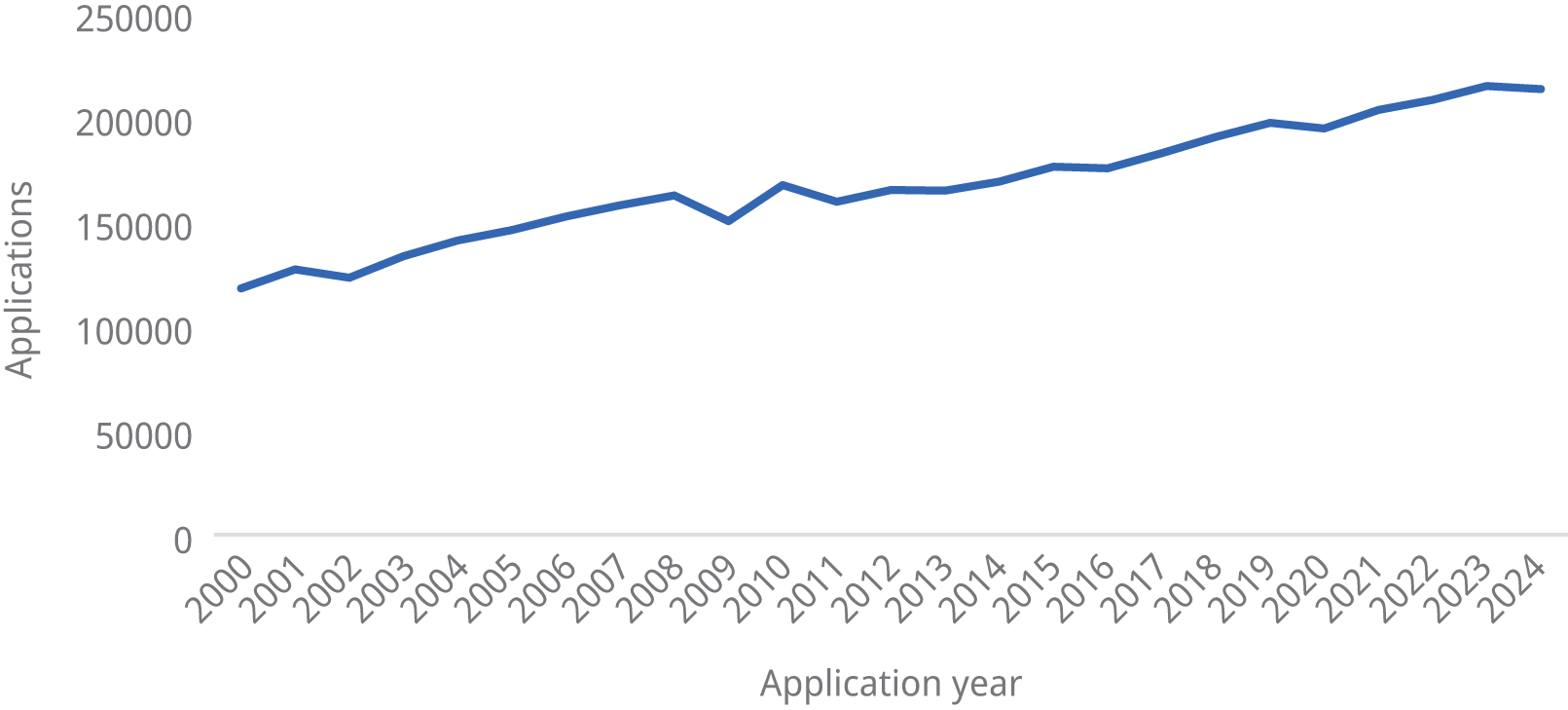
Source: WIPO IP Statistics Data Center, available at www3.wipo.int/ipstats/index.htm?tab=patent